Resources for Modern Retailers
Trends, strategies, and technical guides to help you scale your multichannel operations.

Amazon FBA Inventory Management: The Complete Guide
Amazon FBA handles picking, packing, and shipping so you don't have to. In exchange, it takes a cut of every sale and charges you for the warehouse space your products occupy. That trade-off works bri

Ecommerce and Supply Chain Management: The Complete Guide for Multichannel Brands
A complete guide to ecommerce and supply chain management for multichannel brands, covering the six core stages, failure points, metrics, and systems that keep operations running in real time.

How to Calculate Inventory Carrying Costs (And Why Most Brands Get It Wrong)
Every dollar sitting on your warehouse shelf is a dollar that isn't working for you. It's not funding your next product launch, not paying for ads that drive revenue, and not earning interest. It's ju

Strait of Hormuz Supply Chain Response Plan for Ecommerce Brands
Oil above $110, carrier surcharges climbing, and lead times stretching. The response plan ecommerce brands need now to protect inventory and margins.

Safety Stock Formula: How to Calculate the Right Buffer for Every SKU
The safety stock formula determines how much buffer inventory to hold per SKU. Get it wrong and you either stockout (losing ranking and revenue) or overstock (tying up cash). Here is how to calculate the right number.

How to Set Reorder Points for E-Commerce: The Formula That Prevents Stockouts
Your inventory reorder point is like the warning light on your gas gauge. It doesn't tell you to fill up when the tank is empty, that's too late. It tells you to fill up while you still have enough f

Landed Cost Calculator for Ecommerce: True Cost of Imported Goods
Learn how to calculate landed cost for imported ecommerce goods. Covers the full formula, duty rates by category, hidden fees most sellers miss, and a step-by-step worked example.

Multi-Channel Pricing Strategy: How to Price Differently Without Starting a Channel War
A framework-driven guide to multichannel pricing strategy covering uniform pricing, channel-adjusted pricing, value-based differentiation, MAP compliance, Amazon Buy Box dynamics, bundle strategies, and margin tracking by channel.

Inventory Management for WooCommerce Sellers Expanding to Multichannel
WooCommerce handles single-store inventory well, but has no native sync with Amazon, eBay, or other marketplaces. Here is how to manage inventory across multiple channels without overselling.

Amazon Reimbursement Rules 2026: What Changed and How to Claim
Amazon overhauled its FBA reimbursement policy in late 2025 and early 2026 with shorter claim windows, manufacturing-cost-based payouts, and stricter documentation. This guide covers every reimbursement type, the new filing deadlines, step-by-step claim instructions, and how to audit your account for money Amazon owes you.

Peak Season Ecommerce Operations: The Survival Guide for Multi-Channel Sellers
BFCM and Prime Day can 3-10x your daily orders overnight. This 90-day playbook covers demand forecasting, inventory positioning, sync stress-testing, staffing plans, and contingency protocols so your operations survive peak season intact.

Buffer Inventory Strategy: How Much Safety Stock Is Too Much
Learn how to calculate the right buffer inventory level for your ecommerce business. Covers formulas, carrying cost thresholds, channel-specific buffers, and the signals that your safety stock is too high or too low.

Warehouse Slotting Optimization: Put Fast Movers in the Right Place
A practical guide to warehouse slotting and golden zone optimization for multichannel ecommerce sellers looking to optimize operations and protect margins.

3PL vs In-House Fulfillment: Which is Right for Your Multi-Channel Business?
An honest, numbers-driven comparison of 3PL vs in-house fulfillment for multichannel ecommerce sellers. Includes worked cost examples at three volume tiers, a 12-item hidden fee checklist, and a hybrid model framework.

Wholesale to DTC Transition: Operational Checklist for Brands
A practical guide to transitioning from wholesale to direct-to-consumer ecommerce for multichannel ecommerce sellers looking to optimize operations and protect margins.

When to Add Your Next Sales Channel (Decision Framework)
Multi-channel sellers earn 190% more revenue, but only when operations are solid. Adding channels too early kills margins, increases overselling, and overwhelms support. Use this 5-signal framework and channel priority matrix to know exactly when you're ready to expand.

Cross-Docking for Ecommerce: Skip Storage and Ship Direct
Cross-docking lets ecommerce operations skip warehouse storage entirely. Goods arrive, get sorted, and ship out within hours. Learn when it works, when it fails, and how to set it up.

Bill of Materials Inventory Management for Ecommerce Sellers
How to set up a bill of materials for bundled products, subscription boxes, and kitted SKUs so your component inventory stays accurate across every sales channel.

8 Inventory Management Methods Compared: Which One Fits Your Business?
A side-by-side comparison of 8 inventory management methods, FIFO, LIFO, JIT, ABC Analysis, safety stock, EOQ, cycle counting, and DDMRP, with pros, cons, and clear guidance on which ones fit your business.

Subscription Box Fulfillment Operations: Kitting, Timing, and Scale
A practical guide to subscription box fulfillment kitting and operations for multichannel ecommerce sellers looking to optimize operations and protect margins.

The True Cost of Managing Orders in Spreadsheets (Calculator Inside)
Managing orders in spreadsheets costs the average multichannel seller $50K to $100K per year in hidden expenses. Calculate your real number with our breakdown of the 5 costs nobody tracks.

Ecommerce SOPs That Actually Get Followed: Build, Document, Train
A practical guide to standard operating procedures for ecommerce operations for multichannel ecommerce sellers looking to optimize operations and protect margins.

Product Data Normalization: How to Keep Listings Consistent Across 5+ Channels
Inconsistent product data causes listing rejections, sync failures, and lost sales. Learn how to build a master catalog that feeds all your channels cleanly with automated transformation rules.

Composable Commerce Stack: Build Your Own Best-of-Breed Operations
A practical guide to composable commerce architecture and MACH stack for ecommerce for multichannel ecommerce sellers looking to optimize operations and protect margins.

Dark Store Fulfillment Operations: Convert Retail Space to Ship-from-Store
A practical guide to converting underperforming retail space into dark store fulfillment operations. Covers layout, cost math, order routing, inventory control, and the metrics that determine whether your conversion pays off.

Shopify Stores Are Now Inside ChatGPT. Here's Why That's a Problem.
Shopify is enrolling every store into ChatGPT by default in late March 2026. There's a 4% fee, AI agents decide what gets recommended, and if your inventory isn't synced across channels, you're one viral prompt away from overselling everywhere.

ChatGPT Can Now Buy Products for Your Customers. You Don't Get to Choose Which Ones.
AI agents are making purchasing decisions on behalf of consumers right now. 49% of Americans say AI recommendations already influence what they buy, and 91% of online stores are invisible to these agents. Here is what is actually happening, why your marketing copy is irrelevant, and what you need to fix before your competitors do.

Google's March 2026 Core Update: What E-Commerce Sites Need to Fix Right Now
Google's first full core update of 2026 is live. Sites with original research gained ~22% visibility. AI-generated content dropped. Here is what changed, who won, who lost, and the concrete fixes for e-commerce sites.

Strait of Hormuz Crisis: What It Actually Means for Your E-Commerce Business
The Hormuz closure removed 20% of global oil supply and trapped 450,000 TEU of cargo. Here is exactly how it hits your shipping costs, delivery times, product pricing, and what the data says happens next.

Cycle Counting vs Physical Inventory: Which Method Saves More Time
Compare cycle counting and full physical inventory for your ecommerce warehouse. Learn which method improves accuracy, reduces downtime, and fits your operation size.

How War and Fuel Prices Ripple Through Every Layer of E-Commerce Operations
Oil jumped from $72 to $126/barrel. Shipping surcharges hit $4,000/container. Polymer prices up 42%. This is how armed conflict translates into real cost increases across your entire e-commerce operation, warehouse to doorstep.

The Multichannel Seller's Playbook for Navigating the 2026 Supply Chain Crisis
Shipping costs up 40%, delivery times extended 10-14 days, inventory trapped in the Persian Gulf. A concrete, channel-by-channel playbook for multichannel sellers managing through the Hormuz disruption.

How to Add TikTok Shop as a Sales Channel This Weekend (Complete Walkthrough).
TikTok Shop is projected to hit $17.5 billion in US GMV in 2026, and most multichannel sellers still have not listed a single product. The setup is different from Amazon and eBay: content-first, video-required, and with SLAs that catch unprepared sellers off guard. Here is the Friday-to-Sunday walkthrough that gets you live by Monday morning.

Amazon FBA Prep Changes 2026: What Sellers Must Do Now
Amazon discontinued all in-house FBA prep and labeling services on January 1, 2026. Here is what changed, what sellers must handle themselves, and how to adapt your operations without missing a beat.

Marketplace Fee Comparison 2026: Amazon vs eBay vs Walmart vs Shopify
A data-driven marketplace fee comparison for 2026 covering Amazon, eBay, Walmart, Shopify, TikTok Shop, and Etsy. Includes referral fees, fulfillment costs, per-order breakdowns, and a worked example showing net margin on a $50 product across all six platforms.

eBay Dropshipping in 2026: How It Actually Works (Policies, Setup, and Scaling)
Learn how eBay dropshipping works in 2026. Covers policies, eBay-to-eBay risks, compliant setup, product selection, and scaling operations.

Amazon FBA Fulfillment Fees in 2026: Every Charge Explained (With Calculator)
Complete breakdown of every Amazon FBA fulfillment charge in 2026, pick-pack-ship fees, monthly storage, aged inventory surcharges, low-inventory-level fees, inbound placement fees, returns processing, and removal costs, with rate tables, worked examples, and strategies to reduce each one.

Best Dropshipping Products in 2026: What to Sell (With Margin Math, Not Guesswork)
Find the best dropshipping products for 2026 using a 5-factor viability framework. Real margin calculations, tariff impact analysis, and supplier sourcing tips.

Shopify Fulfillment in 2026: In-House, 3PL, and App Workflows Compared
Complete guide to Shopify fulfillment after the SFN shutdown. Compare in-house, 3PL, and Amazon MCF options with setup instructions, cost breakdowns, and multi-warehouse routing strategies that actually work in 2026.

Amazon Product Listing Guide: How to Create, Optimize, and Rank Listings in 2026
Step-by-step guide covering ASIN creation vs catalog contribution, title optimization, A+ Content, backend search terms, and the multichannel listing management challenge most guides skip.

BigCommerce Inventory Management: Multi-Location Setup Guide
BigCommerce now supports native multi-location inventory with per-location stock assignment, CSV bulk imports, and variant-level tracking. This guide covers setup steps, common mistakes, CSV formatting, and the sync architecture needed when you sell across multiple channels.

Shopify vs WooCommerce for Dropshipping Suppliers: Where to Push Your Catalog
Every platform comparison online is written for retailers. This one is for suppliers. Compare Shopify and WooCommerce from the supplier side: API rate limits, inventory sync reliability, variant handling, and which platform your retailers actually use.

Google Just Killed 61% of Your Organic Clicks. Here's Where They Went.
Organic CTR dropped from 1.76% to 0.61% on queries with AI Overviews. Paid CTR crashed 68%. Google search traffic to publishers fell by a third globally in 2025. The traffic did not vanish, it moved to AI platforms. Shopping searches on ChatGPT and Perplexity grew 4,700% in a single year. Your SEO playbook from 2024 is dead.

Your Google Ads Are Funding a Sale That Won't Pay Out for 5 Weeks. Here's the Math.
You spend $12K on Google Ads this month. The sales happen on Amazon. Amazon holds your money for 14-28 days under DD+7. Your credit card bill arrives before the payout does. For a $100K/month seller, the gap is $23K-$33K at any given time. Most sellers calculate ROAS on revenue, not cash received. In 2026, that mistake can kill your business.

How to Price the Same Product Differently on 6 Channels Without Getting Banned.
Amazon monitors it. Walmart enforces it. eBay ignores it. Your Shopify store is entirely your call. Price parity policies vary wildly across marketplaces, and most sellers either price identically everywhere (leaving money on the table) or price differently without understanding the rules (risking suspension). Here is what is actually allowed, what gets you banned, and the legal strategies that let you optimize pricing per channel.

Your Supplier Just Raised Prices 12%. Here's Why You Found Out Too Late.
Most ecommerce sellers discover supplier price increases when they place their next purchase order: days or weeks after the change. Meanwhile, they have been selling at old margins, losing money on every unit. The gap between reactive and proactive supplier cost management costs the average multichannel seller $15,000 per year in margin erosion, missed repricing windows, and emergency purchase orders.

AI Demand Sensing vs Traditional Forecasting for Ecommerce
Traditional forecasting relies on historical averages and monthly planning cycles. AI demand sensing ingests real-time signals like POS data, weather, social trends, and competitor pricing to generate short-horizon predictions that reduce forecast error by 20-50%. This guide compares both approaches across accuracy, speed, cost, and implementation complexity for ecommerce sellers managing 100 to 10,000 SKUs.

Ecommerce Inventory Management: From Startup to 10,000 SKUs
The stage-by-stage ecommerce inventory management guide for growing brands. Learn the exact methods, tools, and strategies you need at every growth phase, from 50 SKUs in a garage to 10,000+ across five sales channels.

Jack Dorsey Just Fired 4,000 People and Replaced Them with AI. Ecommerce Is Next.
Block CEO Jack Dorsey cut 40% of his workforce and told the world AI made them unnecessary. Shopify followed weeks later. If two of the biggest names in commerce infrastructure are replacing humans with algorithms, the ecommerce sellers still running manual operations are on borrowed time.

Customers Are Using AI to Fake Damage Photos and Steal Your Refunds. Retailers Lost $100 Billion.
Fraudsters are using AI image generators to create fake damage photos that pass visual inspection, fabricate shipping receipts, and file false claims at scale. Ecommerce return fraud now costs retailers over $100 billion a year. Here is how the scam works, why it is getting worse, and what sellers are doing to fight back.

How to Set Up Automated Purchase Orders That Fire When Stock Hits Reorder Point.
The average e-commerce seller spends 6 hours per week creating purchase orders manually. That is 312 hours per year spent on a task a machine should handle. Here is the technical walkthrough for setting up automated PO triggers that fire the moment stock hits reorder point, reducing stockouts by 80% and cutting procurement time by 90%.

The Ecommerce Businesses That Won't Exist in 2027 All Have This One Thing in Common.
They are not the smallest sellers. Not the worst products. Not the unluckiest. The ecommerce businesses that will not survive to 2027 all share one trait: they refused to automate. Manual syncing, manual orders, manual repricing, manual listings. While competitors use automation to move faster and operate cheaper, manual sellers are falling behind at a rate that compounds every single month.

Inventory Cash Conversion Cycle: Turn Stock into Cash Faster
A practical guide to cash conversion cycle DIO DSO DPO for ecommerce for multichannel ecommerce sellers looking to optimize operations and protect margins.

From Multichannel Seller to Dropshipping Supplier: The Complete Playbook
You already have the warehouse, the inventory, and the shipping workflows. Here is the step-by-step playbook for turning your multichannel ecommerce operation into a dropshipping supplier program that generates B2B revenue without new inventory investment.

Shopify Just Fired 100 People From Partnerships. Now an AI Will Answer Your Support Tickets.
Shopify cut roughly 100 of its 300-person partnerships team in March 2026 as part of its Winter '26 restructuring. The people who connected merchants with app developers, theme builders, and agencies are gone. In their place: Sidekick, an AI chatbot. If your business depends on Shopify partner support, your safety net just vanished.

Shopify's New 'Agentic Plan' Lets You Sell on ChatGPT Without a Shopify Store. Wait, What?
Shopify launched a plan that lets WooCommerce, BigCommerce, and Magento sellers plug into its AI commerce infrastructure without migrating their store. Your products show up in ChatGPT, Gemini, and Perplexity. AI-driven traffic to Shopify is up 7x since January 2025. Here is what this means for every seller on every platform.

The Step-by-Step System for Never Overselling Again (Even During Black Friday).
Overselling costs the average multichannel seller $14,000 per year in refunds, penalties, and lost Buy Box eligibility. Here is the 6-layer system that eliminates overselling completely, even when you are processing 500+ orders per hour during Black Friday. It is not about speed. It is about architecture.

The Uncomfortable Truth About Ecommerce Profit Margins in 2026.
Average net margins are 5-10% for most ecommerce businesses. After 2026 tariffs, Amazon fee increases, DD+7, advertising inflation, and return costs, many sellers are operating at 2-3% net or negative. Here is the uncomfortable math most sellers have not done.

Predictive Stockout Alerts: Get Warned 14 Days Before Running Out
A practical guide to predictive stockout alerts using AI and demand signals for multichannel ecommerce sellers looking to optimize operations and protect margins.

Amazon Just Changed When You Get Paid. Most Sellers Haven't Noticed Yet.
On March 12, 2026, Amazon started holding your money for 7 extra days after delivery. No announcement. No opt-out. If you sell $100K/month, you just lost access to $23K-$33K in working capital overnight, and that is only one of six ways Amazon is squeezing sellers this year.

Product Feed Management: The Complete Guide for Ecommerce Sellers (2026)
Learn how to create, optimize, and automate product feeds for Google Shopping, Amazon, Facebook, and more. Covers formats, delivery methods, field mapping, and common mistakes.

How to Set Up Google Shopping Product Feeds (Step-by-Step Guide)
Step-by-step guide to creating and optimizing Google Shopping product feeds. Covers required attributes, feed formats, Merchant Center setup, and common errors.

EOQ Formula for Ecommerce: When It Works and When It Doesn't
Learn the Economic Order Quantity formula with worked examples, understand when EOQ delivers real value for ecommerce brands, and discover the five scenarios where it breaks down for multi-channel sellers.

How to Use AI Agents for Inventory Management: From Alerts to Autonomous Reordering
AI agents connected to your inventory system via MCP can answer stock queries, push reorder alerts, prevent overselling, and identify dead stock, all from Slack or WhatsApp. Here is how to set them up and what results to expect.

Amazon Banned a 10-Year Seller Account Over a Single Complaint. They Never Read the Evidence.
A seller with a decade of perfect performance on Amazon had their account terminated over a single brand complaint. They submitted invoices, receipts, and supplier letters. Amazon's AI never read any of it. One law firm handled 175+ successful reinstatements in 2025 alone, because Amazon's enforcement system is broken by design.

Google Shopping Inventory Feed Errors: How to Fix Common Rejections
Google Merchant Center rejects products for price mismatches, missing GTINs, invalid availability values, and image violations. This guide covers the most frequent feed errors, what causes each one, and the exact steps to resolve them so your products stay approved.

OpenClaw vs Zapier vs Custom Bots: Which Ecommerce Automation Is Right for You?
Three ecommerce automation approaches dominate in 2026: AI agents like OpenClaw, workflow platforms like Zapier and Make, and custom-built bots. This guide compares cost, capabilities, setup time, and real-world use cases to help you choose the right tool, or the right combination.

Real-Time Inventory Sync for Dropshipping Suppliers: Why Your Retailers Keep Overselling
Your retailers are overselling your products because their stock data is hours or days old. Learn why real-time inventory sync is non-negotiable for dropshipping suppliers and how to implement it across Shopify and WooCommerce stores.

How to Go From 1 Channel to 5 Channels in 30 Days Without Hiring Anyone.
Most sellers spend 6 months adding a single marketplace. Here is the week-by-week playbook that gets you live on Amazon, eBay, Walmart, and TikTok Shop in 30 days: with one person, one inventory pool, and zero new hires. The secret is not working harder. It is centralizing inventory so each new channel is a 2-day project, not a 2-month project.

Your Product Feed Is the New SEO. And You're Failing at It.
In 2024, visibility meant keywords and backlinks. In 2026, it means structured product data feeds. Google Shopping, ChatGPT, Perplexity, Amazon Rufus, they all read product feeds, not web pages. 91% of stores are invisible because their feeds are incomplete.

Marketplace Fee Stacking: When Fees from Multiple Channels Eat Your Margin
A practical guide to marketplace fee stacking across multiple channels for multichannel ecommerce sellers looking to optimize operations and protect margins.

Ecommerce Returns: The Multi-Channel Operational Playbook
Returns cost ecommerce brands 20-30% of online revenue. This operational playbook covers return workflows, restocking SOPs, channel-specific policies, and margin recovery tactics for multi-channel sellers.

Temu Seller Center: How to Sell on Temu in 2026 (Setup, Fees, and What Sellers Actually Experience)
Complete guide to Temu Seller Center. Covers seller models, fee structure, application process, fulfillment requirements, and honest pros and cons.

How to Share Your Inventory with Shopify and WooCommerce Stores (Without Spreadsheets)
Stop emailing CSV files to your retail partners. Learn how to automatically push your product catalog and live inventory to Shopify and WooCommerce stores with real-time sync, automated pricing rules, and zero spreadsheets.

The 3-Minute Test That Shows If Your Business Would Survive a Viral TikTok Moment.
A TikTok creator mentions your product and 40,000 people hit your store in 3 hours. Would your operations hold? Most sellers fail 4 out of 5 readiness checks. Take this quick self-assessment to find out where your business would break, and how to fix each weak point before virality finds you.

Amazon FBM Return Label Changes: Impact on Seller-Fulfilled Orders
Amazon now requires prepaid return labels for all FBM orders, removing the high-value item exemption. Here is what changed, what it costs, and how to protect your margins.

AI Agents for Ecommerce Operations: The Complete Guide (2026)
AI agents are replacing dashboards, automations, and spreadsheets as the primary interface for ecommerce operations. This guide covers what AI agents are, how they work, five high-impact use cases, the MCP ecosystem, and three paths to getting started, whether you run one Shopify store or ten marketplace channels.

A TikTok Shop Product Went Viral at 2AM. By 6AM, the Seller Had Oversold on 4 Channels.
A fitness brand's resistance band hit TikTok's algorithm at 2AM. 500 orders landed before sunrise, but inventory on Amazon, eBay, and Shopify never updated. By the time someone checked, 212 units were oversold across four channels. Here is the anatomy of a multichannel meltdown, and the 15-minute sync gap that caused it.

Amazon vs. eBay vs. Walmart vs. Shopify: Which Channel Has the Best Unit Economics in 2026?
We took the same $30 product and calculated true unit economics on Amazon, eBay, Walmart, and Shopify. We included every cost: referral fees, payment processing, fulfillment, advertising, returns, and payout timing. The winner depends on your margins, your category, and how much you value owning the customer relationship.

The Ecommerce AI Bubble: Why Half These Tools Will Be Dead by 2027.
The AI ecommerce market jumped from $7.25B to $8.65B in a year, but the tool count exploded 10x. Most are thin GPT wrappers with ecommerce-flavored prompts. Here is how to tell which AI tools in your stack will last and which ones will vanish by 2027.

Shipping Insurance for Ecommerce: When It Pays for Itself
A practical guide to shipping insurance ROI and when to self-insure vs buy coverage for multichannel ecommerce sellers looking to optimize operations and protect margins.

eBay Inventory Management at Scale: Listings, Variations & Sync
Manage eBay inventory at scale across multi-variation listings, cross-channel sync with Shopify and Amazon, out-of-stock listing preservation, automated repricing, and bulk operations for sellers running 1,000+ SKUs.

How a Customer Request Turned Our OMS Into a Dropshipping Supplier Platform
The story of how a single customer message, 'Can I share my inventory with my customer's Shopify store?', led us to build Seller Mode, turning Nventory from a multichannel OMS into a dropshipping supplier platform that supports Shopify and WooCommerce.

91% of Online Stores Are Invisible to AI. Here's What the Other 9% Know.
AI shopping agents do not read your marketing copy. They read structured data, schema markup, and product attributes. 91% of online stores fail this test, and they are losing sales they will never even know about. Here is the exact checklist the visible 9% are using.

If Your Inventory Sync Takes More Than 30 Seconds, You're Overselling Right Now.
The math is unforgiving. At a 15-minute sync interval with 20 units in stock, there is a 34% probability of overselling during a moderate traffic day. At 5-minute sync: 12%. At 30 seconds: 0.3%. At sub-5-second sync: effectively zero. Sync speed is the most important operational metric for multichannel sellers, and most have never measured it.

Post-Purchase Email Sequence That Reduces Returns by 25%
A practical guide to post-purchase email sequences that reduce ecommerce return rates for multichannel ecommerce sellers looking to optimize operations and protect margins.

How to Prevent Overselling Across Amazon, Shopify, and eBay
Overselling costs $25-150 per incident and risks marketplace suspension. Learn the 3-layer defense framework: real-time sync, channel safety buffers, and atomic inventory operations to protect your multi-channel business.

OpenClaw MCP Server Configuration for Ecommerce: Step-by-Step Guide (2026)
Configure OpenClaw MCP servers for Shopify, Amazon, WooCommerce, and multi-channel OMS platforms. Complete setup guide with YAML config examples, OAuth flows, and troubleshooting for every major ecommerce connection.

Walmart Is Growing 3x Faster Than Amazon. Most Sellers Still Haven't Listed There.
Walmart's marketplace is growing at 27.2% year-over-year versus Amazon's 9.6%. Lower fees, less competition, and only 200,000 sellers compared to Amazon's millions. The opportunity window is open right now, and most sellers are still ignoring it.

Doba's AI Can Now Launch an Entire Dropshipping Store While You Sleep. Should You Be Worried?
Doba Pilot launched March 6, 2026: the first AI agent that can source products, create listings, and launch a complete dropshipping store from a single prompt. But launching is the easy part. Operations, supplier management, and multichannel inventory are where stores actually fail.

Perpetual vs Periodic Inventory System: The Ecommerce Decision
Compare perpetual and periodic inventory systems for ecommerce. Learn which method fits your order volume, when to switch, and how hybrid approaches work in practice.

How to Sync Shopify and Walmart Inventory in Real Time
Step-by-step guide to syncing Shopify and Walmart Marketplace inventory. Covers WFS routing, GTIN mapping, price parity, defect rate protection, and real-time sync.

SKU Management for Multi-Channel Sellers: Naming, Mapping & Sync
Messy SKUs cause sync failures, mis-ships, and phantom inventory. Learn the SKU naming conventions, cross-channel mapping strategies, and bundle management tactics that keep 1,000+ SKU catalogs clean across Amazon, Shopify, eBay, and Walmart.

Your Amazon BSR Is Lying to You. Here's What Actually Determines Your Sales Rank.
BSR updates hourly and is relative, not absolute. A BSR of 5,000 means wildly different things in different categories. What actually drives rank in 2026: sales velocity, conversion rate, Rufus AI recommendations, COSMO relevance scoring, and seller metrics. BSR is an output, not an input. Here is what to actually optimize instead.

ChatGPT for Ecommerce Operations: 15 Prompts That Save Hours
Fifteen copy-paste ChatGPT prompts for ecommerce operations tasks like demand forecasting, supplier negotiation, SKU rationalization, and return-rate analysis. Each prompt includes the exact wording, expected output, and the time it replaces. Built from patterns shared by real sellers on Reddit and tested across inventory, fulfillment, and supply chain workflows.

Inventory Carrying Cost: How to Calculate It and 7 Ways to Reduce It
Inventory carrying cost silently drains 20-30% of your inventory value every year. Learn the exact formula, see a worked example on a $500K inventory, and discover 7 proven strategies to cut your holding costs without sacrificing product availability.

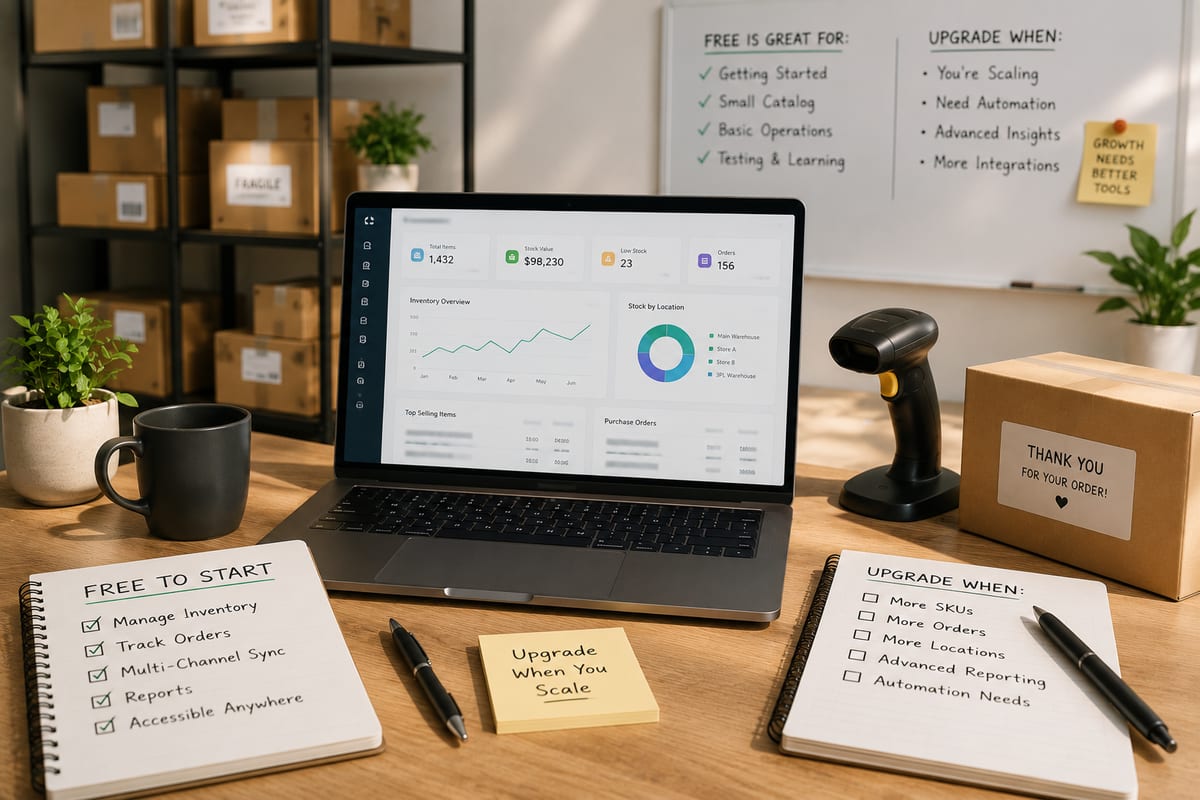
Free Inventory Management Spreadsheet Template (With the Upgrade Path When You Outgrow It)
Download a free inventory management spreadsheet template for Excel and Google Sheets. Track stock, set reorder alerts, and know when to upgrade to real software.

We Tracked Our Inventory Accuracy for a Year. The Results Changed How We Run Everything.
We started at 87% inventory accuracy. Twelve months later, we hit 99.4%. Along the way, we discovered that every percentage point of accuracy improvement had a measurable dollar value: fewer cancellations, lower ad waste, fewer complaints, better supplier terms, and a lower return rate. Here is what we changed each month and what it cost versus what it earned.

How to Build a Product Feed That Gets Accepted on Every Marketplace the First Time.
The average multichannel seller gets rejected on their first listing submission 40-60% of the time. Walmart rejects for missing key features. Amazon rejects for bad GTINs. Google Shopping rejects for missing shipping weight. Here is how to build a single master product feed that satisfies every marketplace's requirements, so you submit once and get accepted the first time.

Section 321 De Minimis Changes 2026: Impact on Cross-Border Sellers
The $800 de minimis exemption is suspended globally. Here is what changed, what it costs cross-border sellers, and how to restructure fulfillment to survive.

How to Sync Shopify and eBay Inventory in Real Time (Without Overselling)
Step-by-step guide to syncing Shopify and eBay inventory. Covers auction holds, variation listings, defect prevention, and real-time sync setup to stop overselling.

Shopify Inventory Management: Beyond the Basics (Multi-Location, Bundles, Sync)
Shopify's native inventory tools get you started, but they fall short for multi-location tracking, bundle management, marketplace sync, and automated reorder points. This guide covers how to extend Shopify inventory for serious multi-channel operations.

eBay's AI Listing Tool Just Made 100,000 Sellers' Jobs 10x Easier. Here's What It Does.
eBay's AI listing tool generates full product listings from a single photo: title, description, category, item specifics, and pricing suggestion. For multichannel sellers, it means listing 100 products on eBay in an afternoon instead of a week. Combined with AI listing tools across Amazon, Shopify, and Walmart, the era of manual product copy is over.

Automated Purchase Order Generation: Set It and Forget It
Manual purchase orders cost ecommerce teams 10-15 hours per week and introduce errors on roughly 1 in 8 orders. Automated PO generation watches your inventory levels, calculates when to reorder, builds the purchase order, and sends it to your supplier without you touching a spreadsheet. This guide covers how automatic PO systems work, the measurable time and cost savings, how to set reorder triggers, and how to handle edge cases like MOQs and multi-supplier catalogs.

How to Survive Black Friday on 5 Channels: The Ops Checklist Nobody Gives You.
Black Friday on one channel is stressful. Black Friday on five channels is a controlled explosion. Most multichannel sellers go in with a pricing plan and an ad budget. They come out with oversells, late shipments, suspended listings, and a 6-week hangover of customer complaints. Here is the 30-day countdown checklist that prevents all of it.

How to Use Safety Stock to Sleep Through Peak Season Without Checking Your Phone.
Peak season anxiety is not about volume. It is about uncertainty. You do not know if your supplier will deliver on time. You do not know if a product will go viral. You do not know if a competitor will undercut you and tank your velocity. Safety stock eliminates the uncertainty. Here is the math, the setup, and the psychology of trusting automation to handle your busiest selling days.

Every Hour Your Inventory Count Is Wrong Costs You $47. Most Sellers Are Wrong for 4 Hours.
Inaccurate inventory counts silently drain your business at $47 per hour through overselling, phantom stockouts, wasted ad spend, marketplace penalties, and customer service overhead. Most multichannel sellers have wrong counts for at least 4 hours per day: that is $188 daily, $67,680 per year. For a $500K seller, that is 13.5% of revenue lost to a problem they do not even know they have.

Digital Product Passports for Ecommerce: EU Compliance 2026
A practical guide to EU Digital Product Passport compliance for ecommerce sellers for multichannel ecommerce sellers looking to optimize operations and protect margins.

How We'd Set Up a 5-Channel Ecommerce Brand From Scratch in 2026
The exact order, tech stack, and timeline for launching on Shopify, Amazon, eBay, Walmart, and TikTok Shop simultaneously. No theory, just the playbook.

Spreadsheets vs. OMS: At What Order Volume Do Spreadsheets Actually Break?
Everyone starts with a spreadsheet. Nobody should end with one. But at what point does the spreadsheet actually break? The answer depends on how many channels you sell on. One channel: ~200 orders/month. Two channels: ~100 orders/month. Three or more: ~50 orders per channel. Here are the exact failure modes, the warning signs, and how to migrate without losing a day of operations.

The Order Management Stack That Scales from $10K to $1M/Month Without Changing Tools
Most sellers rebuild their entire tech stack 2-3 times as they grow. Here is the stack architecture that scales from $10K/month to $1M/month without ripping and replacing, the same tools, configured differently at each stage.

Amazon Sellers Are Secretly Selling More on Shopify Than Amazon. Here's Why.
The quiet migration is underway. Amazon fees keep rising, payouts keep slowing with DD+7, and enforcement keeps tightening. Smart sellers are shifting inventory and ad spend to Shopify where margins are 15-25 percentage points higher, payouts arrive in 1-3 days instead of 14-28, and you actually own the customer data. They keep Amazon for discovery but build profit on Shopify.

When to Hire Your First Operations Manager (Signs You Cannot Wait)
A practical guide to hiring your first operations manager for ecommerce for multichannel ecommerce sellers looking to optimize operations and protect margins.

Amazon Inventory Management: FBA Restock Limits, IPI Score & Automation
Master Amazon FBA inventory management in 2026. Understand IPI scores, restock limits, stranded inventory fixes, long-term storage fees, and how to automate replenishment across multiple sales channels.

How to Turn Your Garage Into a Multichannel Fulfillment Center (Under $2,000).
You do not need a warehouse to run multichannel fulfillment. A 2-car garage, $1,830 in equipment, and a smart layout can handle 50-500 orders per day across 5 channels. Here is the exact budget breakdown, floor plan, pick-pack-ship workflow, and the signals that tell you when to graduate to a 3PL.

Stop Calling It 'Multichannel.' You're Just Logging Into 6 Dashboards.
Most sellers who claim to be multichannel are actually multi-login sellers: same products listed on 6 platforms, managed separately, inventory synced via spreadsheets, orders processed per-platform. Here is the difference and what real multichannel operations look like at every stage.

Marketplace Launch Checklist: First 30 Days on a New Channel
A practical guide to launching on a new marketplace channel in 30 days for multichannel ecommerce sellers looking to optimize operations and protect margins.

Multichannel Inventory Sync: Why Real-Time Beats Batch (With Data)
Real-time inventory sync reduces overselling by 94% compared to batch polling. This data-driven comparison breaks down latency benchmarks, overselling rates by sync speed, and the event-driven architecture behind modern multichannel sync.

How to Evaluate If You Actually Need an OMS (Or If You're Overcomplicating Things)
Not every ecommerce business needs an order management system. Some are wasting money on software they don't need. Others are losing thousands by refusing to upgrade from spreadsheets. Here is the decision framework that tells you which camp you're in.

How One SKU Rationalization Cut Our Shipping Costs by 34% Overnight.
A seller with 2,400 SKUs discovered 60% of revenue came from 180 SKUs. By discontinuing the bottom 1,800 and moving others to on-demand fulfillment, they reduced warehouse space by 40%, simplified picking and packing, concentrated inventory closer to customers, and negotiated better carrier rates. The 34% shipping cost reduction was a byproduct of simplification.

The $0.08 FBA Fee Increase That's Actually Costing Sellers $48,000/Year.
Eight cents per unit sounds harmless until you multiply it across 50,000 monthly units. That is $48,000 per year in direct fees alone. But the real damage comes from five other cost increases hitting simultaneously: storage fees, eliminated prep services, gutted reimbursements, and DD+7 cash flow delays. The total 2026 Amazon cost increase for a mid-tier seller runs $80K to $120K per year.

Ecommerce Acquisition Due Diligence: Operations Checklist for Buyers
A practical guide to operations due diligence for ecommerce acquisitions for multichannel ecommerce sellers looking to optimize operations and protect margins.

The Complete Guide to Becoming a Dropshipping Supplier in 2026
The definitive guide for brands, wholesalers, and multichannel sellers who want to become dropshipping suppliers. Covers operations, pricing, inventory allocation, catalog sharing, platform selection, retailer onboarding, and scaling from 1 to 100 retail partners.

The 15-Minute Daily Routine That Keeps 7-Figure Sellers' Inventory Perfectly Accurate.
Inventory accuracy above 98% is not about better software or bigger teams. It is about a 15-minute daily routine that catches problems before they compound. Here is the exact 6-step sequence that 7-figure multichannel sellers use every morning, each step timed, each step targeted at a specific failure mode that would otherwise cost thousands.

What Is 4PL Logistics and How It Differs from 3PL for Ecommerce
Learn what 4PL logistics means for ecommerce sellers, how it compares to 3PL, when to make the switch, and what real sellers say about costs, visibility, and operational tradeoffs.

What is Inventory Management? The Complete Ecommerce Guide
A comprehensive guide to inventory management for ecommerce sellers. Learn the methods, KPIs, and multi-channel strategies that prevent stockouts, reduce carrying costs, and protect your margins across every sales channel.

Amazon's AI Is Now Writing Your Competitor's Listings. Yours Still Say 'High Quality Premium.'
Amazon's AI listing generator now writes SEO-optimized, Rufus-ready product descriptions automatically. Sellers using it rank higher in AI-powered search results. Sellers still writing 'high quality premium luxury' are becoming invisible. Here is what Rufus and COSMO actually want, and why your old listing copy is killing your conversions.

Order Accuracy Rate: How to Measure and Improve to 99.9%
A practical guide to order accuracy measurement and improvement to 99.9% for multichannel ecommerce sellers looking to optimize operations and protect margins.

Ecommerce Operations Maturity Model
Assess your operations maturity across five stages, from reactive firefighting to predictive growth, and prioritize systems, workflows, and automation for scalable ecommerce operations.

The AI-Native OMS: How MCP, OpenClaw, and Conversational AI Are Replacing the Dashboard
What happens when your OMS speaks every AI protocol? Nventory ships a production MCP server, OpenClaw agent compatibility, and an AI Suite that builds integrations, automations, and fulfillment rules from a single conversation.

40% of Shoppers Now Ask AI Before Buying. Here's What the AI Says About Your Product.
Four out of ten shoppers now ask an AI tool before making a purchase. But most sellers have never checked what those AI tools actually say about their products. Go to ChatGPT and ask what the best product in your category is. If you do not appear, neither do you in a growing percentage of purchase decisions. Here is how to run a monthly AI visibility audit and fix what the machines are getting wrong.

Temperature-Controlled Fulfillment for Ecommerce: Food, Beauty, Supplements
How to set up temperature-controlled fulfillment for food, beauty, and supplement products across multiple ecommerce channels without spoilage, compliance failures, or runaway packaging costs.

Safety Stock Formula for Ecommerce: Complete Guide
Master the safety stock formula for ecommerce with step-by-step calculations, service level tables, and real-world examples for DTC brands selling across multiple channels.

The Average Ecommerce Seller Wastes 11 Hours/Week on Tasks That Should Be Automated.
We audited how multichannel sellers spend their time and found 11 hours per week going to manual inventory updates, order routing, spreadsheet reconciliation, shipping label creation, listing updates, and preventable customer service. At $50/hour, that is $28,600/year in wasted labor. Here is exactly where the time goes and what automation costs versus what it saves.

Hidden Costs of Free Shipping: What It Actually Costs Per Order
A practical guide to true cost of free shipping per order ecommerce for multichannel ecommerce sellers looking to optimize operations and protect margins.

Ecommerce Fulfillment SLA Playbook
A complete playbook for setting, tracking, and consistently hitting ecommerce fulfillment SLAs, from order processing benchmarks to carrier management and escalation workflows.

Recommerce and Resale Operations: Build a Certified Pre-Owned Channel
A practical guide to recommerce and certified pre-owned resale operations for multichannel ecommerce sellers looking to optimize operations and protect margins.

Multi-Warehouse Fulfillment Strategy
Build a distributed fulfillment network that cuts transit times, reduces shipping costs, and scales with your growth. A complete strategic framework for ecommerce operators.

OpenClaw for Ecommerce: How the Fastest-Growing AI Agent Is Reshaping Operations
OpenClaw, the open-source AI agent with 191K+ GitHub stars, connects messaging platforms to AI-powered tools via MCP. Here is how ecommerce teams are using it to run operations from Slack, WhatsApp, and Telegram.

Should You Add Walmart Marketplace? The 5-Question Test That Gives You the Answer.
Walmart Marketplace is the fastest-growing ecommerce channel in the US, but it is not for everyone, and getting it wrong can get your account suspended within weeks. Before you apply, score yourself on these 5 questions. Each one addresses a hard requirement that Walmart enforces aggressively. Four or five yes answers means you are ready. Anything less, and you need to fix the gaps first.

Meta Just Launched AI Shopping on Instagram. Your Product Data Determines If You Exist.
Meta is testing AI-powered shopping across Instagram and Facebook. Sellers upload images, AI creates listings with suggested prices. Facebook Marketplace plus Instagram Shopping plus Meta AI equals discovery-based purchasing: products people did not know they wanted. For sellers, if your product data is messy, Meta AI will not surface you. Image quality, attribute completeness, and pricing accuracy all determine visibility.

AI-Generated Product Bundles: Let Data Decide What Sells Together
A practical guide to AI product bundling using market basket analysis for multichannel ecommerce sellers looking to optimize operations and protect margins.

Inventory Allocation by Channel: Strategy Guide
Allocating inventory across DTC, marketplace, and wholesale channels without overselling or starving your best opportunities is one of the most consequential decisions in multi-channel operations. This guide breaks down the models, the math, and the mechanics.

TikTok Shop Inventory Allocation: Prevent Overselling During Viral Spikes
A practical guide to TikTok Shop inventory allocation during viral demand spikes for multichannel ecommerce sellers looking to optimize operations and protect margins.

Split Shipment Reduction Playbook
Reduce split shipments by 40-60% with proven tactics: order consolidation, inventory positioning, routing rules, and carrier programs that cut multi-package shipping costs.

The 3 Questions That Tell You If Your Inventory Tool Is Lying About 'Real-Time' Sync.
Most inventory tools claim 'real-time sync' in their marketing. In practice, most sync every 5-15 minutes using batch polling: not true real-time. Here are 3 questions that expose the gap, a DIY test you can run in 10 minutes, and the overselling math that shows why the difference between 3-second sync and 15-minute sync can cost you thousands.

Robotic Process Automation (RPA) for Order Management
RPA bots handle the repetitive order management tasks that drain 11 hours per week from your team. Here is how to identify the right processes, choose a tool, and measure ROI.

Ecommerce Order Routing Rules: A Practical Guide
Learn how to design ecommerce order routing rules that reduce shipping cost, cut split shipments, and improve delivery SLA performance across multiple warehouses.

ACP vs UCP: The Two Protocols That Will Decide How AI Agents Buy and Sell in 2026
OpenAI and Stripe shipped ACP. Google and Shopify responded with UCP. Together they define how AI agents discover products, negotiate checkout, and process payments, without a browser. Here is what ecommerce operators need to know.

An AI Agent Bought 47 Products Last Month Without Visiting a Single Website.
Follow one consumer's month of AI-assisted shopping: ChatGPT recommended headphones, Perplexity bought toothbrush refills, Gemini compared protein powders. Forty-seven purchases, zero website visits. Zero-click commerce is not a theory anymore, it is a purchasing pattern. For sellers, this means the storefront is becoming optional. Product data is the new storefront.

Supplier Lead Time Reduction Strategies for Faster Restock
Practical strategies for reducing supplier lead times from weeks to days. Covers negotiation tactics, dual-sourcing, freight tradeoffs, and how to recalculate safety stock as lead times shrink.

2026 US Tariff Changes: What Every Ecommerce Seller Needs to Know (And Do)
De minimis is dead. Learn how 2026 tariff changes affect your margins, inventory strategy, and pricing with 7 actionable strategies to protect your ecommerce business.

Amazon AI Enforcement 2026: How to Avoid Automated Suspensions
Amazon's AI enforcement system now triggers instant account suspensions without human review. Sellers report false positives on metrics, inauthenticity flags on legitimate products, and multi-week appeals. Here is how to stay ahead of the algorithms.

How to Sync Shopify and Amazon Inventory in Real Time (Without Overselling)
Step-by-step guide to syncing Shopify and Amazon inventory in real time. Prevent overselling, fix sync failures, and automate multichannel stock updates.

The Weekend Project That Added $8,000/Month in Revenue: Adding One Sales Channel.
Friday evening: researched Walmart requirements. Saturday: applied and connected inventory sync. Sunday: listed top 50 products and launched. Week 1: $800. Month 1: $3,200. Month 3: $8,000/month. The key: existing inventory management that made adding a channel a weekend project, not a 2-month one.

International Expansion Playbook for Ecommerce: Ship to 10 Countries
A practical guide to international ecommerce expansion and cross-border shipping for multichannel ecommerce sellers looking to optimize operations and protect margins.

Warehouse Management Software: The Modern Playbook For Faster Picking, Fewer Errors And Scalable Fulfillment
A practical playbook to reduce pick errors, prevent inventory drift, and scale warehouse fulfillment across multiple sales channels.

Perplexity Now Has a Buy Button. Google Has AI Overviews. Your Website Has Neither.
Perplexity's 'Buy with Pro' lets shoppers checkout inside a chat window via PayPal. Google AI Overviews appear on 14% of shopping queries. ChatGPT serves 900 million weekly users with product recommendations. Three AI platforms can now sell your products without a single visitor ever reaching your website. If you are not optimized for these channels, you do not exist in the fastest-growing segment of commerce.

B2B Ecommerce Order Management: How It Differs from DTC
A practical guide to B2B ecommerce order management differences from DTC for multichannel ecommerce sellers looking to optimize operations and protect margins.

Why Your Multichannel Inventory Sync Is Failing (And How to Actually Fix It)
Diagnose the 7 most common inventory sync failures causing overselling. Fix batch delays, API limits, bundle errors, and ghost stock with this technical guide.

Peak Season Ecommerce Operations War Room
Build a peak season operations war room with inventory controls, routing fallbacks, and real-time escalation workflows for ecommerce demand spikes.

$0 to $1M in 12 Months Selling on 5 Channels: The Complete Operations Breakdown.
A month-by-month operations breakdown of scaling from zero to $1 million in annual revenue across Shopify, Amazon, eBay, TikTok Shop, and Walmart. Every phase includes: revenue, order volume, tools added, operational challenges, hires, and the decisions that made growth possible versus what would have broken.

Magento (Adobe Commerce) Inventory Management for Multi-Warehouse
A practical guide to managing multi-warehouse inventory on Magento and Adobe Commerce. Covers MSI setup, common pitfalls, stock allocation, order routing, and scaling beyond native capabilities.

Dropshipping Inventory Management: How to Automate Stock Sync with Suppliers
Stop overselling dropshipped products. Automate supplier inventory sync, manage multiple suppliers, and build reliable dropshipping workflows.

The Beginner's Guide to Multichannel Selling (Without Losing Your Mind or Your Inventory).
Most multichannel guides tell you to list everywhere immediately. That advice will bury you. This is the honest beginner's guide: start with one channel, get profitable, add channels in the right order, and build the operational foundation that prevents chaos. Including the minimum tech stack and the #1 mistake sellers make when expanding.

Etsy Inventory Management: Sync Stock Across Etsy and Other Channels
How to sync Etsy inventory with Shopify, Amazon, and eBay in real time. Prevent overselling, fix SKU mapping errors, and automate stock updates across every sales channel.

Ecommerce Returns Management: Turn Your Biggest Cost Center into a Retention Engine
Returns cost $21-$46 per order to process. Learn how to automate RMA workflows, reduce return rates, and turn returns into repeat purchases.

Inventory Cash Flow Management for Ecommerce
Learn how to improve cash flow by optimizing buy cycles, SKU-tier investment strategies, and inventory risk controls that reduce overstock without creating stockouts.

Amazon Rufus Is Answering 20% of All Searches. If It Can't Read Your Listing, You're Invisible.
Over 250 million shoppers now interact with Rufus, Amazon's AI shopping assistant that reads, interprets, and synthesizes product information instead of keyword-matching. Behind it, COSMO models buyer intent in ways traditional SEO cannot touch. If your listing still relies on keyword stuffing, Rufus is skipping you entirely, and you will never know it happened.

Nearshoring for Ecommerce: Move Production Closer to Reduce Risk
Lead times from Asia run 30-45 days. Nearshoring to Mexico or Central America can cut that to under 10. Here is how ecommerce sellers are moving production closer, what it actually costs, and when the math makes sense.

The True Cost of Running Your Ecommerce Business on Spreadsheets
Spreadsheets cost ecommerce businesses more than you think. Calculate the hidden costs of manual inventory tracking and when to switch to real software.

FBA vs. FBM vs. 3PL: The Decision Framework for Every Revenue Level.
There is no single right fulfillment model for every seller. The answer changes at $10K/month, again at $50K, again at $200K. Here is the revenue-tier framework that tells you exactly when to use FBA, when to ship yourself, when to hire a 3PL, and when to combine all three, with cost comparison tables for each level.

Inventory Tokenization: Blockchain for Supply Chain Transparency
A practical guide to blockchain inventory tokenization for supply chain transparency for multichannel ecommerce sellers looking to optimize operations and protect margins.

Walmart Marketplace Inventory Management: The Seller's Complete Guide (2026)
Most sellers fail on Walmart because they apply Amazon logic. Learn the inventory, listing, and fulfillment strategies that actually work on Walmart Marketplace.

How to Run a 6-Figure Ecommerce Brand in 4 Hours/Day Using AI.
The 4-hour daily schedule that keeps a six-figure ecommerce brand running without burnout. Hour by hour: AI-generated reports, content review, supplier monitoring, and customer engagement. Here is the exact breakdown of tools, tasks, and decisions that let one operator replace a five-person team.

Amazon vs Temu vs Shein: Where Ecommerce Sellers Should Focus in 2026
A detailed comparison of Amazon, Temu, and Shein for ecommerce sellers in 2026, covering fee structures, audience demographics, product-category fit, fulfillment models, and a data-backed framework for deciding where to allocate your inventory and ad spend this year.

What Is Distributed Order Management (DOM)? And Why Growing Brands Need It
Your OMS tells you what was ordered. DOM decides where it should ship from. Learn when you need DOM and how to implement it without enterprise software.

73% of Multichannel Sellers Can't Answer This Question About Their Own Inventory.
We asked 200 multichannel sellers one question: What is your exact available-to-promise quantity for your top 10 SKUs, right now, across all channels? Only 27% could answer within 5 minutes. The gap between what is in your warehouse and what is available to sell is where every overselling nightmare begins.

Your Competitor's AI Writes Better Product Titles Than Your Copywriter. Here's Proof.
A/B test data from Amazon shows AI-generated product titles outperform human-written titles on click-through rate by 14-22%. AI titles are optimized for Rufus AI readability, COSMO intent matching, search algorithm patterns, and human click-through simultaneously. Your copywriter reads 10 competitor titles. The AI reads 10,000.

Ecommerce Operations Playbook for Recession-Proofing Your Business
A practical guide to recession-proofing ecommerce operations through inventory and cost optimization for multichannel ecommerce sellers looking to optimize operations and protect margins.

AI-Powered Order Routing: How Smart Fulfillment Cuts Shipping Costs by 15-30%
Your shipping costs are high because your routing is dumb. Learn how AI-powered order routing reduces fulfillment costs by 30-46% and speeds up delivery.

What 7-Figure Sellers Know About AI That 5-Figure Sellers Don't.
5-figure sellers use AI to write product descriptions and emails. 7-figure sellers use AI for predictive reordering, dynamic pricing, anomaly detection, and supplier monitoring. The operational use of AI is 10x more valuable than the content use. Here is the mindset shift.
Customer Order Tracking Page Optimization: Reduce WISMO Calls by 60%
A practical guide to order tracking page optimization to reduce WISMO calls for multichannel ecommerce sellers looking to optimize operations and protect margins.

Flipkart Seller Inventory Sync with Shopify and Amazon India: The Complete Guide
How Flipkart sellers sync inventory with Shopify and Amazon India in real time. Covers API limitations, sync delays, SKU mapping, and the tools that actually work for India's 1.4 million marketplace sellers.

How to Get Your Products Into ChatGPT Shopping Results (Step-by-Step).
ChatGPT now shows product recommendations with buy buttons directly in conversations. Millions of shoppers are asking ChatGPT what to buy instead of searching Google or Amazon. If your products are not appearing in these results, you are invisible to a rapidly growing shopping channel. This step-by-step guide covers everything from structured data markup to product attribute completeness to Google Merchant Center verification, the exact requirements to get your products surfaced when ChatGPT users ask for purchase recommendations.

Inventory Write-Off Tax Strategy for Ecommerce Sellers
A practical guide to inventory write-off tax deductions ecommerce for multichannel ecommerce sellers looking to optimize operations and protect margins.

The AI That Reprices Your Products Every 15 Minutes Is Beating the Sellers Who Reprice Monthly.
Dynamic pricing AI adjusts prices 2,880 times per day based on competitor data, demand elasticity, and inventory levels. Sellers using it report 3-8% higher margins on the same products. Here is how it works, the tools available, the marketplace risks, and how to implement safely across multiple channels.

Seasonal Inventory Planning: Buy, Stock, and Sell by Calendar
A practical guide to seasonal inventory planning and demand calendar for ecommerce for multichannel ecommerce sellers looking to optimize operations and protect margins.

Inventory Ops Incident Response Playbook
When your inventory sync goes down, your WMS crashes, or a supplier shipment arrives damaged, you need a playbook: not a panic. Here are the incident classes, triage procedures, and communication templates.

How Much Does Overselling Actually Cost? We Tracked 10,000 Cancelled Orders to Find Out.
We tracked 10,000 orders that were cancelled because sellers did not have the inventory they listed. The average cost per cancellation is not just the refund: it is $47.30 when you add up refund processing, lost customer acquisition cost, negative review risk, marketplace penalties, restocking labor, and wasted shipping. At scale, this number is devastating.

The Sellers Who Automated Everything in 2025 Are Now Outpricing You by 15%. Here's Their Stack.
The 15% price gap is not from cheaper products. It is from lower operational costs. Automated sellers spend $2.30/order on operations. Manual sellers spend $5.80/order. That $3.50/order gap equals 15% on a $23 average product. Here is their exact stack and the compounding effect over 12 months.

Finished Goods Inventory Management for Multichannel Sellers
Finished goods inventory is the stock that sits ready to ship, and mismanaging it across channels causes overselling, dead stock, and cash flow problems. Learn how to track, allocate, and replenish FGI across Amazon, Shopify, eBay, and Walmart with practical rules and real numbers.

Bonded Warehouse for Ecommerce: Defer Duties and Improve Cash Flow
Bonded warehouses let ecommerce importers store goods without paying duties until the inventory actually sells. This guide covers how bonded warehousing works under CBP regulations, the real cost savings on duty deferral, setup requirements, and when it makes financial sense for online sellers.

High-SKU Catalog Operations Guide
Learn how to manage high-SKU ecommerce operations with governance, workflow design, exception controls, and complexity management frameworks.

How to Set Up AI-Powered Inventory Forecasting for Free Using Google Sheets.
You do not need expensive software to start forecasting demand. This step-by-step tutorial shows you how to build a basic AI-powered inventory forecasting model using Google Sheets, Apps Script, and the free tier of the Gemini API. Import your sales data, configure the model for seasonality and trends, and generate 30-day demand predictions that beat gut-feeling ordering by 20-30%. Includes actual code snippets you can copy and paste. This is a starter solution, for serious forecasting at scale, purpose-built tools are essential, but it costs nothing and works today.

Warehouse Automation for Small Ecommerce: Where to Start Under $5K
A practical guide to warehouse automation for small ecommerce operations on a budget under $5,000, covering barcode scanners, label printers, software-first strategies, and phased rollout plans with real ROI data.

Ecommerce Operations Dashboard KPIs for Founders
Track the right operations KPIs weekly to catch inventory, fulfillment, and margin risks before they compound: with alert thresholds, cadence design, and a sample executive dashboard layout.

Zapier for Ecommerce Is a $14,000/Year Mistake. Here's What to Use Instead.
A typical multichannel seller needs 40-60 Zaps to replicate basic OMS functionality: inventory sync, order routing, stock alerts, PO triggers, listing updates. At 50K+ tasks per month, that is $500-$1,500/month in Zapier fees. And it still breaks during Black Friday because Zapier does not understand inventory logic, cannot handle race conditions, and has no error recovery for the one thing that matters most, keeping stock counts accurate across channels.

We Automated 90% of Our Order Operations in 60 Days. Here's the Exact Playbook.
A 60-day implementation diary: from fully manual order processing to 90% automation. Week-by-week breakdown covering order routing, inventory sync, shipping labels, reorder alerts, returns processing, and reporting. Before and after metrics: 47 hours/week down to 6, error rate from 4.2% to 0.3%, cost per order from $3.80 to $0.42.

AI-Powered Returns Processing: Route, Grade, and Restock Automatically
AI returns processing cuts handling time by 40-50%, catches fraud 25% faster, and restocks sellable items within hours instead of days. Here is how automated routing, grading, and restocking work in practice.

How to Build an Ecommerce Business That Runs Without You (The Real Version, Not the Guru Version).
No laptop-on-beach fantasy. The real version: 6-12 months of intense systems building, then gradual delegation to automation and team. What 'runs without you' actually means is 5 hours/week of oversight, not zero. Here is the honest timeline and the honest cost.

EDI Inventory Management: Automate Supplier Communication at Scale
Learn how EDI automates purchase orders, invoices, and inventory updates between you and your suppliers. Covers setup costs, document types, ROI timelines, and when EDI makes sense for ecommerce sellers.

The Exact Safety Stock Formula for Sellers Doing $50K-$500K/Month (With Calculator).
Most sellers calculate safety stock wrong. They use average demand, set an arbitrary buffer, and pray. The real formula is Safety Stock = Z x σdLT, and every variable matters. Here is how to calculate it correctly at different revenue tiers, with worked examples and tables you can use today.

Dual Sourcing Strategy for Ecommerce: Never Depend on One Supplier
Single-supplier dependency is the most common and most preventable cause of stockouts in ecommerce. Sellers who split procurement across two qualified suppliers reduce supply disruption risk by 40-60% while keeping cost premiums under 5%. Here is the operational playbook for building a dual sourcing strategy that protects revenue without inflating overhead.

Allocating Inventory for Virality: The Playbook for TikTok Shop and Social Commerce
Traditional allocation models break when a TikTok creator drives 5,000 orders in 90 minutes. Here is the allocation playbook built for viral, non-linear social commerce demand.

How to Write Amazon Listings That Rufus AI Actually Recommends (Not Just Indexes).
Amazon's Rufus AI reads your listings differently than the old A9 search algorithm. Getting indexed means your product shows up in search. Getting recommended means Rufus actively suggests your product to shoppers asking questions. The gap between indexed and recommended is where the money is. Here is how Rufus synthesizes your title, bullets, description, reviews, Q&A, and images to decide which products to recommend, and exactly how to optimize for it.

When to Hire Your First Operations Manager (Signs You Cannot Wait)
Most ecommerce founders wait too long to hire an operations manager. By the time they post the job listing, they have already lost months of growth to fulfillment fires, inventory mistakes, and processes held together by memory alone.

Beyond Stockout Rate: The 7 Inventory KPIs That Actually Predict 2026 Profitability
Stockout rate and inventory turnover tell you what already happened. These 7 forward-looking KPIs predict profitability in a post-tariff, AI-enabled ecommerce landscape.

AI Can Now Predict What You'll Sell Next Week With 80% Accuracy. Your Gut Feeling Can't.
AI demand forecasting reduces prediction errors by 20-50% versus traditional methods. ML models analyze sales velocity, seasonality, marketing calendars, competitor pricing, weather, and social trends simultaneously. Here is how to set it up, even with free tools, and the ROI for a 500-SKU catalog.

Packaging Optimization for Ecommerce: Reduce DIM Weight Charges
A practical guide to ecommerce packaging optimization to reduce dimensional weight charges for multichannel ecommerce sellers looking to optimize operations and protect margins.

AI Price Optimization Across Marketplaces: Stay Competitive Without Tanking Margins
Manual repricing across 5 channels is a full-time job that still leaves money on the table. AI-driven pricing adjusts every 15 minutes based on competitor moves, demand signals, and margin floors.

We Analyzed 1 Million Orders. Here's When Customers Actually Buy (Hour by Hour).
We pulled timestamped data from 1 million multichannel orders and mapped purchase behavior hour by hour, day by day, and platform by platform. Amazon peaks at 8-10pm. Shopify peaks at 12-2pm. eBay spikes on Sunday nights. These patterns should change how you allocate inventory, schedule ads, and staff your operation.

ABC Analysis for Ecommerce Inventory: Classify SKUs That Actually Move
Learn how to classify your ecommerce SKUs using ABC analysis, set the right thresholds for your catalog, and focus your inventory budget on products that drive real revenue.

Packing Station Setup for High-Volume Ecommerce: Layout and Workflow
A practical guide to designing packing stations that handle 500 or more orders per day. Covers layout dimensions, equipment placement, ergonomic guidelines, throughput benchmarks, and workflow sequencing for ecommerce fulfillment teams.

3PL Performance Scorecard for Ecommerce
Build a 3PL scorecard with operational and financial metrics across speed, accuracy, cost, exception handling, and communication to improve SLA adherence and fulfillment quality.

Cost of Goods Sold (COGS) for Ecommerce: Calculate It Right
A practical guide to COGS calculation for ecommerce including landed costs for multichannel ecommerce sellers looking to optimize operations and protect margins.

The $14/Month AI Tool That Replaced Our $4,200/Month Virtual Assistant.
A seller paying $4,200/month for a virtual assistant team doing inventory updates, order processing, listing management, customer emails, and reporting replaced them with a stack of AI tools totaling $14/month. The VA was not bad. The AI just became good enough. Here is what replaced what.

Vendor Managed Inventory (VMI) for Ecommerce: Complete Setup Guide
VMI shifts replenishment decisions from your team to your supplier. When done right, it cuts inventory holding costs by 15-25% and drops stockout rates by 28% or more. When done wrong, it creates overstocked shelves and damaged supplier relationships. This is the step-by-step setup guide for ecommerce sellers who want to get it right.

Amazon Buy Box Algorithm 2026: What Actually Wins the Box
Over 82% of Amazon sales go through the Buy Box. The algorithm evaluates total landed price, fulfillment method, seller metrics, inventory depth, and account history in real time. FBA has a structural advantage, but FBM sellers who maintain sub-0.5% order defect rates and 1-2 day delivery can compete. Here is how the algorithm works in 2026, what each factor actually weighs, and the pricing strategy that wins without destroying margins.

Marketplace Fee Management for Ecommerce
Learn how to manage marketplace fees, identify hidden leakage, and protect margin with operational controls across Amazon, Walmart, and eBay.

The 1-Person Ecommerce Brands Making $500K/Year. Their Secret Isn't What You Think.
The secret is not a great product or brilliant marketing. It is ruthless operational efficiency through automation. These solo operators automated inventory sync, order routing, shipping, customer service, listings, forecasting, and purchase orders. What is left: 4 hours/day of strategic work on $500K in revenue.

Amazon Product Compliance Documents 2026: What You Need on File
Amazon now requires category-specific compliance documents for every ASIN you sell. Missing a single certificate or test report can suppress your listing or freeze your account. This guide covers exactly which documents you need by product category, where to upload them, how much testing costs, and what to do when Amazon rejects your submission.

The End of the Cron Job: Why Event-Driven Inventory Sync Became Non-Negotiable in 2026
Batch sync on a cron schedule cannot survive TikTok-driven demand spikes. Event-driven inventory sync is no longer a luxury, it is operational survival in 2026.

What Your 3PL Isn't Telling You About Their Actual Error Rate.
Your 3PL says they have a 99.5% accuracy rate. That number is technically true and deeply misleading. It measures pick accuracy: one step in a multi-step process. When you add wrong items shipped, packing damage, late shipments, inventory count discrepancies, and mislabeled products, the real error rate is 2-5%. Here is how to audit yours.

The Inventory Reorder System That Runs Itself (We Haven't Placed a Manual PO in 8 Months).
Eight months ago, we placed our last manual purchase order. Since then, our inventory reorder system has generated 342 POs across 14 suppliers, maintained a 99.7% in-stock rate, and reduced our carrying costs by 12%. No human touches the process unless something unusual happens. Here is exactly how we built it.

Ecommerce Supply Chain Resilience Playbook for 2026
80% of businesses faced supply chain disruptions last year. A practical playbook covering supplier diversification, inventory buffers, demand planning, and operational frameworks that keep ecommerce operations running when the next disruption hits.

AI Customer Service Now Handles 57% of All Ecommerce Inquiries. Your Support Team Is Next.
57% of ecommerce brands now use AI for at least a quarter of all customer interactions. 37% expect to reach 51-75% within two years. The cost math is brutal: AI support runs $0.10-$0.50 per interaction versus $5-$15 per human agent. Here is what AI handles well, what still needs people, and the multichannel data problem nobody is solving.

Customer Lifetime Value and Inventory Planning: Connect the Dots
A practical guide to connecting customer lifetime value to inventory planning decisions for multichannel ecommerce sellers looking to optimize operations and protect margins.

The True Cost of a Stockout in 2026: A Post-Tariff Calculator Including Costs Everyone Ignores
The standard stockout formula misses 60% of the actual cost. This post-tariff model includes algorithmic ranking penalties, tariff-inflated emergency restocking, and customer lifetime value erosion.

The Average Ecommerce Business Has $41,000 in Dead Inventory Right Now.
Industry data shows the average SMB ecommerce brand is sitting on $41,000 in dead or slow-moving inventory. That dead stock costs 20-30% of its value per year just to store: meaning $8,200 to $12,300 annually in carrying costs alone. Most sellers know they have dead inventory. Few know how much it actually costs or what to do about it. Here is the full breakdown: how to calculate your dead inventory, what it costs you, the psychological barrier stopping you from dealing with it, and the liquidation playbook.

Micro-Fulfillment Centers for Ecommerce: Cost, Setup, and ROI
A practical breakdown of micro-fulfillment center costs, setup timelines, and ROI for ecommerce sellers. Includes per-order cost comparisons, payback period data, and when MFCs make sense for your business.

Ecommerce P&L Template: Track Profit by Channel, SKU, and Month
A practical guide to profit and loss tracking by channel and SKU for ecommerce for multichannel ecommerce sellers looking to optimize operations and protect margins.

Your Returns Are Costing You $23 Each. AI Can Cut That to $7. Here's How.
The average ecommerce return costs $23 when you add up every hidden expense: shipping, labor, inspection, restocking, damaged write-offs, payment processing losses, and wasted customer acquisition spend. AI-powered return systems are cutting that number to $7 by eliminating steps that never needed to happen. Here is the full breakdown.

Ecommerce Return Rate Benchmarks 2026 by Category
A practical guide to ecommerce return rate benchmarks by product category 2026 for multichannel ecommerce sellers looking to optimize operations and protect margins.

The Real Reason Your Competitors Can Sell for Less (It's Not Their Margins).
Your competitor is selling the same product for 15% less and still making money. They are not taking a loss. They are not getting a secret deal from the manufacturer. They are spending less to deliver the same product: lower shipping costs, fewer returns, less wasted ad spend, faster inventory turns. Operational efficiency is pricing power.

We Ran the Same Product on Amazon, Shopify, eBay, Walmart, and TikTok. Here's Who Won.
We ran a 90-day experiment: same product, same price, same images, same ad budget across Amazon, Shopify, eBay, Walmart, and TikTok Shop. We tracked units sold, revenue, profit margin, return rate, customer acquisition cost, and payout speed. The results surprised us. Amazon won volume. Shopify won margin. eBay won profit per unit. Walmart won growth rate. TikTok won acquisition cost but had the worst return rate. The right channel depends entirely on what you are optimizing for.

Natural Language Inventory Queries: Ask Your OMS Questions in Plain English
A practical guide to natural language queries for inventory management systems for multichannel ecommerce sellers looking to optimize operations and protect margins.

I Let AI Write All 2,000 of My Product Descriptions. Sales Went Up 23%.
A home goods seller rewrote every product description using AI. Before: generic, keyword-stuffed copy. After: benefit-focused, attribute-rich, AI-readable structured descriptions. The 23% sales lift came from better search matching, improved conversion, and visibility in AI shopping tools like ChatGPT and Gemini.

Amazon IPI Score Guide 2026: Storage Limits and How to Improve
Learn how Amazon calculates your IPI score in 2026, what thresholds trigger storage limits, and the proven strategies sellers use to raise their score and protect FBA capacity.

Beyond Buffers: The Event-Driven Overselling Prevention Architecture for 2026
Static safety stock and hourly sync jobs cannot prevent overselling in the age of viral commerce. Learn the event-driven architecture that updates inventory in milliseconds.

Payment Processing Fees Compared: Shopify, Stripe, PayPal, Amazon Pay 2026
A practical guide to payment processing fee comparison across providers 2026 for multichannel ecommerce sellers looking to optimize operations and protect margins.

RMA Process Design for Ecommerce Teams
Design an RMA process that improves customer trust while reducing returns processing time and operational waste, from request to resolution with automation points and SLA targets.

The Seller Who Ships 500 Orders/Day From a Spare Bedroom. His Entire Process Takes 2 Hours.
Marcus runs a 500-order-per-day operation from a 12x14-foot spare bedroom. No warehouse. No employees. His entire daily process, from order review to carrier pickup, takes exactly 2 hours. Here is every tool, layout decision, and automation that makes it possible.

Ecommerce Customs Compliance Guide: HS Codes, Duties, Documentation
HS code misclassification costs ecommerce sellers thousands in penalties and delayed shipments. A practical guide to customs compliance covering classification, duty calculation, documentation, and broker selection.

Your Competitor Is Fulfilling Orders 3x Faster Than You. Here's Their Entire Tech Stack.
The gap between amateur and professional multichannel sellers is not product quality or pricing. It is speed. Top sellers pick and ship orders within 90 seconds of placement. Average sellers take hours. The difference is a specific technology stack that costs $500-1,200/month and eliminates every manual step between 'order placed' and 'label printed.'

87% of Sellers Can't Tell You Their True Cost Per Order. Can You?
Most ecommerce sellers calculate cost per order by adding COGS, marketplace fees, and shipping. That covers about 40% of the real number. The true cost per order includes picking and packing labor, packaging materials, payment processing, a portion of returns, customer service time, software subscriptions, and advertising spend. The sellers who know their real CPO make better decisions about which channels to prioritize, which products to keep, and how to price for profit.

Freight Rate Volatility 2026: How to Budget When Shipping Costs Spike
Container rates swung from $1,200 to $3,400 per FEU in a single quarter. Fuel surcharges doubled. Carrier GRIs landed with two weeks notice. Here is a step-by-step framework for building a shipping budget that absorbs the shock instead of passing it to your margins.

Multi-Channel Pricing Operations Playbook
Build multichannel pricing operations that align margin goals with channel competitiveness and fulfillment costs across Amazon, Shopify, and more.

96% of Ecommerce Teams Are Using AI Daily. The Other 4% Are Updating Spreadsheets.
New data shows 96% of ecommerce professionals now use AI in their daily workflows. Customer support leads at 96% adoption, followed by product recommendations at 88% and inventory forecasting with 20-50% fewer errors. The 4% still doing it manually are falling behind in cost, speed, and accuracy.

Social Commerce Operations 2026: Sell on TikTok, Instagram, and Pinterest
A practical guide to social commerce operations across TikTok Shop, Instagram, and Pinterest for multichannel ecommerce sellers looking to optimize operations and protect margins.

Inside the Supply Chain of a Brand That Ships 10,000 Orders/Day From 4 Warehouses.
A mid-market DTC fashion brand ships 10,000 orders per day from warehouses in New Jersey, Nevada, Ohio, and the Netherlands. Here is how they decide which warehouse fulfills which order, how they handle split shipments, what happens when a warehouse runs out of a size, and the tech stack that makes it all work.

WooCommerce vs Shopify Inventory Management: Feature Comparison 2026
A side-by-side comparison of WooCommerce and Shopify inventory management in 2026 covering native features, multi-location support, plugin ecosystems, multichannel sync, and total cost of ownership for growing ecommerce brands.

Stockout Cost Calculation: Complete Guide
Stockouts cost far more than a single lost sale. Learn how to calculate the true cost of inventory shortages, including customer churn, marketplace penalties, and emergency restock fees, and build a prevention stack that protects your revenue.

We Replaced 6 Ecommerce Tools With 1. Our Monthly Stack Cost Dropped From $847 to $99.
Six separate tools: an inventory tracker, an order router, a shipping label generator, a marketplace lister, a spreadsheet automation service, and a reporting dashboard. Total: $847/month. But the real cost was not the subscriptions: it was the 12 hours per week spent switching between tools, reconciling data, and fixing sync errors. We consolidated everything into one OMS platform and the operational difference was immediate.

Faire Wholesale Inventory Sync for DTC Brands Selling Wholesale
DTC brands expanding into Faire wholesale face a specific operational problem: keeping inventory accurate across channels that move at different speeds, in different quantities, on different payment terms. This guide covers the allocation models, sync mechanics, and margin math that make the difference between profitable wholesale expansion and chronic overselling.

Dynamic Buffer Profiles: Why Static Safety Stock Formulas Are Obsolete in 2026
The Z-score safety stock formula served ecommerce for a decade. DDMRP dynamic buffer profiles and three-component SKU-specific models deliver 30-45% inventory reductions with better service levels.

Ecommerce Break-Even Calculator: Know Your Real Profitability Per SKU
A practical guide to break even analysis per SKU for ecommerce for multichannel ecommerce sellers looking to optimize operations and protect margins.

The Real Cost of Switching Your OMS Mid-Growth (It's Not What You Think).
Every growing ecommerce brand hits the moment where their order management system cannot keep up. The visible cost of switching, new subscription, migration time, training, is what scares most sellers. But the invisible costs are far larger: dual-system operation, temporary sync gaps, broken automations, historical data gaps, and team productivity dips. Here is the full cost breakdown, plus the even bigger cost of staying on a tool you have outgrown.

Same-Day Delivery Operations for Small Ecommerce Brands
A practical guide to same-day delivery operations for small ecommerce brands for multichannel ecommerce sellers looking to optimize operations and protect margins.

Inventory Turnover Benchmarks for Ecommerce
What is a good inventory turnover ratio for ecommerce? Discover industry benchmarks by vertical, the DSI companion metric, and actionable tactics to improve your turns without triggering stockouts.

AI Product Photos Now Cost $0.10. Your $150/Shot Photographer Just Became Optional.
40% of ecommerce product images will be AI-generated by the end of 2026. A single product photo that cost $75-$150 from a photographer now costs $0.05-$0.25 from an AI tool. Here is when AI photos work, when they do not, and how much you save at every catalog size.

Headless OMS: Decouple Your Order Management from Your Storefront
A practical guide to headless order management system architecture for ecommerce for multichannel ecommerce sellers looking to optimize operations and protect margins.

Amazon Low Inventory Level Fee: How to Avoid It Without Overstocking
Complete guide to the Amazon low-inventory-level fee in 2026 including thresholds, calculation method, exemptions, and practical strategies to stay above 28 days of supply without tying up capital in excess stock.

Pick-Pack-Ship Optimization Checklist
A practical checklist covering warehouse picking methods, packing station design, shipping automation, and KPI benchmarks to reduce cost per order and boost fulfillment speed.

How to Know Exactly When to Reorder Stock (The Formula That Replaced Our Gut Feeling).
We used to reorder when stock 'looked low.' Then we missed a $47,000 sales window because our best product stocked out for 11 days. Now we use a formula. Reorder Point = (Average Daily Sales x Lead Time) + Safety Stock. Sounds simple. But calculating each variable correctly across multiple channels is where everyone gets it wrong.

Consignment Inventory for Ecommerce: How It Works and When to Use It
Consignment inventory lets you stock products without paying for them upfront. You only pay the supplier after you sell each item. This guide covers how consignment works in ecommerce, the accounting rules you need to follow, when it makes sense for your business, and how to avoid the disputes that derail most consignment relationships.

We Tracked 50,000 Multichannel Orders. The #1 Reason for Cancellation Shocked Us.
We analyzed 50,000 multichannel orders across Amazon, Shopify, eBay, Walmart, and TikTok Shop to find the real reasons sellers lose revenue to cancellations. The #1 cause was not customers changing their minds. It was inventory discrepancies: wrong stock counts across channels causing overselling. Here is every cancellation reason ranked, the dollar impact of each, and how to prevent them.

Autonomous Last-Mile Delivery 2026: Drones, Robots, and Lockers
A practical guide to autonomous last-mile delivery including drones, robots, and smart lockers for multichannel ecommerce sellers looking to optimize operations and protect margins.

Reorder Point Calculator: Formula & Guide
Learn how to calculate your reorder point using the ROP formula, including lead time, safety stock, and demand variables, with worked examples for ecommerce.

An AI Just Built a Complete Shopify Store in 11 Minutes. The Owner Hasn't Logged In Since.
Doba Pilot builds entire dropshipping stores, product sourcing, listing copy, images, pricing, through natural language commands. Setup now takes 11 minutes. But running the store still takes 11 hours a day. The gap between AI-built and AI-run is where most sellers get stuck.

Warehouse KPIs Dashboard: 12 Metrics Every Ecommerce Brand Should Track
The 12 warehouse KPIs that separate profitable ecommerce operations from chaotic ones, with formulas, benchmarks, and a dashboard layout you can build this week.

The Agentic Inventory Stack: How Multi-Agent AI Is Replacing Multichannel Sync in 2026
Multichannel inventory sync is evolving from data propagation to autonomous decision-making. Learn how multi-agent AI architectures are reshaping inventory operations in 2026.

Sustainability in Ecommerce Operations: Carbon-Neutral Fulfillment
A practical guide to sustainable ecommerce operations and carbon-neutral fulfillment for multichannel ecommerce sellers looking to optimize operations and protect margins.

WooCommerce + Shopify Catalog Governance
Create governance standards for WooCommerce and Shopify catalogs to reduce errors and improve operational reliability across platforms.

US Tariff Impact on Ecommerce Sourcing 2026: China, India, Vietnam
China tariffs hit 145%. Vietnam and India offer alternatives, but quality and lead times vary. Here is how ecommerce sellers are shifting sourcing in 2026 and what the real cost tradeoffs look like.

Returns Restock Accuracy Framework
Improve returns restock accuracy and prevent phantom inventory with a practical reverse-logistics framework covering inspection workflows, reconciliation processes, and KPI dashboards.

The Hidden Setting in Shopify That's Costing You Sales Every Day.
There is a default setting in Shopify that most store owners never check. It is called 'Continue selling when out of stock,' and it is turned ON by default. When inventory hits zero, Shopify keeps accepting orders: leading to overselling, cancellations, and angry customers. But turning it off without proper inventory management is just as dangerous.

Voice Commerce Inventory Management: Prepare for Alexa and Google Orders
A practical guide to voice commerce inventory management for Alexa and Google Shopping for multichannel ecommerce sellers looking to optimize operations and protect margins.

Barcode System Setup for Ecommerce Warehouse: Complete Guide
A step-by-step guide to setting up a barcode system in your ecommerce warehouse, covering hardware selection, barcode types, software integration, implementation steps, and cost benchmarks so you can reach 99%+ inventory accuracy.

Pick Path Optimization: Reduce Warehouse Walking Time by 40 Percent
Warehouse pickers spend 60 to 70 percent of their shift walking. Pick path optimization cuts that travel time through smarter routing, slotting, and batching, recovering 3 to 4 full-time equivalents in a 20,000-line operation without hiring.

Multi-Brand Ecommerce Operations: Run Multiple Stores from One Backend
A practical guide to running multiple ecommerce brands from a single backend for multichannel ecommerce sellers looking to optimize operations and protect margins.

Machine Learning for Inventory Classification: Beyond ABC Analysis
ABC analysis groups SKUs by revenue alone. Machine learning classification uses demand volatility, lead time, supplier risk, and margin data together to assign each product to a cluster that drives smarter reorder rules, better safety stock, and lower carrying costs. This guide covers the algorithms, the data you need, and how to move from static tiers to dynamic, multi-dimensional inventory classes without a data science team.

The Real Cost of 'Free' Returns: How Return Policies Are Bankrupting Small Sellers.
Free returns are not free. Each return on a $30 product costs the seller $20-30 when you add up return shipping, processing labor, inspection, restocking, the unsellable rate, lost payment processing fees, and wasted customer acquisition costs. At a 15% return rate, returns add $3-4.50 to the cost of every unit sold, not just the ones that come back.

Returnless Refund Strategy: When Not Shipping Back Saves Money
A practical guide to returnless refunds and when they save money over traditional returns for multichannel ecommerce sellers looking to optimize operations and protect margins.
Warranty and RMA Tracking for Ecommerce: Build a System That Scales
A practical guide to warranty and RMA tracking systems for ecommerce for multichannel ecommerce sellers looking to optimize operations and protect margins.

Lightspeed POS Inventory Integration with Ecommerce Channels
How to connect Lightspeed POS inventory to Shopify, Amazon, and other ecommerce channels. Covers sync methods, multi-location mapping, common failure points, and the operational workflows that keep stock counts accurate across retail and online.

Amazon Inventory Placement Service vs Distributed Inventory in 2026
A cost breakdown of Amazon Inventory Placement Service vs distributed inventory in 2026, including per-unit fees, delivery speed trade-offs, and when AWD makes more sense than either option.

Squarespace Inventory Sync: Connect to Amazon and eBay
Squarespace has no native inventory sync with Amazon or eBay. This guide covers the real integration options, API limitations, and a step-by-step path to keeping stock accurate across all your channels.

Cost Per Order Calculation: The Number Most Sellers Get Wrong
A practical guide to calculating true cost per order including hidden costs for multichannel ecommerce sellers looking to optimize operations and protect margins.

We Interviewed 50 7-Figure Sellers. They All Do This One Thing Differently.
We talked to 50 ecommerce sellers who each do over $1M/year. They sell different products, on different channels, with different team sizes. But they all share one habit that separates them from everyone else: they treat inventory as a financial asset, not an operational task. Here is what that actually looks like in practice.

Warehouse Error-Proofing SOP for Ecommerce
Build an error-proofing SOP for ecommerce warehouses with quality gates at every stage, receive, pick, pack, handoff, and audit, plus barcode controls, training loops, and a 30-day rollout plan.

What Happens Inside Amazon's Warehouse When You Send an FBA Shipment (With Photos).
Your FBA shipment does not sit neatly on a shelf with your brand name on it. The moment Amazon scans it in, your products get split apart and scattered randomly across a million-square-foot facility. Here is the step-by-step journey from truck dock to customer doorstep, and why understanding it makes you a smarter seller.

Etsy + Shopify Operations Framework
Build a repeatable Etsy + Shopify operations framework to prevent stock errors and maintain fulfillment quality across both channels.

Marketplace Inventory Sync: A Unified Guide for Amazon, eBay, and Walmart
Each marketplace has unique sync behavior, API quirks, and failure modes. This unified guide covers the platform-specific rules and a single architecture that handles all three reliably.

The Inventory Formula Amazon's Top 1% Sellers Use (That Nobody Talks About).
Amazon's top sellers do not reorder when stock 'feels low.' They use a dynamic formula that combines safety stock, lead time demand, seasonal coefficients, and channel velocity weighting. Here is the exact formula, worked examples at different scales, and why static reorder points are costing you thousands in lost sales and dead stock.

TikTok Shop Operations Readiness Checklist
Prepare inventory, routing, and fulfillment workflows for TikTok Shop demand spikes without overselling or delays.

Dead Stock Reduction Playbook for Ecommerce
Reduce dead stock with a practical SKU triage model, channel-specific recovery strategies, and prevention systems that free up cash without killing brand value.

How a 2-Person Brand Sells on 8 Channels Without Hiring. Their Entire Stack Costs $200/Month.
A husband-wife candle brand went from one Etsy shop to eight sales channels, Shopify, Amazon, eBay, TikTok Shop, Faire, their own site, and a local POS, without hiring a single employee. Their total software stack costs $197/month. Here is every tool, every dollar, and exactly how they pulled it off.

From Forecasting to Autonomous Reordering: How Agentic AI Is Replacing the Demand Planner
AI-improved forecasting accuracy is table stakes. In 2026, agentic AI systems autonomously place purchase orders, negotiate with suppliers, and redistribute inventory, 90% faster than manual planning.

I Quit Amazon After 6 Years. Here's Every Reason Why (And Where My Revenue Went).
Six years, $4.2 million in Amazon sales, and a growing realization that the platform was eating my business alive. Rising fees, DD+7 cash flow delays, AI-driven suspensions, and zero customer data ownership finally pushed me off. Here is where every dollar of revenue went, and why my net profit actually increased 18% despite lower total revenue.

eBay Listing Operations at Scale
Run eBay listing operations at scale with better catalog governance, SKU controls, fulfillment alignment, and lifecycle workflows for large catalogs.

How One Cancelled Order on Amazon Can Cost You $12,847 (We Did the Math).
One cancelled order. That is all it takes. The cascade starts with a refund and ends 90 days later with $12,847 in total damage: ODR increase, search ranking loss, reduced organic traffic, higher advertising costs, a negative review, processing fees, return shipping, customer lifetime value destruction, and the compounding effect of lost momentum. Here is every dollar, mapped step by step.

Forecast Accuracy for Ecommerce Inventory
Learn how to measure forecast accuracy with the right metrics, MAPE, WAPE, and bias, set realistic target bands by SKU class, and build a weekly improvement loop that prevents stockouts before they happen.

Your Best-Selling Product Is Actually Losing Money. Here's the Math Most Sellers Never Do.
A $25 product generating $50,000/month in revenue. The bestseller. The hero SKU. But when you calculate the true unit economics, COGS, marketplace fees, shipping, returns, advertising, storage, prep, the profit per unit is negative $0.40. You are paying to give this product away. Here is the math that changes how you look at every product in your catalog.

Catalog Normalization for Reliable Ecommerce Operations
Inconsistent product data is the root cause of inventory sync errors, failed order routing, and marketplace listing rejections. Here is the normalization process that fixes it at the source.

Walmart On-Time Delivery Operations Playbook
Improve Walmart OTD performance with fulfillment routing, cut-off management, exception-handling workflows, and daily operational cadences.

Dead Stock Is Eating Your Margins. Here's How to Find and Kill It in 48 Hours.
Dead stock, inventory with zero sales in 90+ days, costs you 25-35% of its value annually in carrying costs alone. A $30,000 dead stock pile is burning $625-$875 every month just sitting there. Here is the exact 48-hour plan to identify it across every channel, price it to move, and liquidate it before it consumes what is left of your margins.

Inventory Data Observability: Applying the Five Pillars to Catch Sync Failures Before They Become Oversells
Stop troubleshooting inventory sync errors after customers complain. Apply the five pillars of data observability to catch sync failures proactively, before they become oversells.

The Marketplace Fee Nobody Talks About That Costs Sellers $3,800/Year on Average.
You track referral fees, FBA costs, and advertising spend down to the penny. But there is a fee hiding in plain sight that most international sellers never notice: currency conversion and cross-border settlement charges. At a 1.5-3% spread on every international transaction, a seller doing $150K in cross-border revenue loses $3,750/year to exchange rates they never agreed to.

Demand Forecasting Models for Ecommerce
Compare ecommerce demand forecasting models, from moving averages to exponential smoothing, and learn which one to use based on SKU behavior, data maturity, and lead-time risk.

Why 40% of Multichannel Sellers Go Backwards After Adding Their 3rd Channel.
Adding your second channel doubled your revenue. Adding your third should have tripled it. Instead, your margins shrank, your error rate spiked, and you are working 60-hour weeks managing three dashboards. Here is the math on why operational complexity grows exponentially, not linearly, with each new channel, and where the break-even point actually falls.

Amazon FBA vs FBM Inventory Planning Guide
Learn how to plan inventory across Amazon FBA and FBM to reduce stockouts, lower fees, and improve delivery performance with a hybrid fulfillment strategy.
From Hub-and-Spoke to Mesh: The Micro-Fulfillment Network Reshaping Inventory Control
The shift from centralized warehouses to distributed micro-fulfillment mesh networks requires a fundamentally different approach to inventory control. Here is the architecture.

5 Inventory Mistakes That Quietly Kill Ecommerce Businesses (Most Sellers Make #3 Daily).
These five inventory mistakes do not announce themselves. They erode your margins by 2-3% per quarter until the business is underwater: not tracking at the variant level, ignoring lead time in reorder calculations, manually syncing stock across channels, skipping safety stock buffers, and treating all channels equally for allocation. Most sellers make mistake #3 every single day.

Stop Overselling: The Technical Guide to Inventory Buffers & Safety Stock
Overselling kills retention. Learn how to implement dynamic safety stock levels, buffer logic, and allocation rules to protect your customer experience.

We Calculated How Much Spreadsheet Inventory Management Actually Costs. It's $127,000/Year.
We broke down every cost of managing inventory with spreadsheets for a $500K/year ecommerce business: 1,248 hours of labor, a 3.2% overselling rate, 6 stockout events per quarter, and a human error rate of 4.7%. The total: $127,000/year in direct and indirect costs. Here is the full calculation.

Carbon-Aware Order Routing: Adding an Emissions Dimension to Fulfillment Logic
Modern order routing optimizes cost and speed. In 2026, leading brands are adding a third variable: carbon emissions. Learn how Scope 3 APIs make sustainable fulfillment measurable and profitable.

Why Your 3PL Integration is Failing (and How to Fix It)
Is your warehouse blindly shipping orders? Discover the common pitfalls of 3PL connectivity and how to build a feedback loop that actually works.

Your Shopify Store Is Leaking Money. Here Are 9 Places to Check Right Now.
The average Shopify store loses $2,100-$4,800 per month to avoidable leaks: wrong payment processing settings, abandoned checkout gaps, shipping miscalculations, dead stock, app bloat, and more. Here are 9 specific places your store is bleeding money, and how to stop each one today.

Headless Commerce vs Monoliths: What Every CTO Needs to Know
Decoupling your frontend from your backend is the key to agility. We break down the architecture, costs, and strategic advantages of going headless.

Why Shopify Charges You to Use Your Own Payment Processor (And How to Avoid It).
If you do not use Shopify Payments, Shopify charges you an extra 0.5-2% on every transaction: on top of what your payment processor already charges. On $50K/month in sales, that penalty costs $3,000-$12,000 per year. Here is when Shopify Payments actually makes sense, when third-party processors save you money despite the penalty, and how to structure your payments to minimize total cost.

A Single Oversell Cost Us Our Amazon Account. Here's What We Did Wrong.
One oversold order. One cancellation. One A-to-Z claim. One ODR spike above 1%. One account suspension. It took 47 days to get back online, and we lost $93,000 in revenue while our account was frozen. Here is how a single inventory error triggered a chain reaction that nearly killed our business.

Inventory Reconciliation SOP for Ecommerce Teams
Inventory counts drift. Without a reconciliation process, small errors compound into overselling, write-offs, and financial misstatements. Here is the SOP your operations team needs.

The Hidden Costs of Manual Order Processing
Are you still copy-pasting addresses? Uncover the true cost of manual workflows and how automation directly impacts your bottom line.

Amazon Takes 52% of Every Sale. Here's the Full Breakdown Most Sellers Never See.
You know about the 15% referral fee. But what about the FBA pick-and-pack fee, storage, advertising, return processing, aged inventory surcharges, and inbound placement fees? Add them all up on a typical $30 product and Amazon keeps $15.60, that is 52 cents on every dollar. Here is the line-by-line breakdown.

The 7 Amazon Fees Nobody Tells You About Until Your First Invoice Arrives.
You know about the referral fee. You know about FBA fees. But do you know about the aged inventory surcharge, the low-inventory-level fee, the inbound placement fee, the returns processing fee, the high-return-rate fee, the removal fee, and the ungating costs? That $20 product with a $5 referral fee actually costs $11.47 in total Amazon fees. Here is every hidden fee, with exact dollar amounts.

SKU Mapping for Multi-Supplier Catalogs: Step-by-Step Guide
When multiple suppliers sell the same product under different identifiers, your catalog becomes chaos. Learn the data model, mapping logic, and governance rules for reliable multi-supplier SKU mapping.

Mastering TikTok Shop: Operational Strategies for Viral Sales
Going viral is a logistics nightmare. Learn how to prepare your operations for the massive spikes that come with social commerce success.

We Lost $47,000 in One Weekend Because Our Inventory Was 4 Hours Out of Sync.
A Friday afternoon TikTok viral spike, a Saturday morning Amazon Lightning Deal, and an inventory sync that only ran every 4 hours. By Sunday, we had 312 orders we could not fulfill, three marketplace warnings, and $47,000 in direct losses. Here is the full timeline of the worst weekend of our ecommerce career.

Dropshipping After De Minimis: The Inventory Playbook for the Post-Tariff Era
The de minimis exemption is dead and a 15% global import surcharge is live. Here is the inventory playbook for dropshippers navigating the post-tariff landscape of 2026.

Audit Trails & Accountability: Securing Your Supply Chain Data
Who changed that stock level? Why was that order discounted? In enterprise ops, visibility is security. Learn why audit trails are non-negotiable.

Shopify Markets, Fulfillable Inventory, and the End of the Single-Store Sync Mindset
Shopify inventory sync has moved beyond simple stock count updates. Learn how Shopify Markets, fulfillable inventory controls, and ADD vs SYNC feed separation create a reliable multi-market inventory architecture.

10 Must-Have OMS Features for High-Growth Brands in 2026
As e-commerce evolves, your order management system needs to keep up. Here are the features that will define success this year, from AI routing to green fulfillment.

Returns Are Your Third Sales Channel: How Smart Disposition Engines Turn Returns Into Revenue
Returns cost $21-$46 each. Smart disposition engines route every returned item to its most profitable path, restock, refurbish, recommerce, or liquidate, turning your biggest cost center into revenue.

The Ultimate Guide to Real-Time Inventory Sync
Overselling is the silent killer of customer retention. Learn how real-time sync works under the hood and why 5-minute updates are no longer enough.

Backorder vs Preorder vs Out-of-Stock: Policy Playbook for Ecommerce
When inventory runs out, should you accept backorders, take preorders, or simply show out of stock? The wrong policy costs revenue. The right one depends on your product, supply chain, and channel.

Scaling from Shopify to Marketplaces: A Playbook
Expanding to Amazon, eBay, and Walmart requires more than just listing products. Discover the operational playbook for seamless multichannel expansion.

Multichannel Order Management System: Scale Without Overselling
One source of truth that centralizes orders, keeps inventory accurate and turns fulfillment into a repeatable machine. Your unfair advantage for multichannel scale.