Inventory Management Software Free: Real vs Marketing
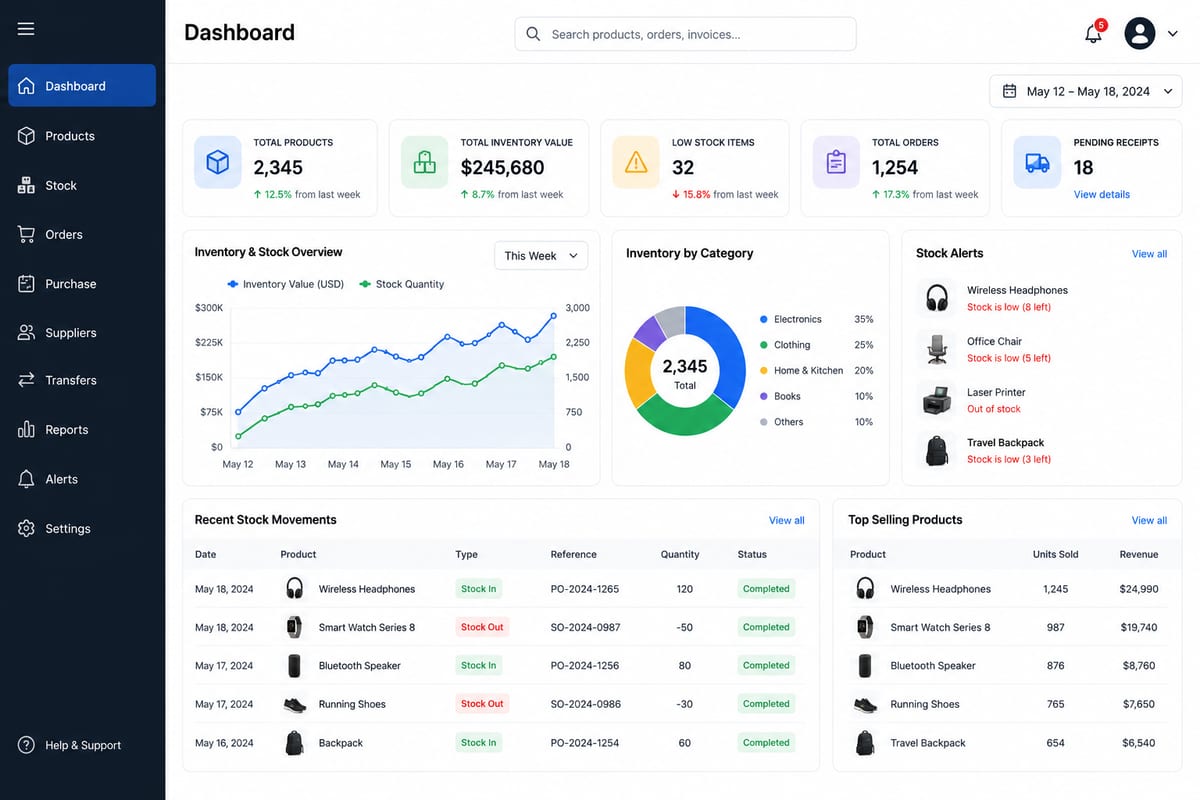
The phrase "inventory management software free" returns a mix of two very different things. On one side, you have legitimate free tools built by vendors who view free tiers as part of a sustainable product strategy. On the other, you have marketing funnels disguised as free products, tools that include just enough functionality to hook you and immediately throttle you on basic features within a week. The difference between these two categories is not visible from the marketing pages, but it is everything for whether the tool will actually work for your operation.
This article walks through how to tell the difference, what real inventory management software free options look like in practice, and how to avoid wasting a setup weekend on a tool that turns out to be paid by month two.
Why "Free" Means Two Different Things
Software vendors use "free" strategically. Some vendors offer real free tiers because their economics work that way, the cost of serving free users is low, free users provide product feedback and word-of-mouth, and the conversion to paid is gradual and natural. Other vendors offer "free" tiers as customer acquisition channels, designed to demonstrate value briefly and then create urgency for paid upgrades through artificial limitations.
Both approaches are legitimate business strategies. The problem is that vendors do not label which approach they are taking. Buyers have to figure it out themselves, often by losing time to the wrong tool.
For inventory management software free specifically, the stakes of getting this wrong are high. Inventory tools are deeply integrated into operational workflows. Migrating away from a tool that turns out to be a marketing funnel costs days of staging work and risks breaking checkout during cutover.
How to Tell Real Free From Marketing Free
Five signals reliably distinguish genuine free tiers from marketing funnels.
Signal 1: What is Actually Included
Real free tiers include the core functionality that defines the product category. For inventory management software, that means real-time sync, multi-channel support, variation tracking, and basic reporting. Marketing free tiers exclude one or more of these and put them behind paid tiers.
If "real-time sync" requires a paid upgrade, it is not real inventory management software free. It is a demo with a paywall.
Signal 2: The Time Limit
Real free tiers do not expire. They might have usage limits (number of SKUs, number of channels, number of orders), but the access does not run out after 14 or 30 days. Marketing free tiers almost always include a countdown timer that ends the experience whether or not the user is converting.
A 14-day free trial is not inventory management software free. It is a paid product with a no-charge demo period.
Signal 3: The Credit Card Requirement
Real free tiers typically do not require a credit card to access. The vendor is not trying to collect billing information they will need later. Marketing free tiers usually require a card on file from day one, often with auto-conversion to paid after the trial period.
Card-required "free" tools are paid products with conversion-friction reduced. Card-not-required tools are real free tiers.
Signal 4: The Limit Cliffs
Real free tiers have generous core-feature limits and add advanced features at paid tiers. Marketing free tiers have aggressive core-feature limits designed to force quick upgrades. Watch for things like 100 SKUs maximum, 1 channel maximum, 50 orders/month maximum, these are conversion mechanisms, not user-friendly free tiers.
A free tier limited to 100 SKUs and 1 channel is not real free inventory management software for any growing operation. It is calibrated to force upgrade.
Signal 5: How the Vendor Talks About Free Users
Look at the vendor's documentation, support pages, and community channels. Real free-tier vendors treat free users as part of the product. Their docs cover free-tier workflows. Their support is accessible to free users. Their community is welcoming to free-tier feedback.
Marketing-funnel vendors often treat free users as second-class, slower support, minimal documentation, community channels filled with upgrade pressure. The pattern shows up in subtle ways across every customer touchpoint.
What Real Inventory Management Software Free Actually Looks Like
A genuine free tier in this category typically includes:
Core multi-channel sync. Connection to multiple sales channels (Amazon, eBay, Walmart, Shopify, etc.) with real-time stock propagation.
Variation-level tracking. Each variation gets its own stock count and sync rules.
Reasonable limits. Generous SKU counts, multiple connected channels, no artificial throttling on basic operations.
Open access to documentation. Setup guides, API documentation, troubleshooting resources available to all users.
Functional support channels. Forum support, knowledge base, community help, even if priority support requires paid tiers.
Standard data export. The ability to export your inventory data and order history in standard formats without administrative gatekeeping.
No credit card requirement. Account creation and full free-tier access without billing information.
No time-based expiration. The free tier remains free indefinitely as long as you stay within the free-tier limits.
Tools that include all of these are real inventory management software free options. Tools that exclude two or more are marketing funnels.
The Architectural Quality of Free Tools
Legitimately free does not mean architecturally inferior. Some of the best inventory management tools in the WooCommerce ecosystem are available free with full architectural quality. The vendor's business model, usually a combination of paid premium tiers, hosting partnerships, or platform fees from connected services, makes the free tier sustainable without compromising the underlying product.
When evaluating free options, the same architectural questions apply that you would ask of paid products.
Is sync webhook-driven or polling-based? According to Cloudflare's documentation on webhooks, event-driven sync handles inventory changes far more reliably than polling-based alternatives. Real free tools can implement webhook-driven sync just as well as paid ones.
Does it track variations at the SKU level? Variable products break tools that do not handle variation-level inventory correctly, regardless of whether the tool is free or paid.
Are the integrations native or middleware? Native API connections outperform middleware-routed integrations. Some free tools use native integrations; others rely on middleware. The architectural choice matters more than the price.
Is there a real audit trail? Operator-accessible logging is foundational to operational accuracy. According to Wikipedia's overview of inventory management, audit trails are the basis of inventory operational integrity at any scale.
Free tools that pass these architectural questions are functionally equivalent to paid alternatives for the specific scope they cover.
How Nventory's Free Tier Fits
The free Nventory plugin on WordPress.org is a real inventory management software free option, not a marketing funnel. Specifically:
It includes core multi-channel sync to all 30+ supported channels, Amazon, eBay, Walmart, TikTok Shop, Etsy, Shopify, BigCommerce, Squarespace, and others. No channels are paywalled.
It uses webhook-driven sync with sub-5-second propagation. The architectural property that defines modern inventory management is included in the free tier.
Variations track at the SKU level. Buffer stock is configurable per SKU. Audit logging is fully accessible to free-tier users.
There is no credit card requirement to install or use. The free tier does not expire.
Paid tiers add advanced features, multi-warehouse routing, advanced fulfillment workflows, custom reporting, priority support, but the free tier is a complete product for stores that do not need those advanced features yet.
This is what real inventory management software free looks like. Compare it to free tiers that limit you to 100 SKUs, one channel, or 14 days, and the difference is structural.
Common Mistakes When Choosing Free Inventory Tools
A few patterns that lead to wasted setup time and disappointing migrations.
Picking based on pricing page promises alone. Real evaluation happens on staging, not on marketing pages. Install and test before committing.
Trusting "freemium" language without checking the actual limits. "Freemium" tools vary enormously in what is actually free. Always verify the specific feature included in the free tier.
Ignoring architectural quality because the tool is free. Free does not excuse polling-based sync, weak variation handling, or inaccessible audit trails. Apply the same architectural standards regardless of price.
Not verifying data portability. Free tools that lock your data become expensive prisons when you eventually want to migrate.
Skipping the staging test. Even free tools should be evaluated on staging before going to production. The cost of testing is your time; the cost of skipping is potential checkout breakage.
Final Thoughts
Inventory management software free comes in two very different forms, real free tiers built into sustainable product strategies, and marketing funnels designed to convert quickly to paid. The difference shows up in five specific signals: what is included, the time limit, the credit card requirement, the limit cliffs, and how vendors treat free users. Real free tiers exist and are viable for serious operations. Marketing funnels waste your time.
If you want to test a real free tier built around the architectural patterns that actually matter, download Nventory free from WordPress.org and run it on staging this week. Visit nventory.io to compare integrations and see what a genuine free tier looks like in practice.
Frequently Asked Questions
Yes, when the free tier is real and the architectural quality is solid. Many growing WooCommerce stores run successfully on free tools for months or years before upgrading to paid tiers as they grow.
Usually nothing problematic. Vendors with sustainable business models can offer real free tiers because paid tiers serve advanced needs that free users grow into naturally. The catch is that you will eventually outgrow the free tier and upgrade, which is the same path you would take with any tool.
Indefinitely if you stay within free-tier limits. The free Nventory plugin on WordPress.org does not have time-based expiration. Many users stay on the free tier for years.
Marketing funnels disguised as free tiers. Users install something they think is free, hit hidden limits within a week, and have to either upgrade or migrate. Real free tiers do not have this problem.
Yes, the right ones can. The free Nventory plugin supports 30+ channels. Free tools that limit you to one or two channels are not designed for multi-channel operations.
Audit your current data, standardize SKUs across channels, set up the new tool on staging, validate sync accuracy for 7 to 14 days, then cut over on a low-traffic weekend. Most migrations take 1 to 3 weeks.
Related Articles
View all
Cloud Based Inventory Management: The Architecture Edge
Cloud based inventory management is not just about the cloud. The architectural advantages that determine whether the platform actually scales for you.

Multichannel Inventory Management: Complete 2026 Guide
Master multichannel inventory management with real-time sync, smart routing, and zero overselling. Built for ecommerce sellers ready to scale.

WooCommerce Inventory Management: 2026 Playbook
WooCommerce inventory management built for multi-channel sellers. Sync stock across Amazon, eBay, and TikTok Shop without plugin conflicts.