Cloud Based Inventory Management: The Architecture Edge
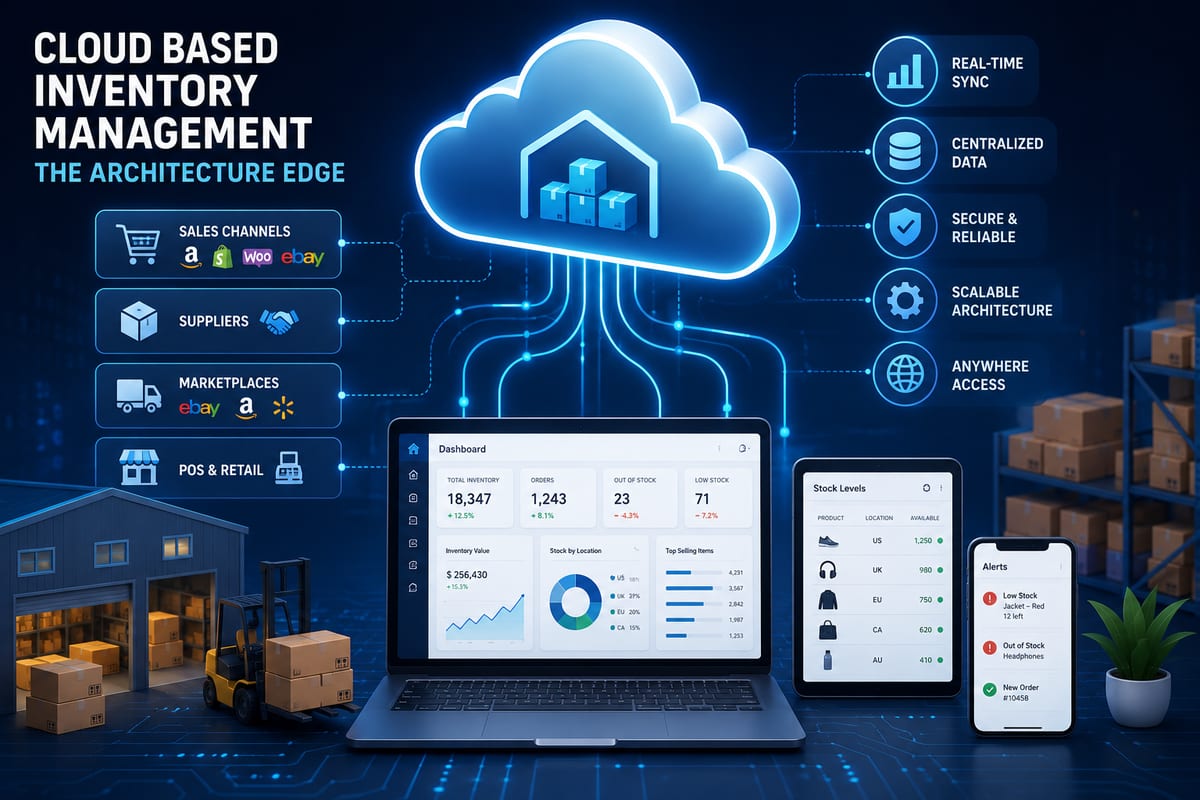
Most articles about cloud based inventory management treat the cloud as the differentiator. The pitch goes: cloud good, on-premise bad. Skip your hosting headaches. Scale infinitely. The pitch is not wrong, exactly, but it misses the architectural choices inside the cloud that actually determine whether a platform delivers on the promise. Two cloud based inventory management platforms with identical marketing copy can have completely different operational behavior depending on how they are built.
This article cuts through the marketing layer and examines the architectural decisions inside cloud based inventory management platforms that determine whether they scale cleanly or break under real load.
What "Cloud Based" Actually Means in Practice
The phrase has become so generic it is almost meaningless. Technically, almost everything in 2026 is cloud-based in some sense. The question worth asking is what architectural pattern a specific cloud platform implements.
Three patterns dominate cloud based inventory management.
Pattern 1, Multi-tenant SaaS. One application instance serves many customers, isolated by tenant identifiers in shared infrastructure. Cost-efficient for vendors. Resource contention possible during peak periods.
Pattern 2, Single-tenant SaaS. Each customer gets their own dedicated application instance. More expensive for vendors. Better isolation, predictable performance.
Pattern 3, Serverless event-driven. No persistent application instance, events trigger compute on demand. Scales automatically with load. Limited by event-handler architecture.
Most cloud based inventory management vendors use Pattern 1 (multi-tenant SaaS) because it is the most economically viable. Pattern 3 (serverless event-driven) is the architectural endpoint for inventory operations specifically because inventory is fundamentally an event-driven problem, sales happen, stock changes, updates propagate. Forcing it into a request-response model adds latency that webhooks eliminate.
According to Cloudflare's documentation on webhooks, event-driven architectures handle high-velocity inventory changes far more reliably than request-driven alternatives.
What the Cloud Solves and What It Does Not
The cloud genuinely solves a specific set of problems for inventory management.
Problems the cloud solves. Server provisioning, security patching, backup management, hardware maintenance, geographic distribution, automatic scaling under load, integration with other cloud services.
Problems the cloud does not solve. Architectural inadequacy of the application itself, sync logic that is still polling-based under the hood, variation handling that was not designed for real catalogs, audit trails that do not exist regardless of where the application runs.
This is the trap most buyers fall into when evaluating cloud based inventory management platforms. They assume "cloud" means "good architecture" by default. It does not. A cloud-hosted polling-based inventory system has the same architectural limitations as an on-premise polling-based system. The cloud solves operational problems, not architectural ones.
The Architectural Properties That Actually Matter
When evaluating cloud based inventory management platforms, six architectural properties determine whether the platform will actually scale cleanly.
1. Sync Architecture
Webhook-driven, not polling-based. Cloud based inventory management platforms that still rely on cron-style polling at 5 to 15 minute intervals are using cloud infrastructure to host outdated architecture. The cloud does not fix the polling problem.
2. Multi-Tenancy Isolation
Strong tenant isolation prevents one customer's load spike from affecting another customer's performance. Weak isolation creates noisy-neighbor problems during peak periods.
3. Event Logging Infrastructure
Every stock change, order import, and webhook event logged with timestamps, source attribution, and replay capability. This is much easier to do correctly in the cloud than on-premise, but only if the platform was designed for it.
4. Concurrency Handling
Per-SKU locking during stock updates to prevent race conditions when multiple sales hit the same SKU simultaneously. The cloud makes this easier to scale but does not implement it automatically.
5. Failure Recovery
Automatic retry with exponential backoff for failed external API calls, dead-letter queues for unrecoverable failures, periodic reconciliation passes to catch anything the primary sync missed. Cloud platforms can do this well; not all of them do.
6. Data Portability
Standard format exports, public API access, customer data retrievable without administrative gatekeeping. The cloud makes this technically easy. Vendor business models often make it hard.
What the Cloud Genuinely Improves Over Local Plugins
For inventory management specifically, cloud based platforms have specific advantages over local-only WordPress plugins.
Performance footprint. Heavy operations run on dedicated cloud infrastructure rather than your WordPress hosting account. Your admin stays fast even at 5,000+ SKUs because the database is not doing the work.
Sync velocity. Cloud platforms can implement webhook-driven sync more easily than local plugins because the cloud infrastructure is built for high-throughput event processing.
Reliability. Cloud platforms have multi-region failover, automatic backups, and recovery procedures that local plugins cannot match.
Scaling. Cloud platforms scale compute resources automatically with load. Local plugins are constrained by your hosting tier.
Integration depth. Cloud platforms can implement deep marketplace integrations using each channel's API, with consolidated authentication and monitoring. Local plugins are constrained by what runs reliably on shared hosting.
According to Wikipedia's overview of inventory management, centralized data ownership across distributed sales channels is foundational to operational accuracy. Cloud based inventory management platforms can deliver that centralization on dedicated infrastructure rather than asking your WordPress hosting account to handle it.
The Hybrid Pattern That Wins
For WooCommerce stores specifically, the architectural sweet spot is hybrid: a lightweight WordPress plugin connected to a cloud-based inventory platform that handles the heavy operational work.
The plugin's job is narrow. It hooks into WooCommerce events, captures stock changes, and forwards them to the cloud platform via signed webhooks. Heavy operations, sync logic, channel coordination, retry handling, audit logging, bulk operations, happen on the cloud platform's dedicated infrastructure.
This pattern combines the best of both worlds. Deep WooCommerce integration through the plugin. Operational scalability through the cloud platform. Your WordPress instance stays fast because it is not doing the heavy work. The cloud platform stays reliable because it is purpose-built for inventory operations.
How Nventory Implements Cloud Based Inventory Management
Nventory.io is a cloud based inventory management platform built around the hybrid pattern described above. The free Nventory plugin on WordPress.org installs in your WordPress admin as a lightweight connector. The heavy operational work, sync logic, webhook processing, multi-channel coordination, variation tracking, audit logging, retry handling, runs on dedicated cloud infrastructure.
The architecture is event-driven, not request-response. When stock changes in WooCommerce, the plugin captures the event and forwards it to the cloud platform. The platform fans out updates to 30+ connected channels in parallel via signed webhooks. Sync propagation typically completes in under 5 seconds.
Variations track at the SKU level. Buffer stock is configurable per SKU. Every event logs with operator-accessible replay capability. Standard format data exports are available without gatekeeping. The free tier includes the core multi-channel sync without a credit card.
For WooCommerce stores evaluating cloud based inventory management options, this is one example of the architectural patterns the category should deliver.
Common Misconceptions About Cloud Based Inventory Management
Three patterns of incorrect thinking show up repeatedly when buyers evaluate the category.
"Cloud means real-time sync." Cloud means hosted off-premise. It says nothing about whether sync is webhook-driven or polling-based. Many cloud platforms still use polling architectures internally.
"Cloud means scalable." Cloud infrastructure can scale, but the application running on it might not. A poorly designed application in the cloud is still a poorly designed application.
"Cloud means more secure than on-premise." Cloud platforms have specific security advantages but also specific risks. Vendor security practices matter more than the deployment model.
"Cloud is always more expensive." Total cost of ownership often favors cloud platforms when you factor in hosting, maintenance, security, and operational overhead of on-premise systems.
"Free cloud tools are not real." Real free tiers exist on legitimate cloud platforms. The free Nventory plugin on WordPress.org is one example, full multi-channel sync, no credit card.
What to Verify Before Committing
Before committing to any cloud based inventory management platform, verify these specific properties.
Sync architecture. Webhook-driven or polling-based, with specific propagation latency numbers from the vendor.
Multi-tenancy model. Shared, dedicated, or serverless, and what isolation guarantees the vendor provides.
Audit trail accessibility. Operator-accessible logs for every stock change, order import, and webhook event.
Variation handling. Tested on staging with at least 12 real variations of one parent product before committing.
Native vs middleware integrations. Direct API connections to your specific channels, not third-party integration providers.
Data portability. Standard format exports, public API access, no administrative gatekeeping on retrieval.
Free tier honesty. Real free tier that includes core functionality, not a 14-day demo masquerading as free.
Final Thoughts
Cloud based inventory management is not valuable because of where the servers live. It is valuable when the architecture inside the cloud is built around event-driven sync, native integrations, variation-level tracking, accessible audit trails, and clean data portability. Cloud platforms that deliver these properties scale cleanly. Cloud platforms that do not are running outdated architecture on modern infrastructure.
If you are evaluating cloud based inventory management platforms for a WooCommerce operation, download Nventory free from WordPress.org and run it on staging this week. Visit nventory.io to review platform architecture documentation and see how the cloud implementation handles the operational details that actually matter.
Frequently Asked Questions
For multi-channel WooCommerce stores, a hybrid pattern with a lightweight plugin connected to a webhook-driven cloud platform fits best. The free Nventory plugin on WordPress.org is one example built specifically for this use case.
For multi-channel ecommerce operations, almost always yes. The performance, reliability, and integration depth advantages compound over time. On-premise systems are typically only worth the trade-offs for enterprises with specific compliance requirements.
Reputable platforms encrypt data in transit and at rest, use signed webhook payloads, support SOC 2 compliance, and provide clear data residency information. Always verify these specifics before committing.
Production-grade platforms have multi-region failover, automatic recovery procedures, and clear status pages. Outages should be brief and rare. Single-region platforms with no failover are higher risk.
Yes, if you chose a platform with clean data portability. Always verify export capability and API access before committing. Platforms that lock data inside closed systems become expensive prisons.
Sometimes. Total cost of ownership often favors cloud platforms when you factor in plugin conflicts, hosting overhead, and operational complexity. Free tiers like the Nventory free plugin make starting cost-free.
Related Articles
View all
Inventory Management Software Free: Real vs Marketing
Inventory management software free options are not all real. Tell the difference between genuine free tools and crippled marketing funnels.

Multichannel Inventory Management: Complete 2026 Guide
Master multichannel inventory management with real-time sync, smart routing, and zero overselling. Built for ecommerce sellers ready to scale.

WooCommerce Inventory Management: 2026 Playbook
WooCommerce inventory management built for multi-channel sellers. Sync stock across Amazon, eBay, and TikTok Shop without plugin conflicts.