Inventory Tracking That Surfaces What Matters
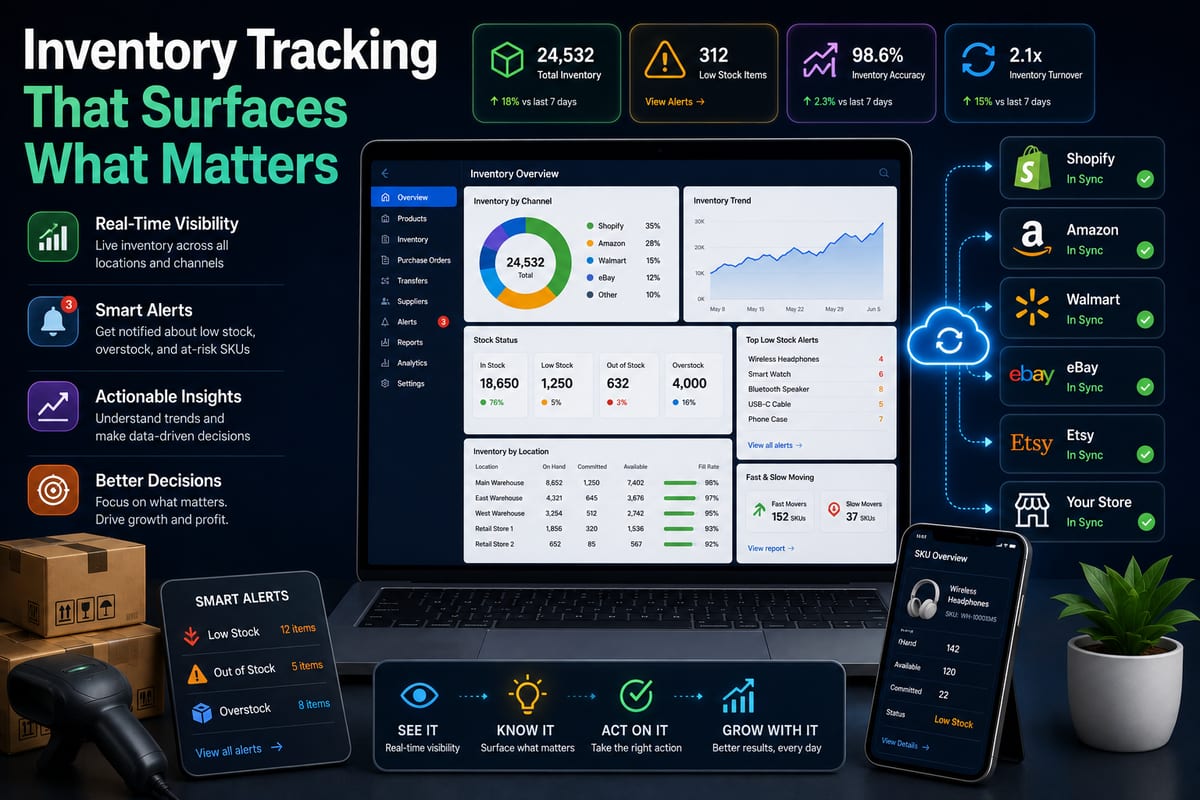
Most inventory tracking is graded on the wrong criteria. Vendors market it as "see your stock counts in real time" and operators evaluate it on how clean the dashboard looks. Both miss the point. Inventory tracking that actually pays for itself does something more interesting, it surfaces problems before they cost money. Drift accumulating silently. Variations diverging across channels. Webhook failures producing invisible gaps. Order routing errors affecting fulfillment. The right inventory tracking catches these issues; the wrong inventory tracking lets them grow until customers notice.
This article walks through what serious inventory tracking actually requires, why most tools miss it, and how to evaluate options based on what they actually catch rather than what they claim to show.
What Inventory Tracking Should Actually Surface
The basic function of inventory tracking is to show current stock counts across channels and locations. That is table stakes. What separates useful inventory tracking from window dressing is what else gets surfaced beyond current state.
Stock drift indicators. Discrepancies between expected and actual counts that suggest silent data corruption is happening somewhere. The drift may be small individually but compounds over time.
Sync delays. Webhook propagation taking longer than expected. Cross-channel updates lagging beyond acceptable thresholds. Pattern indicators that the underlying sync layer is struggling.
Variation divergence. Specific variations showing inconsistent stock counts across channels. The kind of problem that breaks operations silently because parent-level counts look fine.
Webhook failure patterns. Failed webhook deliveries that retry logic eventually recovered from. Useful to see because patterns of failure indicate underlying infrastructure issues.
Order routing anomalies. Orders that took unusually long to route, routed to unexpected warehouses, or required manual intervention. These signal automation gaps worth fixing.
Refund-restoration gaps. Refunds that should have restored stock counts but did not. Common cause of the "phantom inventory" problem that destroys month-end reconciliation.
Operations with inventory tracking that surfaces these get to fix problems before customers notice. Operations with inventory tracking that only shows current state learn about problems through cancellation reports and customer service tickets.
Why Most Inventory Tracking Misses the Important Signals
The architectural reasons for poor inventory tracking are predictable. They show up consistently across the tools that market well but underperform in practice.
Polling-based sync produces incomplete data. Tools that check channels every 5 to 15 minutes literally do not see what happens between polls. Failed webhooks during the gap go unnoticed. The dashboard shows what the last poll captured, not actual state. For the architectural depth, see our inventory sync guide.
Parent-level tracking hides variation problems. Tools that aggregate at the parent product level cannot surface variation-level divergence. The data they do not collect cannot show problems they are not designed to see.
Inaccessible logging. Tools that store event logs in vendor backends rather than operator-accessible interfaces make problems impossible to diagnose without support tickets. By the time vendor support responds, the problem has compounded.
Missing reconciliation passes. Tools without periodic reconciliation never catch drift between webhook updates. Real-time sync alone is not enough; periodic safety-net reconciliation catches what real-time misses.
Weak alerting. Tools that do not proactively alert on anomalies require manual review to catch issues. Most operators do not have time to review inventory data daily.
According to Wikipedia's overview of inventory management, audit trails and proactive monitoring are foundational to operational accuracy at any retail scale. Tools that skip these properties are not built for production use regardless of their marketing.
The Five Problems Inventory Tracking Should Catch Before You Do
Operations running on serious inventory tracking systems catch specific problem categories before they hurt revenue. Operations running on weak tracking learn about these problems through their customers.
Problem 1: Slow stock drift. Channels disagreeing by small but persistent amounts. Good tracking compares channel-by-channel and flags discrepancies. Weak tracking shows aggregate counts that obscure the disagreement.
Problem 2: Refund-restoration failures. Refund events that should restore stock but do not. Good tracking audits refund flows for canonical action firing. Weak tracking treats refund processing as outside scope.
Problem 3: Variation count divergence. Specific variations showing wrong counts on specific channels. Good tracking compares variation-by-variation. Weak tracking aggregates at parent level.
Problem 4: Webhook delivery failures. Failed webhooks that retry logic recovered from. Good tracking shows operators the failure history. Weak tracking hides recovery operations entirely.
Problem 5: Phantom availability. Variations marked sold-out on the storefront but still showing as available on marketplaces. Good tracking cross-checks channel states. Weak tracking shows what each channel claims without comparison.
Each of these problems compounds silently in operations without appropriate tracking. Each becomes obvious with the right tool. The architectural difference between catching them early and learning about them late shows up directly in customer experience and operational efficiency.
How to Audit Your Current Inventory Tracking Capability
Before evaluating new inventory tracking tools, audit your current setup against the five problem categories above.
Audit step 1: Reconcile physical inventory. Count one warehouse fully and compare to system counts. A 3%+ gap suggests refund-restoration failures or accumulated drift.
Audit step 2: Cross-check channels. Pull current stock for 20 SKUs from your storefront and compare to the same SKUs on each connected marketplace. Disagreements suggest sync gaps.
Audit step 3: Test variation handling. Sell out one variation of a complex variable product on staging. Wait 5 minutes. Check every channel. Inconsistencies indicate variation-level tracking gaps.
Audit step 4: Sample webhook logs. If your current tool exposes webhook delivery logs, sample them for failed deliveries that did not retry. Each one represents potential silent drift.
Audit step 5: Pull cancellation reports. Review 90 days of cancellations caused by inventory unavailability. Patterns reveal what your current tool is not flagging proactively.
The audit usually surfaces 2 to 4 hidden problem categories that your current tool is not catching. Those problems are what better inventory tracking exists to surface. This audit is also useful for broader multichannel ecommerce operations assessment.
The Architecture That Catches What Matters
Inventory tracking that surfaces hidden problems shares specific architectural properties.
Comprehensive event logging. Every stock change, every order import, every webhook event logged with timestamps, source attribution, and replay capability. Operators can review exactly what happened during any time window.
Variation-level data model. Each variation tracked as its own entity with its own history. Cross-channel divergence at the variation level surfaces because the data exists.
Anomaly detection logic. Automatic flagging of unusual patterns, sudden stock changes, unusual refund volumes, repeated webhook failures, channel disagreements on the same SKU.
Reconciliation passes. Periodic background reconciliation comparing current state across channels and flagging discrepancies. Catches what real-time sync misses.
Proactive alerting. Notifications when something needs human attention. Operators do not have to remember to check; the system surfaces issues as they emerge.
Operator-accessible interfaces. All logging and audit data accessible to operators without going through support. Problems can be diagnosed in minutes rather than days.
According to Cloudflare's documentation on webhooks, event-driven architectures naturally produce the audit trails that make catching hidden problems possible. Polling-based architectures do not capture the granular event data that enables this kind of visibility.
How Nventory Implements Comprehensive Inventory Tracking
Nventory.io is built around the architectural patterns that produce useful inventory tracking. Every stock change, order import, and webhook event logs with timestamps and source attribution. Variations track at the SKU level. Cross-channel state is comparable and flagging discrepancies is built-in. Periodic reconciliation passes catch anything webhooks miss. Operator-accessible interfaces expose the audit trail without support tickets.
For WordPress and WooCommerce stores, download Nventory free from WordPress.org. For Shopify operations, install Nventory from the Shopify App Store. Both versions connect to the same multi-channel platform with identical tracking capabilities.
The free tier includes the core inventory tracking functionality without subscription cost. Paid tiers add custom reporting, advanced alerting configurations, and priority support for operations with specific tracking needs beyond the standard implementation.
The architectural value is specifically that hidden problems become visible. Operations using Nventory for inventory tracking typically catch issues weeks or months earlier than operations using tools without these architectural properties.
What Good Inventory Tracking Looks Like in Daily Operations
Operations running on inventory tracking that actually surfaces problems have specific operational characteristics worth describing.
The daily routine does not involve manual reconciliation. The system shows discrepancies when they appear; the team addresses them. The work is reactive in the good sense, responding to specific surfaced issues rather than proactively hunting for problems.
Peak seasons reveal tracking issues quickly. The first few oversells become diagnostic moments rather than mystery problems. The audit trail shows exactly what failed and when, enabling quick fixes before the pattern compounds.
Monthly physical reconciliation matches system counts within tight tolerances. Drift does not accumulate because tracking catches it as it emerges.
Customer service workload from inventory-related issues stays low. The kinds of problems that produce angry customers, overselling, phantom availability, refund mishandling, get caught before customers experience them.
The team can focus on growth rather than fighting inventory fires. The tracking does the operational work that consumes attention in less-disciplined operations.
Common Inventory Tracking Mistakes
A few patterns to avoid.
Choosing tools based on dashboard appearance. Pretty dashboards do not necessarily indicate good tracking. Substance matters more than visual polish.
Trusting "real-time" claims without verification. Without specific webhook latency numbers and operator-accessible logs, "real-time" is marketing language.
Not testing variation handling. Variable products break tools that do not track variations correctly. Test specifically.
Ignoring audit trail accessibility. If you cannot access detailed event logs as an operator, your tracking is incomplete regardless of what the dashboard shows.
Underestimating reconciliation passes. Real-time sync alone is not sufficient. Periodic reconciliation catches what real-time misses.
Final Thoughts
Inventory tracking that actually pays for itself is not the one with the loudest marketing or the cleanest dashboard. It is the one that catches hidden problems before they grow into customer-facing crises. Stock drift, refund-restoration gaps, variation divergence, webhook failures, and phantom availability are the categories of problems that compound silently in operations without good tracking. The right tool surfaces them; the wrong tool lets them grow until they become emergencies.
If you want to test inventory tracking built around the architectural properties that catch hidden problems, install Nventory on your platform of choice. For WordPress and WooCommerce stores, download Nventory free from WordPress.org. For Shopify stores, install Nventory from the Shopify App Store. Visit nventory.io to review platform capabilities and see how the architecture surfaces the issues that most operations do not yet realize they have.
Frequently Asked Questions
Tools with comprehensive event logging, variation-level data models, anomaly detection, reconciliation passes, and operator-accessible interfaces. Nventory implements all of these, available on WordPress.org and the Shopify App Store.
Reconcile physical inventory monthly. Cross-check stock counts across channels weekly. Review cancellation reports quarterly. Any of these audits typically surfaces problems your current tool is not flagging.
Yes, when the architecture is right. Real free tiers from architecturally serious vendors include comprehensive event logging and variation-level tracking. The free Nventory tier is one example.
Monthly physical reconciliation. Weekly cross-channel stock checks during high-velocity periods. Quarterly cancellation pattern review. The cadence catches problems before they compound.
Refund-restoration failures. Plugins that process refunds without firing the canonical restoration action create persistent stock drift that nobody catches until month-end reconciliation.
It might surface anomalies that look like problems but turn out to be normal variance. Filtering signal from noise is part of operating any monitoring system. Most tools let operators tune alert thresholds to reduce false positives.
Related Articles
View all
Tips on How to Sell on eBay: Operational Practices at Scale
Tips on how to sell on eBay alongside multiple channels. The operational practices that protect seller standing and produce sustainable margin.
Multi Channel Marketing vs Omni Channel: Honest Comparison
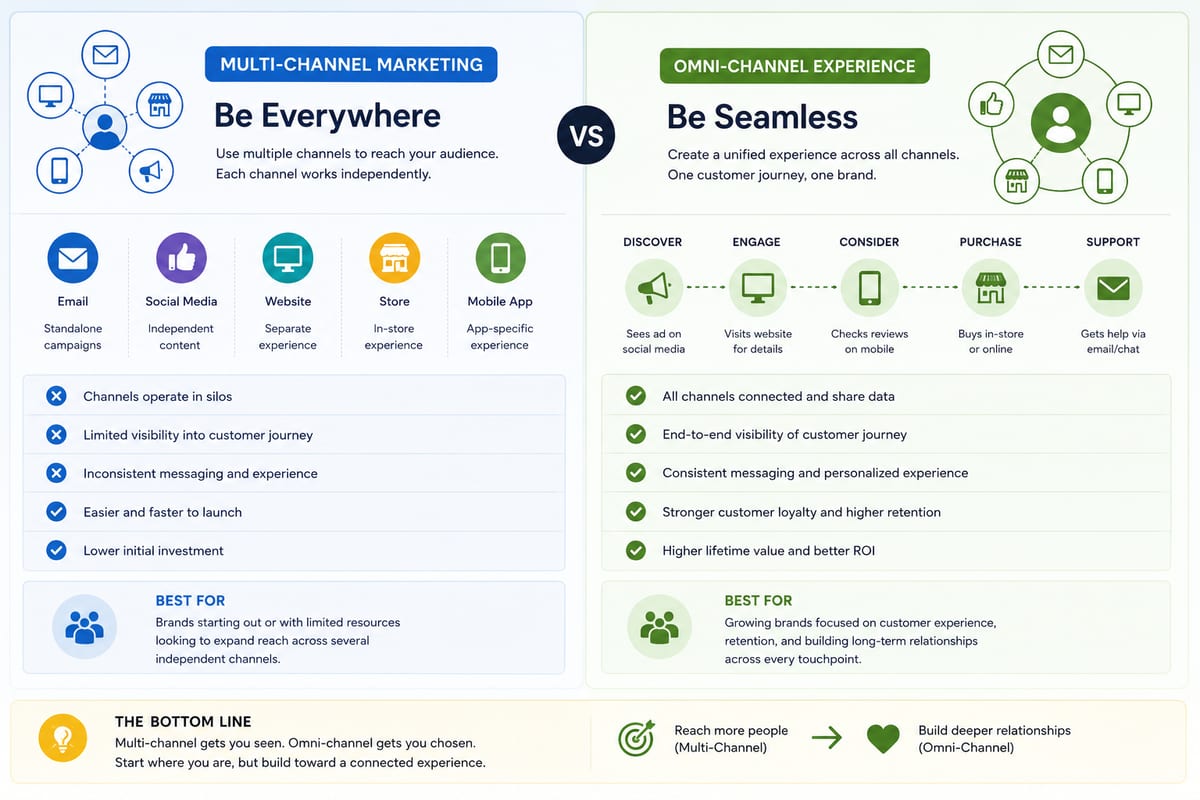
Multi channel marketing vs omni channel breakdown for ecommerce operations. The operational differences that determine which approach fits your business.

ERP Software vs Multi-Channel Platforms: Honest Choice
ERP software comparison for growing ecommerce brands. When ERP fits and when multi-channel platforms produce better outcomes at lower cost.