Multichannel Ecommerce: The Operational Playbook 2026
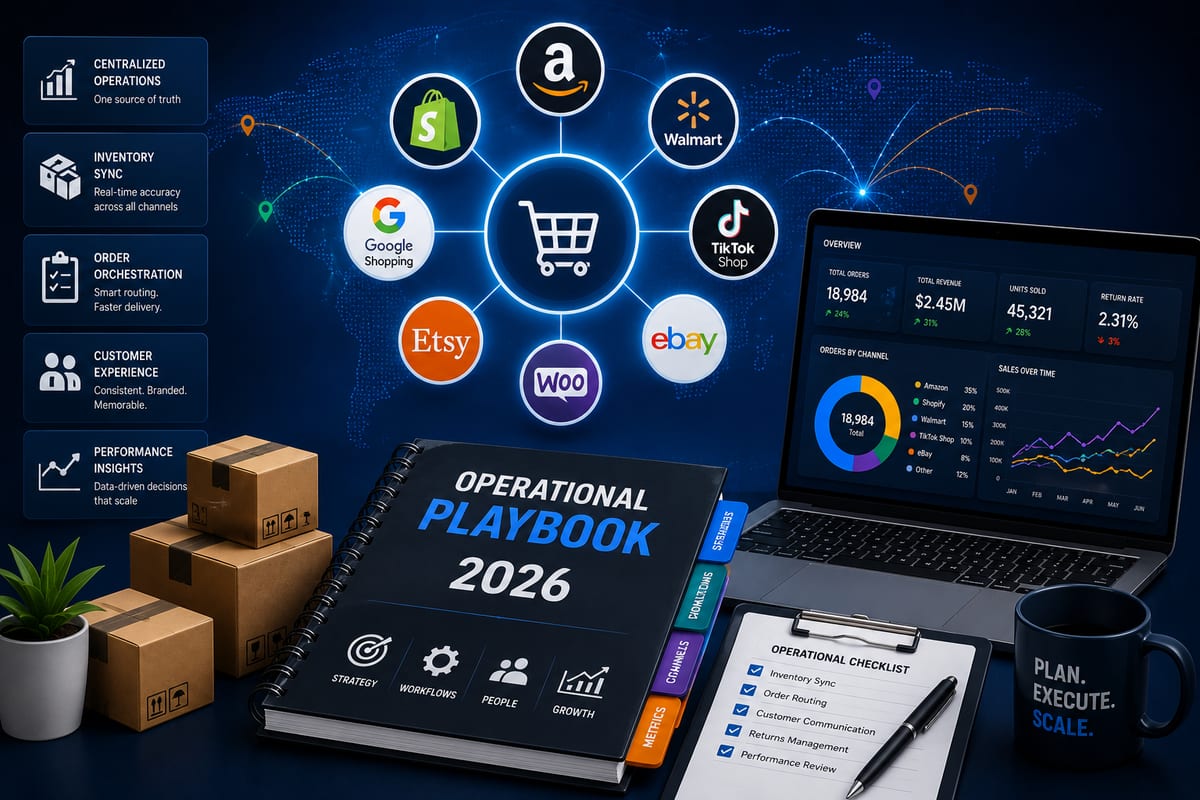
Multichannel ecommerce is not a buzzword anymore. It is the operational reality for any brand serious about reaching customers in 2026. The single-channel ecommerce business is increasingly fragile, algorithm changes, marketplace policy shifts, and platform-specific risks make depending on one channel structurally unsafe. The brands that scale through volatility share a small set of operational patterns. The brands that stall share the opposite patterns.
This article walks through what multichannel ecommerce actually requires operationally, the architectural decisions that separate winners from losers, and the practical playbook that scaling brands follow whether they are running on Shopify, WooCommerce, or something else entirely.
What Multichannel Ecommerce Actually Means
The phrase gets used loosely. To set expectations, multichannel ecommerce in 2026 typically means selling on three or more of the following simultaneously:
- A primary owned storefront (Shopify, WooCommerce, BigCommerce, or similar)
- Amazon Seller Central and/or Amazon FBA
- eBay or similar auction-style marketplaces
- Walmart Marketplace
- TikTok Shop
- Etsy or category-specific marketplaces
- Social commerce channels (Instagram, Facebook Shops)
- Wholesale and B2B channels
The operational complexity scales non-linearly with channel count. Adding a third channel produces more operational work than going from one to two. Adding a fifth produces more than going from three to four. By the time a brand operates on five channels, multichannel ecommerce becomes a discipline rather than a strategy.
Why Most Multichannel Ecommerce Operations Struggle
Brands typically struggle with multichannel ecommerce because they treat it as a product distribution problem when it is actually an operational architecture problem. The thinking goes: "We need to be on more channels to reach more customers, so let's list our products on Amazon and eBay." The thinking misses that listing products is the easy 10%, the hard 90% is keeping everything synchronized as orders flow through.
The operational failure modes are predictable:
Inventory drift between channels. The same SKU shows different stock counts on different channels. Customers buy items that do not exist. Refunds pile up. Account health metrics degrade.
Order routing chaos. Orders from different channels need different fulfillment paths. Without automation, every order requires manual attention. Operations team time scales linearly with order volume rather than capacity.
Pricing inconsistency. Channels have different fee structures, different competitive dynamics, and different margin requirements. Operations without systematic pricing logic watch margins erode invisibly.
Customer service fragmentation. Each channel has its own messaging system, return policies, and customer expectations. Without consolidation, support teams duplicate work across channels.
Marketing attribution confusion. Multi-channel customers interact with multiple touchpoints before purchasing. Without unified attribution, you cannot tell which channels actually drive growth.
These problems compound. Each one creates work that prevents fixing the others. Brands often spend two years stuck at the same revenue level because operational complexity consumes the team's growth capacity.
The Operational Architecture That Scales
Multichannel ecommerce operations that scale share a small set of architectural patterns. They are worth understanding because they predict business outcomes more reliably than which specific channels a brand operates on.
Centralized inventory ownership. One system owns the canonical stock count for every SKU. According to Wikipedia's overview of inventory management, centralized data ownership across distributed sales channels is foundational to operational accuracy. Scaling brands embody this principle; stalling brands violate it by stacking channel-specific plugins that fight each other.
Real-time event-driven sync. When anything changes anywhere in the operation, every relevant system knows about it within seconds. Polling-based sync at 5 to 15 minute intervals is not enough for serious multichannel operations. For a deeper architectural breakdown, see our guide on inventory sync.
Variation-level granularity. Stock counts, prices, and availability track at the variation level rather than the parent product level. Brands selling apparel, footwear, or configurable goods break tools that do not handle variations correctly.
Native channel integrations. Direct API connections to each channel rather than middleware-routed integrations. Middleware adds latency and creates failure points that compound across channels.
Unified order management. All orders from all channels flow into one operational view with appropriate routing logic. The team works in one system rather than juggling separate dashboards per channel.
Comprehensive logging. Every event, stock change, order import, webhook delivery, logs with timestamps and replay capability. When problems occur (and at sufficient scale, they always do), the audit trail enables fast diagnosis.
Operations with all six properties scale cleanly. Operations missing two or more struggle predictably.
The Three Stages of Multichannel Ecommerce Maturity
Brands typically progress through three operational stages as they scale multichannel ecommerce.
Stage 1: Bolted-On Multichannel (Months 0-12)
The brand launched on one channel and added a second. The operations team handles cross-channel coordination manually. Spreadsheets and a few plugins keep things barely synchronized.
Symptoms: weekly manual reconciliation, occasional oversells, the founder still does inventory adjustments personally.
This stage works for brands under $500K annual revenue. Beyond that, the manual coordination does not scale.
Stage 2: Stacked Plugins (Months 12-24)
The brand added more channels and addressed each with a specialized plugin. WooCommerce now has 8+ plugins handling inventory; Shopify has 5+ apps doing similar work. Plugin conflicts have started producing stock drift.
Symptoms: monthly reconciliation crises, peak season overselling, the team starts talking about "fixing inventory" as a project.
This stage is where most brands get stuck. The plugin stack provides just enough functionality to keep operating but creates structural problems that prevent scaling further.
Stage 3: Unified Operations (Months 24+)
The brand consolidated to a unified multichannel ecommerce platform that owns inventory, sync, and order management as a single system. Stacked plugins were removed. Operations team time dropped dramatically.
Symptoms: peak season runs cleanly, oversell rates approach zero, the team can focus on growth rather than fighting operational fires.
This stage is where serious multichannel ecommerce operations live. The transition from Stage 2 to Stage 3 is the highest-leverage operational decision growing brands make.
What Triggers the Stage 2 to Stage 3 Migration
Brands do not usually migrate from stacked plugins to unified operations preventatively. They migrate after a specific triggering event makes the structural problem undeniable.
Trigger 1: A peak season disaster. Black Friday or holiday season produces enough overselling, cancellations, and customer service damage that the operations team cannot recover quickly.
Trigger 2: An account health crisis. Amazon, eBay, or another marketplace issues a suspension warning due to cross-channel inventory drift. The seriousness of the warning forces immediate operational change. For Amazon-specific implications, see Amazon inventory management.
Trigger 3: A growth ceiling realization. The brand realizes they have been at the same revenue level for 6+ months because operational complexity consumes the growth team's capacity. The math finally adds up: fixing operations is the highest-leverage growth investment available.
Trigger 4: A team burnout moment. Someone on the operations team leaves because the weekly reconciliation grind became unbearable. The founder finally sees what the work actually costs.
Trigger 5: A failed channel launch. The brand tries to add a fifth channel and finds the existing stack cannot handle it. The structural limits of stacked plugins become obvious.
Any one of these triggers is usually enough to motivate the migration. Brands that wait for two triggers before acting usually wish they had acted on the first.
How to Run a Multichannel Ecommerce Migration
Migrating to unified operations requires care because the transition itself can produce operational disruption if mismanaged.
Step 1: Audit your current stack. Document every plugin, app, and integration currently touching inventory or orders. This is the migration map.
Step 2: Standardize SKUs across all channels. Inconsistent SKU naming is the single most common cause of post-migration sync failures. Fix this before connecting anything new.
Step 3: Choose a unified platform fit for your scale. Look for platforms with the six architectural properties: centralized ownership, real-time sync, variation granularity, native integrations, unified order management, comprehensive logging.
Step 4: Set up on staging first. Clone production. Install the unified platform there. Run synthetic orders for at least a week.
Step 5: Migrate one channel at a time. Start with your highest-volume marketplace. Validate accuracy for 7 to 14 days before adding the next channel.
Step 6: Deactivate redundant plugins as they become unnecessary. Do not run old and new systems in parallel, they will fight for data control.
Step 7: Cut over on a low-traffic day. Final transitions happen Sunday mornings, never Friday evenings before peak season.
Most migrations take 2 to 4 weeks of staging work plus a low-traffic cutover weekend. The hesitation is usually emotional rather than technical.
How Nventory Supports Multichannel Ecommerce Operations
Nventory.io is built specifically for the Stage 2 to Stage 3 transition. The platform consolidates inventory, channel sync, and order management into a unified system that replaces stacked plugin setups.
The platform connects to 30+ channels through native API integrations, WooCommerce, Shopify, BigCommerce, Amazon, eBay, Walmart, TikTok Shop, Etsy, and more. Sync is webhook-driven with sub-5-second propagation. Variations track at the SKU level. Every event logs with replay capability for operator-level diagnostics.
For WordPress and WooCommerce stores, download Nventory free from WordPress.org. For Shopify operations, install Nventory from the Shopify App Store. Both versions connect to the same multi-channel platform with identical capabilities.
According to Cloudflare's documentation on webhooks, event-driven architectures handle high-velocity multi-channel data far more reliably than polling-based alternatives. For multichannel ecommerce operations specifically, this is the architectural property that determines whether peak seasons run cleanly or produce cancellation cascades.
Operational Habits That Separate Scaling Brands
Beyond architecture, scaling multichannel ecommerce brands share specific operational habits.
They standardize SKUs ruthlessly. Every variation has the same SKU on every channel. New product launches start with SKU standardization, not as an afterthought.
They test on staging first. No inventory plugin or app installation happens directly on production. Staging environments catch problems before customers do.
They monitor before they need to. Low-stock alerts, sync failure notifications, and webhook health checks are configured before peak season, not during the first crisis.
They reconcile monthly. Even with reliable real-time sync, monthly physical-versus-system reconciliation catches drift before it compounds.
They invest in audit trails. When problems occur, they want to know exactly what happened, when, and why. Platforms without operator-accessible logs get eliminated from consideration.
They protect data portability. They verify export capability before committing to any platform. Tools that lock data become expensive prisons; tools that expose data through clean APIs preserve operational flexibility.
Final Thoughts
Multichannel ecommerce is the operational reality of growing brands in 2026. The brands that scale through it share specific architectural and operational patterns: centralized inventory, real-time sync, variation granularity, native integrations, unified order management, and comprehensive logging. The brands that stall share the opposite patterns, stacked plugins, polling-based sync, fragmented data, manual coordination. The transition from stacked plugins to unified operations is the highest-leverage operational decision most growing multichannel brands face.
If you are running multichannel ecommerce operations and want to test a unified platform built for the Stage 2 to Stage 3 transition, install Nventory on your platform of choice. For WordPress and WooCommerce stores, download Nventory free from WordPress.org. For Shopify stores, install Nventory from the Shopify App Store. Visit nventory.io to review platform capabilities and see how the architecture handles multichannel ecommerce operations at scale.
Frequently Asked Questions
Platforms with centralized inventory ownership, webhook-driven sync, native integrations, and unified order management. Nventory handles these, available on WordPress.org and the Shopify App Store.
Most scaling brands operate on 3 to 5 channels. Fewer creates dangerous platform dependence. More creates operational complexity that outpaces marginal revenue gain.
Stacked plugins work at low scale. Unified platforms are required past Stage 2 of operational maturity. Brands that recognize the transition earlier scale faster than brands that delay it.
Most migrations take 2 to 4 weeks of staging work plus a low-traffic cutover weekend. SKU standardization across channels usually takes longer than the platform setup itself.
Yes, when the operational architecture matches the scale. Small brands with two channels can run on simple setups. Operational maturity matters more than absolute scale.
Treating multichannel as a distribution problem when it is actually an operational architecture problem. The brands that struggle add channels without upgrading their operational stack. The brands that scale upgrade the stack first.
Related Articles
View all
Inventory Automation That Actually Saves Operations Time
Inventory automation for ecommerce operations past manual reconciliation. The categories that produce compounding labor savings at scale.
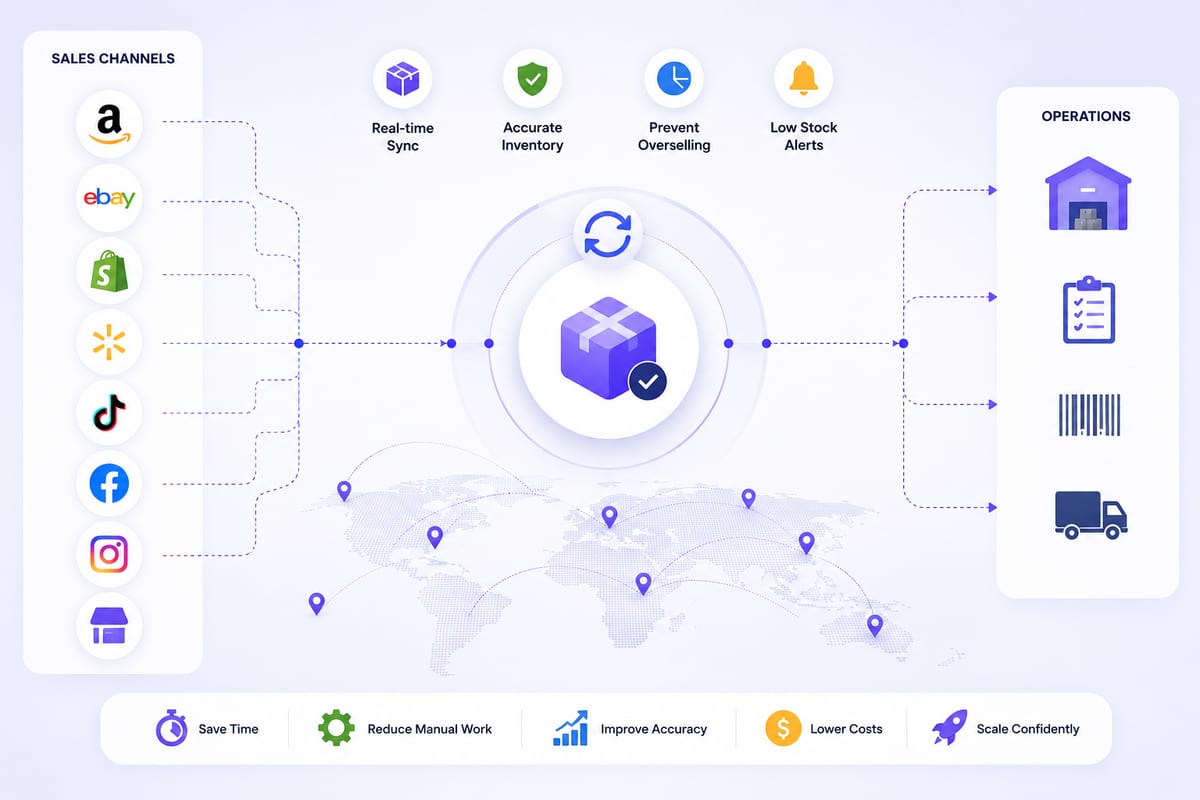
Cross Channel Inventory Management Without the Chaos
Cross channel inventory management for operations running on multiple platforms. The architectural patterns that prevent coordination breakdowns.
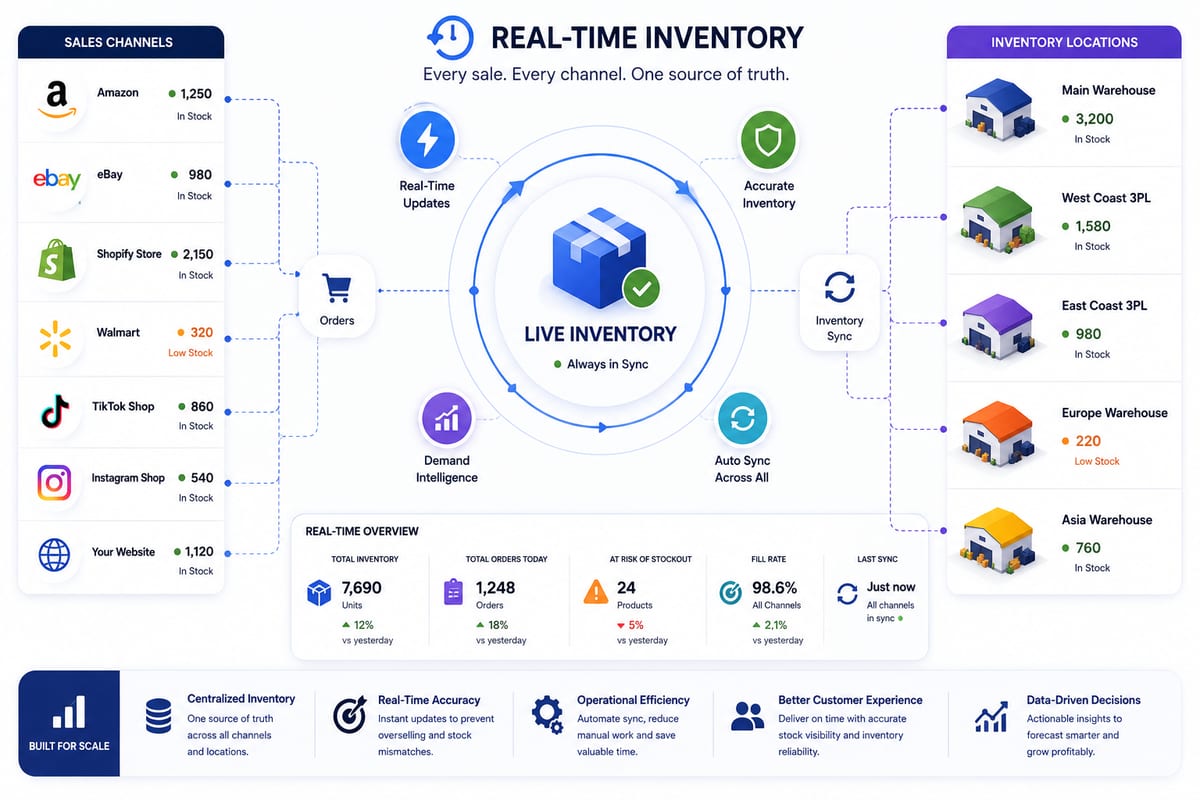
Real Time Inventory Management at Multi-Channel Scale
Real time inventory management requirements for multi-channel ecommerce. The architecture that delivers sub-5-second propagation under load.