eBay Inventory Management for Cross-Channel Sellers

Most eBay sellers eventually expand. They start on eBay, build a customer base, then add their own storefront on Shopify or WooCommerce, often picking up Amazon or other marketplaces along the way. The moment they cross from eBay-only to multi-channel selling, eBay inventory management changes from "update listings when stock arrives" to "coordinate stock across systems that do not naturally talk to each other." What worked as a manual workflow on eBay alone becomes a constant source of listing suspensions, defect rate damage, and operational pain.
This article walks through what eBay inventory management actually requires for cross-channel sellers, the eBay-specific consequences of inventory drift, and the architectural choices that prevent the problems that destroy eBay seller standing.
Why eBay Inventory Management Has Different Stakes
eBay punishes overselling and shipping failures aggressively through its seller performance system. Where some marketplaces produce cancelled orders and unhappy customers as the worst outcome, eBay produces account-level consequences that compound into existential business risk.
The eBay-specific consequences include:
Defect rate damage. Cancelled transactions hit your defect rate metric. eBay's threshold is 2%, crossing it triggers warnings, then restrictions, then suspension. Cross-channel inventory drift is the most common cause of defect rate crossings.
Late shipment metric impact. When sync delays force manual order routing or fulfillment delays, shipping deadlines get missed. Late shipments hit a separate eBay metric that compounds with defect rate damage.
Top Rated Seller status loss. Sellers with degraded performance metrics lose Top Rated Seller benefits, which affect search ranking, eligibility for premium placements, and final value fee discounts. The financial impact is meaningful and difficult to recover from quickly.
Selling limit restrictions. eBay restricts the number and value of items sellers can list based on performance metrics. Drift-induced cancellations can trigger selling limit reductions that constrain growth.
Account suspension risk. Repeated metric violations escalate to suspensions that can take weeks to resolve. During suspension, you lose the listing ranking and customer reviews you spent years building.
These consequences make eBay inventory management uniquely high-stakes for cross-channel sellers. The same inventory drift that produces an annoying cancelled order on your storefront produces multi-year recoverability problems on eBay specifically. Similar dynamics apply on Amazon inventory management, but eBay's specific metric structure creates its own patterns.
What Cross-Channel eBay Operations Actually Need
The core requirement is straightforward: when stock changes anywhere in the operation, eBay needs to know within seconds. The implementation reality is more demanding.
Real-time eBay sync. eBay's Trading API and newer Sell APIs support fast inventory updates. Tools that exploit this capability propagate stock changes in under 5 seconds. Tools that poll at 5 to 15 minute intervals leave overselling windows wide open during peak periods.
eBay-specific SKU mapping. eBay listings use specific SKU and Custom Label conventions that must map cleanly to your storefront and other channel SKUs. Inconsistent mapping is the single most common cause of eBay sync failures.
Variation handling for Multi-Variation Listings (MVL). eBay's Multi-Variation Listings have specific structure requirements for variations (size, color, etc.). Sync tools need to handle MVL correctly or variation tracking breaks.
Auction vs Buy It Now handling. eBay supports both auction-style and fixed-price listings with different inventory implications. Sync tools need to understand which listings deplete stock immediately and which only deplete on auction completion.
eBay store inventory vs marketplace listings. Sellers running both an eBay Store and individual marketplace listings have specific inventory routing needs. Tools that handle one but not the other produce edge case failures.
According to Wikipedia's overview of inventory management, centralized data ownership across distributed sales channels is foundational to operational accuracy. For eBay-heavy operations specifically, this principle becomes survival economics.
The Three Common eBay Inventory Management Setups
Cross-channel eBay sellers typically use one of three architectural patterns. Each has predictable strengths and weaknesses.
Pattern 1: Manual Coordination
eBay listings managed directly through Seller Hub. Storefront inventory managed independently. Cross-channel reconciliation happens through manual spreadsheet work or daily review.
Strengths: low cost, no integration complexity, works for very low-volume operations.
Weaknesses: does not scale past 100 daily orders, breaks during sales events, weekly reconciliation becomes inevitable.
Pattern 2: eBay-Specific Sync Plugin
A specialized plugin or app that connects your storefront to eBay specifically. Other channels handled by other plugins. Each connection operates independently.
Strengths: easy to start, channel-specific feature depth.
Weaknesses: plugins fight each other for control of storefront inventory data, conflicts compound over time, cross-channel reconciliation falls to the operations team. This is where most growing cross-channel eBay sellers get stuck.
Pattern 3: Unified Multi-Channel Platform
One platform handles inventory across eBay and all other channels through a unified architecture. The storefront has one connector to the platform; the platform handles every external channel including eBay.
Strengths: clean architecture, scales with channel count, eliminates plugin conflicts, real-time sync, eBay performance metrics protected by reliable sync.
Weaknesses: higher upfront setup complexity than Pattern 2.
For eBay sellers running on 3+ channels or doing meaningful eBay volume, Pattern 3 is the right architectural choice. The eBay-specific consequences of inventory drift make stacked architectures operationally dangerous, not just inconvenient.
The Multi-Variation Listing Complication
eBay's Multi-Variation Listings (MVL) add a specific complexity to cross-channel inventory management. A single eBay listing can contain dozens of variations (sizes, colors, styles), each with its own stock count and SKU mapping.
The implications for sync:
Variation-level granularity required. Tools that track stock at the parent product level cannot handle eBay MVL correctly. Each variation needs its own count.
eBay-specific variation structure. eBay's variation model has specific attribute and value naming conventions. Sync tools need to map storefront variations to eBay variations correctly.
Restocking implications. When a variation runs out and gets restocked, the eBay MVL needs to update specifically. Treating restocks as parent-level changes produces wrong availability.
Cross-channel variation consistency. Variations on eBay should match variations on Shopify, WooCommerce, Amazon, and other channels. Inconsistency confuses customers and produces operational errors. This connects to the broader inventory sync architecture challenges across channels.
Tools that handle eBay MVL correctly are noticeably different from tools that pretend MVL is just like simple inventory. The difference shows up in production with variation-heavy catalogs.
How Nventory Handles eBay Inventory Management
Nventory.io is built specifically for the cross-channel eBay use case. The platform handles eBay-specific complexity, Trading API integration, MVL support, defect-rate-protective sync speed, multi-marketplace handling, through a unified webhook-driven architecture.
eBay inventory propagates in under 5 seconds. SKU mapping is configurable per channel. Multi-Variation Listings track at the variation level. Every event logs with replay capability for performance metric diagnostic work.
For storefront integration, Nventory connects to both major ecommerce platforms. For WordPress and WooCommerce stores, download Nventory free from WordPress.org. For Shopify operations, install Nventory from the Shopify App Store. Both versions connect to the same multi-channel platform with the same eBay-specific capabilities.
The architectural value for eBay sellers specifically: the sync architecture is designed around eBay's defect rate sensitivity. Sub-5-second propagation prevents the defect rate damage that destroys eBay seller standing. According to Cloudflare's documentation on webhooks, event-driven sync is the only architectural pattern that delivers this speed reliably under load.
How to Migrate eBay Inventory Management Cleanly
Migrating eBay inventory management from a stacked-plugin setup to a unified platform requires care because eBay punishes mistakes during migration aggressively.
Step 1: Document your current eBay seller performance baseline. Note your current defect rate, late shipment rate, and other performance metrics. This baseline lets you detect migration-induced regressions immediately.
Step 2: Standardize SKUs across eBay and storefront. Inconsistent SKU naming is the #1 cause of post-migration eBay sync failures. Fix this before connecting anything.
Step 3: Map eBay Multi-Variation Listings carefully. Variation attributes need to map correctly between storefront variations and eBay MVL structure. Test mapping on staging before connecting.
Step 4: Migrate eBay last, not first. Connect the new platform to your storefront and lower-stakes channels first. Validate sync accuracy for 7 to 14 days before adding eBay.
Step 5: Cut over eBay on a low-traffic day. Sunday morning beats Friday evening. Have the old plugin deactivated and the new platform validated before peak hours begin.
Step 6: Monitor eBay performance metrics daily for 30 days post-migration. Any unusual movement in defect rate, late shipment rate, or cancellation rate needs immediate investigation.
Migrating eBay inventory management during peak seasons or major sales events is the highest-risk operational decision a cross-channel seller can make. Plan migrations for low-volume months.
Common eBay Inventory Management Mistakes
A few patterns that produce defect rate damage and seller standing problems.
Running polling-based sync at long intervals. eBay's flash sales and featured placements drain inventory faster than polling can react. Sub-5-second sync is not a luxury, it is a requirement for protecting performance metrics.
Skipping SKU standardization. Inconsistent SKU naming between eBay and storefront produces sync mismatches that look random but follow predictable patterns.
Ignoring Multi-Variation Listing complexity. Treating eBay MVLs as simple parent products produces variation-level sync failures that frustrate customers and damage metrics.
Using stacked plugins instead of unified platforms. Plugin conflicts between eBay connectors and storefront stock managers produce silent data corruption that takes weeks to diagnose.
Not monitoring eBay seller dashboard daily. Performance metrics can degrade subtly across multiple weeks before triggering warnings. Daily monitoring catches degradation before it becomes restriction risk.
Final Thoughts
eBay inventory management for cross-channel sellers has different stakes than inventory management on other channels. eBay's defect rate sensitivity means inventory drift produces multi-year recoverability problems rather than just operational annoyance. The architectural choices that prevent overselling everywhere become survival economics on eBay specifically. Sub-5-second sync, Multi-Variation Listing handling, unified platforms instead of stacked plugins separate operations that scale on eBay from operations that get restricted.
If you are running eBay inventory management across multiple channels and want to test a platform built for the eBay-plus-storefront use case, install Nventory on your platform of choice. For WordPress and WooCommerce stores, download Nventory free from WordPress.org. For Shopify stores, install Nventory from the Shopify App Store. Visit nventory.io to compare eBay integration capabilities and review the platform documentation.
Frequently Asked Questions
Tools with sub-5-second eBay sync, Multi-Variation Listing handling, and unified cross-channel architecture. Nventory implements these, available on WordPress.org and the Shopify App Store.
Sub-5-second propagation is the standard for protecting eBay performance metrics. Slower sync creates defect rate damage that compounds into seller standing problems.
Yes. eBay MVL has specific attribute and structure requirements. Tools that handle variations as generic data without eBay-specific awareness break for variation-heavy catalogs.
Done correctly, no, accurate sync improves performance metrics, which protects Top Rated Seller eligibility. Done incorrectly with polling-based sync, yes, because sync delays produce defect rate damage.
Yes. Modern platforms like Nventory treat all of them as connected channels and sync inventory between them simultaneously. This is a common pattern for serious multichannel ecommerce operations.
Three layers: webhook-driven sync for sub-5-second propagation, buffer stock configuration of 1 to 3 units per SKU, and daily monitoring of eBay performance metrics. The combination eliminates almost all overselling risk.
Related Articles
View all
Inventory Automation That Actually Saves Operations Time
Inventory automation for ecommerce operations past manual reconciliation. The categories that produce compounding labor savings at scale.
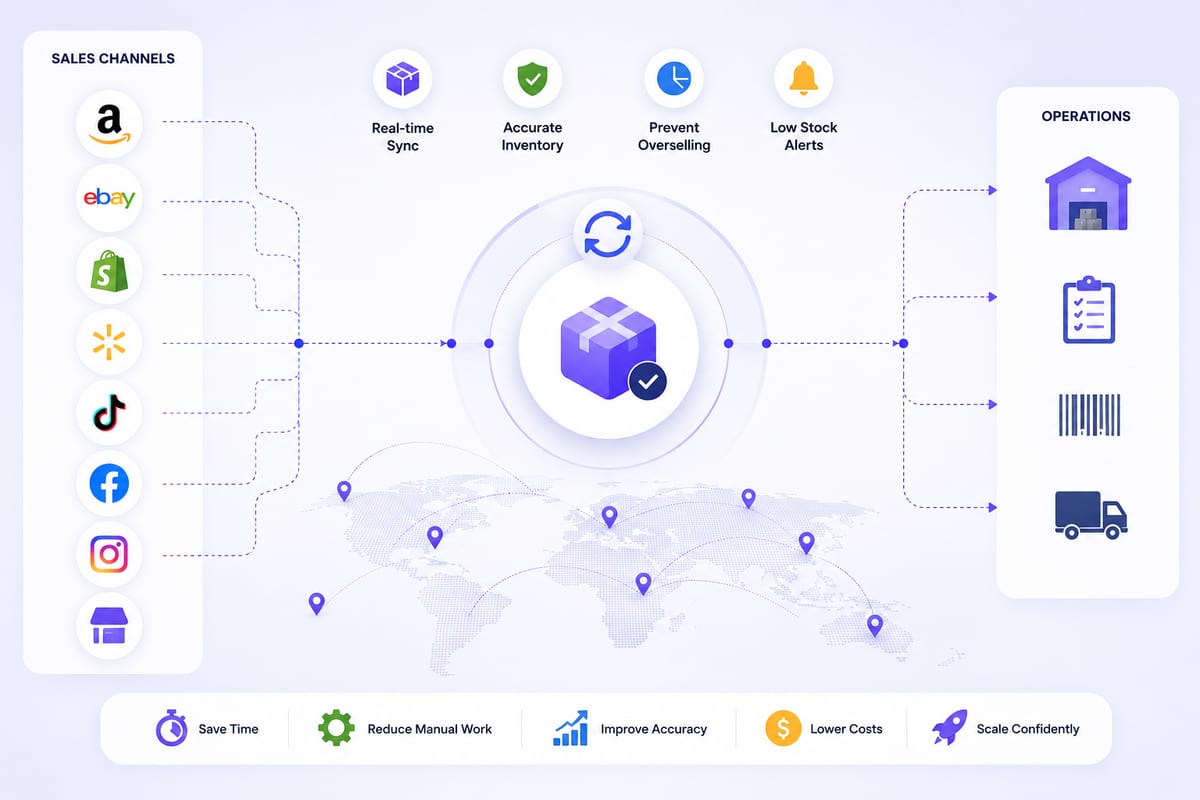
Cross Channel Inventory Management Without the Chaos
Cross channel inventory management for operations running on multiple platforms. The architectural patterns that prevent coordination breakdowns.
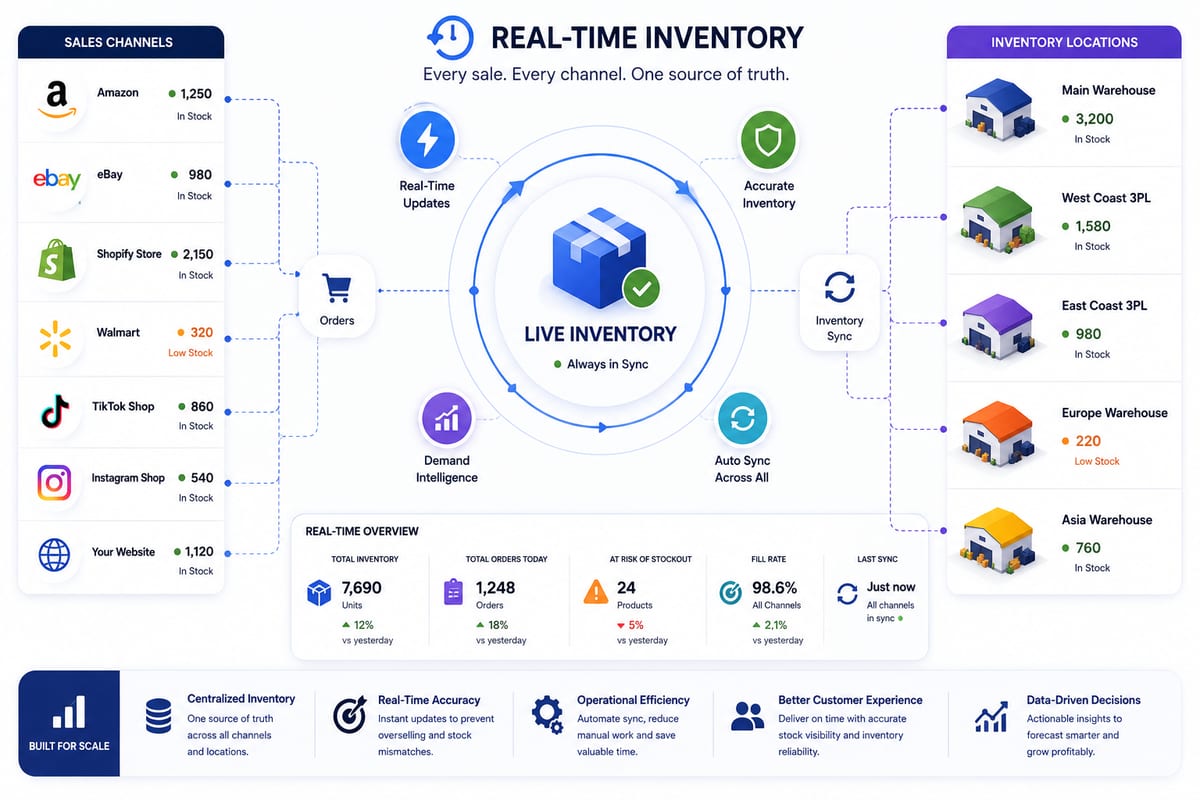
Real Time Inventory Management at Multi-Channel Scale
Real time inventory management requirements for multi-channel ecommerce. The architecture that delivers sub-5-second propagation under load.