Inventory Automation That Actually Saves Operations Time

Inventory automation gets pitched as the universal solution to operational complexity. Vendors promise dramatic time savings, error elimination, and operational excellence. The reality is more nuanced. Some inventory automation categories produce compounding time savings that genuinely transform operations. Other categories produce automation that looks impressive in demos but barely affects real operational labor. The difference matters because operations have limited automation investment capacity and should direct it toward categories with actual returns.
This article walks through which inventory automation categories actually save time, which categories look good but do not compound, and how to evaluate automation investments based on real operational impact rather than demo material.
What Inventory Automation Actually Covers
The phrase covers a wide range of operational tools. At the broadest definition, inventory automation is any software that handles inventory-related work humans would otherwise do manually. That definition is too loose to be useful for planning.
The narrower definition that matters: inventory automation eliminates specific operational tasks that scale with business volume. The work does not grow when sales grow because the software absorbs the load. This is the kind of automation that produces compounding leverage rather than one-time labor savings.
Real inventory automation eliminates:
- Cross-channel inventory sync work that would otherwise scale with channel count
- Order routing decisions that would otherwise require human attention per order
- Refund-restoration processing that would otherwise need manual touches
- Reorder triggering that would otherwise depend on human monitoring
- Stock allocation across channels that would otherwise require manual analysis
- Audit trail creation that would otherwise need manual documentation
Demo automation produces:
- Dashboards that display data without taking action on it
- Reports that aggregate information without surfacing operational triggers
- AI-powered "insights" that require human interpretation and follow-up
- Notification systems that just shift work from one form to another
For broader strategic context, see our ecommerce automation framework on the categories that actually compound.
The Four Inventory Automation Categories That Actually Compound
Across operations measuring automation ROI carefully, four categories consistently produce compounding labor savings.
Category 1: Multi-Channel Inventory Sync Automation
The highest-impact inventory automation category for any operation with multiple sales channels. When stock changes anywhere, every connected channel updates within seconds through automated webhook-driven sync.
The compounding mechanism: manual cross-channel reconciliation scales linearly with channel count and order volume. Automated sync eliminates this scaling burden entirely. Operations adding their fifth channel without automation face dramatically more reconciliation work than operations with automated sync.
According to Cloudflare's documentation on webhooks, event-driven sync handles high-velocity multi-channel inventory automation far more reliably than polling alternatives. The architectural foundation matters as much as the automation itself.
Category 2: Order Routing Automation
When orders arrive, automation decides fulfillment paths based on stock availability, customer location, channel-specific rules, and operational economics. Each routing decision happens in milliseconds without human attention.
The compounding mechanism: routing one order manually takes about a minute. Routing 1,000 orders manually takes 17 hours of focused work. Routing 10,000 orders manually is not possible. Operations automating routing scale order volume without growing fulfillment headcount linearly.
Category 3: Refund and Restoration Automation
Refund processing automatically triggers stock restoration, customer communication updates, and accounting entries without manual touches. The automation handles the routine cases; humans only touch exceptions.
The compounding mechanism: return rates in ecommerce typically run 10 to 30%. Operations without refund automation spend significant team time on routine processing. Automation reduces this to exception handling that scales with operational complexity rather than order volume.
Category 4: Reorder Triggering Automation
When stock levels drop below configured thresholds, automation triggers purchasing workflows automatically. Buyers handle exception cases and large strategic purchases; routine replenishment happens without human attention.
The compounding mechanism: monitoring reorder thresholds across thousands of SKUs manually is impossible. Automation handles the monitoring continuously while humans focus on the strategic purchasing decisions that benefit from human judgment.
The Inventory Automation Categories That Do Not Compound
A few inventory automation categories appear constantly in vendor marketing but produce limited compounding value.
Inventory dashboard automation. Tools that aggregate inventory data into dashboards. Useful for reporting but rarely take operational action on the data. The dashboard does not reduce work; it just visualizes work that still has to happen.
AI demand forecasting automation. Predicts demand patterns. Useful when working but breaks down during volatility (viral products, seasonality changes, supply disruptions). Forecasts often require human interpretation before producing actionable decisions.
Inventory anomaly detection automation. Surfaces unusual patterns that might indicate problems. Useful but requires human investigation per anomaly. Saves analysis time but shifts work rather than eliminating it.
Inventory reporting automation. Generates regular reports automatically. Saves manual report generation but does not eliminate the work of acting on report insights.
These categories are not worthless, they have value. They just do not compound at the same rate as the four high-impact categories. Operations focusing automation investment here see real but limited returns compared to operations focused on high-compounding categories.
How to Prioritize Inventory Automation Investments
For operations evaluating where to invest inventory automation effort, here is the practical priority order.
Priority 1: Multi-channel inventory sync automation. Highest impact for any operation with 2+ channels. Implement before any other inventory automation. The labor savings compound dramatically as channel count grows.
Priority 2: Order routing automation. Second-highest impact for operations with multi-warehouse or 3PL relationships. Single-warehouse operations get less leverage here.
Priority 3: Refund and restoration automation. Third priority for operations with meaningful return rates. Often combined with Priority 1 because restoration depends on sync.
Priority 4: Reorder triggering automation. Fourth priority for operations with predictable demand patterns. More complex operations need humans involved in purchasing decisions.
Lower priorities: Dashboards, AI forecasting, anomaly detection, reporting. Real value but lower compounding impact.
Operations following this priority order produce significantly better automation ROI than operations automating based on vendor pitches. For broader operational framework, see our inventory management reference.
The Architectural Foundation Inventory Automation Requires
Inventory automation only delivers compounding value when the architectural foundation supports it. Three properties separate automation that scales from automation that breaks.
Event-driven foundation. Automation triggered by events (orders placed, stock changed, refunds processed) rather than scheduled jobs. Event-driven automation responds in seconds; scheduled automation has inherent latency.
Comprehensive logging. Every automated action logs with timestamps, source attribution, and replay capability. When automation fails (and it will), the audit trail enables fast diagnosis without slowing operations.
Idempotent operations. Automated actions can run multiple times without producing wrong results. Critical because retry logic and webhook delivery semantics produce duplicate executions in normal operation.
According to Wikipedia's overview of inventory management, centralized data ownership and event-driven propagation are foundational properties of accurate operations at scale, and inventory automation builds on these foundations.
How Nventory Implements Compounding Inventory Automation
Nventory.io handles the highest-impact inventory automation categories, multi-channel sync, order routing, and refund-restoration, through a unified webhook-driven platform. The architecture is event-driven, comprehensively logged, and idempotent by design.
The platform connects WooCommerce, Shopify, and other storefronts to Amazon, eBay, Walmart, TikTok Shop, Etsy, and 30+ other channels. Sync propagation completes in under 5 seconds. Order routing handles multi-warehouse and channel-specific rules. Refund workflows trigger stock restoration automatically.
For WordPress and WooCommerce stores, download Nventory free from WordPress.org. For Shopify operations, install Nventory from the Shopify App Store. Both versions implement the same automation architecture.
The free tier includes the core inventory automation functionality without subscription cost. Paid tiers add advanced routing logic for operations with specific multi-warehouse or fulfillment workflows. The labor savings from Priority 1 and Priority 2 automation typically pay for any paid tier subscription within the first month.
For broader operational context, see how inventory automation connects to inventory tracking, the tracking layer surfaces issues that automation addresses.
Common Inventory Automation Mistakes
A few patterns to avoid when planning automation programs.
Automating before standardizing. Automation amplifies what already exists. Automating chaotic workflows produces faster chaos. Standardize SKUs, processes, and rules before automating them.
Picking automation tools based on AI marketing. AI capability is useful for some categories but produces limited returns in core inventory automation. Webhook-driven sync produces more value than AI-powered dashboards for most operations.
Automating low-impact categories first. It is tempting to start with dashboards because they are easy. But the compounding leverage lives in higher-priority categories.
Skipping the failure-mode planning. Every automation will fail occasionally. Plan how failures surface to operators, how recoveries work, and what manual fallbacks exist.
Underestimating the architectural foundation. Automation built on weak foundations produces brittle systems. Invest in the architectural foundation first.
Final Thoughts
Inventory automation that actually saves operations time lives in four specific categories: multi-channel sync, order routing, refund-restoration, and reorder triggering. Most other automation categories produce limited compounding value despite vendor marketing. Operations prioritizing automation investment based on compounding potential produce dramatically better ROI than operations automating based on what looks impressive. The architectural foundation determines whether automation delivers on its promise.
If you want to implement the highest-impact inventory automation categories on a platform built around the right architecture, install Nventory on your platform of choice. For WordPress and WooCommerce stores, download Nventory free from WordPress.org. For Shopify stores, install Nventory from the Shopify App Store. Visit nventory.io to review platform capabilities for inventory automation.
Frequently Asked Questions
Multi-channel inventory sync automation for operations selling on 2+ channels. The labor savings compound dramatically as channel count grows. Nventory implements this, available on WordPress.org and the Shopify App Store.
For operations implementing the four high-compound categories correctly: typically 15 to 40 hours of operational labor per week eliminated as channel count and order volume grow. The savings compound over time as the business scales.
Yes, selectively. Single-channel operations under 100 orders/day benefit most from refund automation. Multi-channel operations need sync automation from day one.
AI demand forecasting and inventory dashboards. Both produce real value but require human interpretation and follow-up. The compounding labor savings are smaller than vendor marketing implies.
Yes, when the architecture supports it. The free Nventory tier handles core multi-channel inventory automation without subscription cost.
For Priority 1 automation: typically 30 days to show clear labor savings. For Priority 2 and 3: 60 to 90 days. For lower priorities: often 6+ months or never, depending on operational fit.
Related Articles
View all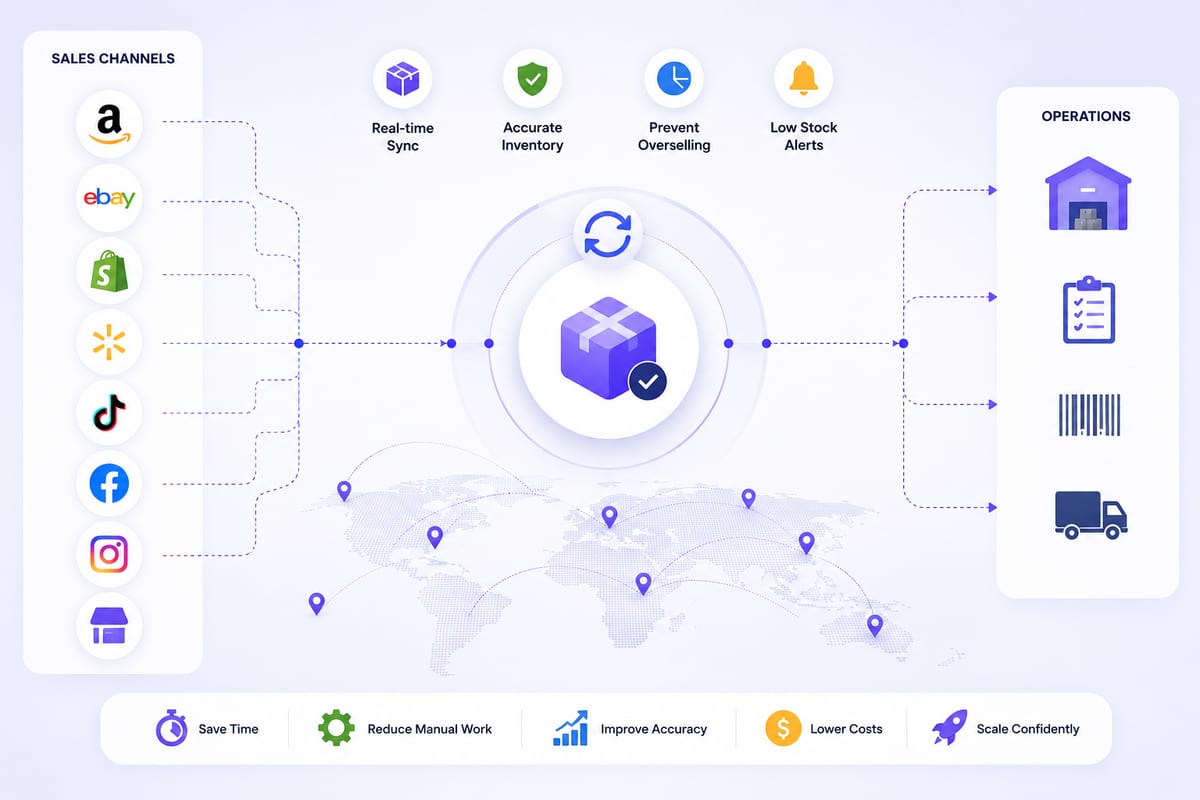
Cross Channel Inventory Management Without the Chaos
Cross channel inventory management for operations running on multiple platforms. The architectural patterns that prevent coordination breakdowns.
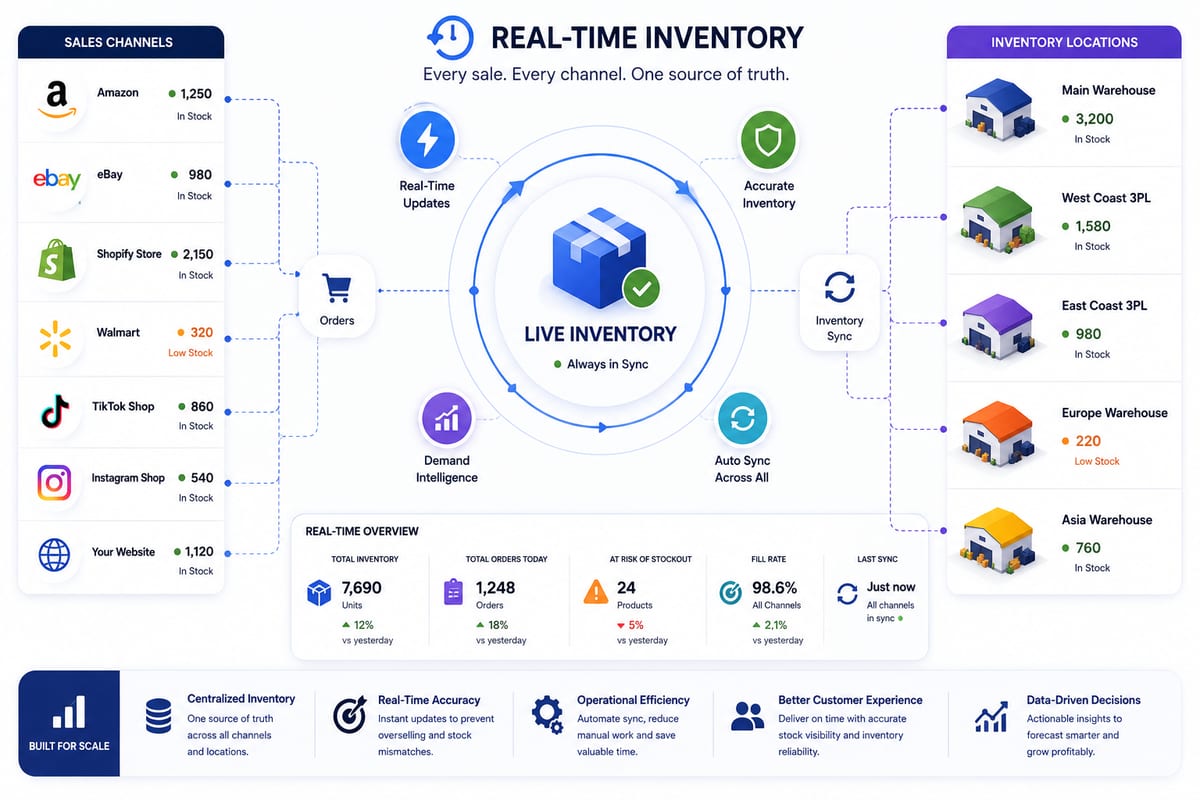
Real Time Inventory Management at Multi-Channel Scale
Real time inventory management requirements for multi-channel ecommerce. The architecture that delivers sub-5-second propagation under load.
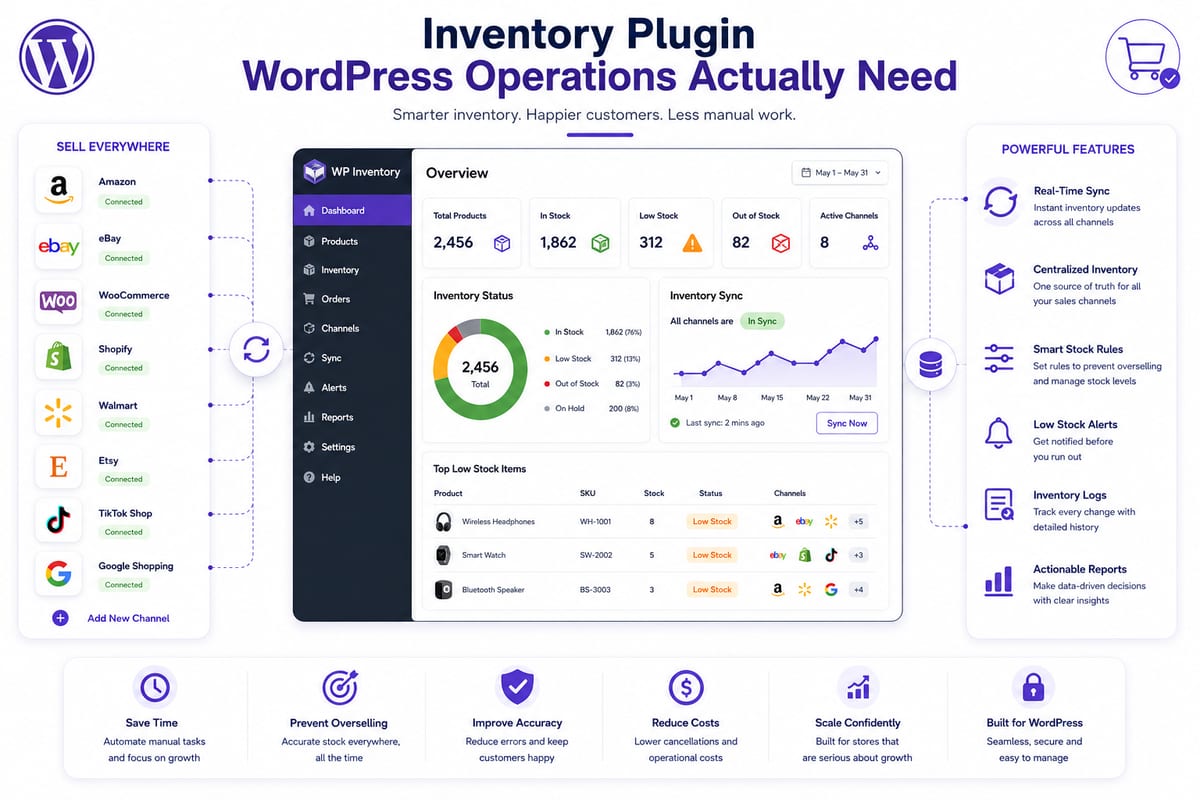
Inventory Plugin WordPress Operations Actually Need
Inventory plugin WordPress comparison for serious WooCommerce stores. The architectural properties that scale past the WordPress plugin stack ceiling.