Inventory Management: The Complete Operational Reference
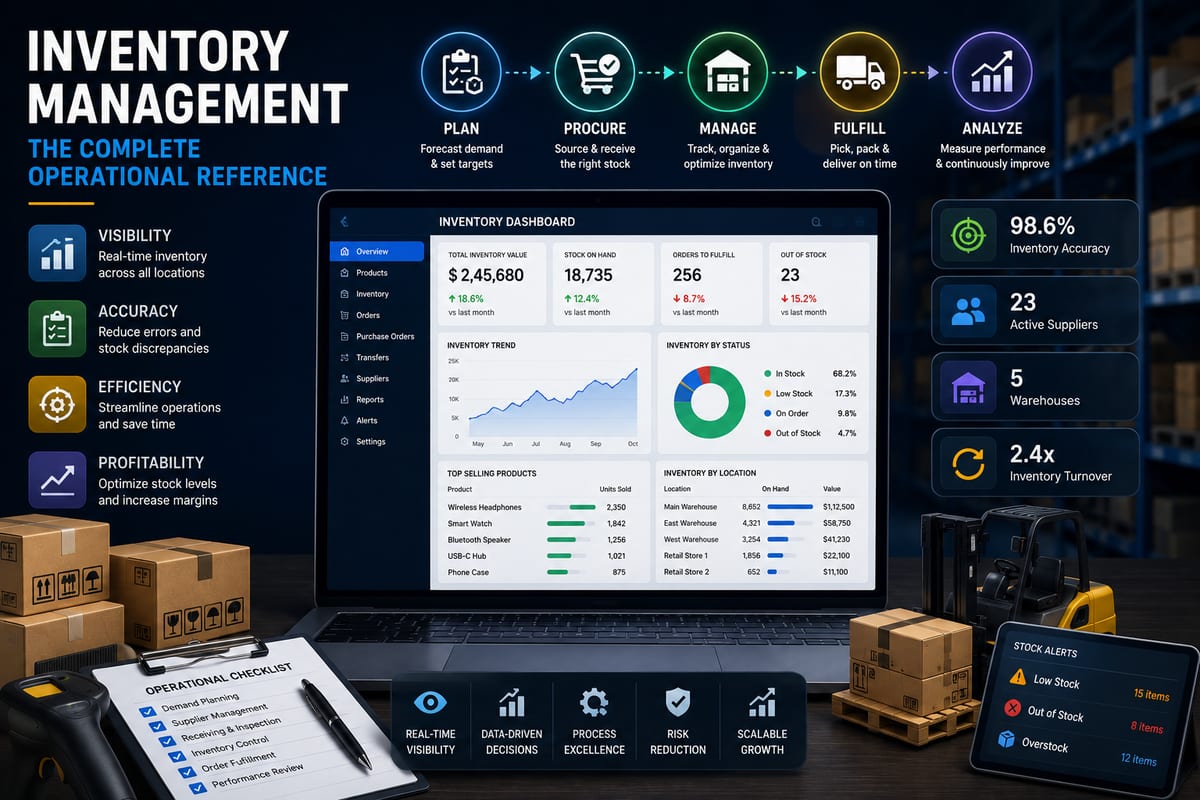
Inventory management is one of those disciplines that sounds simple in the abstract and reveals its complexity only in practice. Track what you have, know when to reorder, prevent overselling. Three sentences cover the basic theory. The operational reality is that brands spend years trying to get inventory management right and most never fully do. The brands that scale through that complexity share specific architectural and operational patterns. The brands that stall share the opposite patterns.
This article is a complete reference for inventory management as it actually works in 2026 ecommerce operations. It covers the conceptual foundation, the architectural patterns that scale, the operational practices that compound over time, and the specific decisions that separate successful brands from the ones still fighting fires.
What Inventory Management Actually Means
The discipline of inventory management covers several distinct sub-disciplines that often get conflated in vendor marketing.
Stock tracking. Knowing how many units of each SKU you have at any moment. The foundation everything else builds on.
Demand forecasting. Predicting how much you will sell of each SKU over future periods. Required for purchasing decisions, allocation planning, and operational sizing.
Replenishment planning. Deciding when to reorder each SKU, in what quantities, from which suppliers, to which locations. The operational layer that connects forecasting to purchasing.
Multi-channel synchronization. Keeping stock counts consistent across every channel where you sell. The fastest-growing complexity area for modern ecommerce.
Order fulfillment routing. Deciding which warehouse or fulfillment partner ships each order based on stock availability, customer location, and channel-specific rules.
Returns and reverse logistics. Processing returns back into available inventory correctly, including damaged goods handling and refund-restoration accuracy.
Different inventory management tools handle different subsets of these. Generic "inventory management software" usually means the first one and maybe the second. Production-grade inventory management for multi-channel ecommerce requires all six working together.
Why Inventory Management Is Different for Ecommerce
Inventory management theory originated in industrial supply chains where lead times measure in weeks, demand changes slowly, and reconciliation happens monthly. Ecommerce inventory management operates under fundamentally different conditions.
Lead times measure in seconds, not weeks. When a customer adds a product to cart, decisions about availability need to happen instantly. Stock data that is hours old produces overselling.
Demand changes hourly during volatility. A TikTok video, an Amazon featured placement, an influencer mention can spike demand by 100x in minutes. Forecasting models built for stable demand fail completely.
Reconciliation needs to be continuous. Monthly inventory counts work for industrial operations. Ecommerce needs continuous reconciliation between channels because drift accumulates within days, not months.
Cancellation costs are non-linear. Industrial buyers tolerate occasional fulfillment issues. Ecommerce customers leave reviews, request refunds, and damage marketplace metrics. The cost of one cancellation is measurable in customer lifetime value, not just the refund amount.
Multi-channel coordination becomes mandatory. Industrial operations typically supply through one or two distribution channels. Ecommerce operations supply through 3 to 8 channels simultaneously, each with different update mechanics and tolerances.
These differences mean ecommerce inventory management requires architectural approaches that traditional inventory management theory does not address. The brands that recognize this design their operations around ecommerce-native patterns. The brands that do not try to force industrial models onto ecommerce reality and struggle predictably.
The Architectural Foundation That Scales
Successful ecommerce inventory management at scale shares a small set of architectural properties. These properties predict business outcomes more reliably than which specific tools a brand uses.
Centralized data ownership. One system owns the canonical stock count for every SKU. According to Wikipedia's overview of inventory management, centralized data ownership across distributed sales channels is foundational to operational accuracy. Brands that stack channel-specific tools without a canonical layer create the structural drift that breaks operations.
Event-driven synchronization. When anything changes anywhere, all relevant systems know within seconds. Polling-based sync at 5 to 15 minute intervals does not scale to modern ecommerce velocity. For the architectural deep-dive, see our ecommerce inventory software guide.
Variation-level granularity. Each variant tracked as its own SKU. Brands selling configurable products break tools that aggregate at the parent level.
Native channel integrations. Direct API connections to each channel rather than middleware-routed integrations. Middleware adds latency and failure points.
Audit trails. Every event logs with timestamps, source attribution, and replay capability. When something fails at scale, the audit trail is the only diagnostic tool.
Buffer stock as default. 1 to 3 units reserved per SKU as a safety net against brief sync gaps. The simplest, cheapest oversell prevention technique.
Operations with all six properties scale cleanly. Operations missing two or more struggle predictably. The properties are knowable in advance, brands that adopt them early avoid the structural problems that emerge when operations expand without architectural foundation.
Inventory Management Through the Three Stages of Growth
Brands progress through three distinct stages of inventory management maturity as they scale. Each stage has predictable characteristics and predictable transition points.
Stage 1: Manual Operations (Revenue Under $500K)
The brand runs on simple tools, native storefront inventory, basic spreadsheets, occasional manual reconciliation. The founder or a single operations person handles inventory work directly.
This stage works when the operation is small enough that human attention can absorb the coordination overhead. Single-channel brands or brands with two channels and low order volume can run successfully on Stage 1 setups for years.
The stage transitions when adding channels or growing order volume overwhelms manual coordination capacity.
Stage 2: Stacked Tooling (Revenue $500K-$3M)
The brand has added channels and addressed each with specialized tools. Multiple inventory plugins, channel-specific connectors, and standalone reporting tools have accumulated. The operations team handles cross-tool coordination.
This stage produces operational pain. Plugin conflicts produce stock drift. Manual reconciliation becomes weekly. Peak seasons create cancellation cascades. Most brands get stuck in Stage 2 for 12 to 24 months before recognizing that the structural problem requires architectural change rather than more tools.
This is also where multichannel ecommerce operations typically hit their limits and need consolidation.
Stage 3: Unified Operations (Revenue $3M+)
The brand consolidated to a unified inventory management platform that owns the canonical layer across all channels. Stacked tools were eliminated. Operational discipline became architectural rather than manual.
This stage is where serious ecommerce inventory management actually lives. Operations team time drops dramatically. Peak seasons run cleanly. The team can focus on growth rather than fighting operational fires.
The transition from Stage 2 to Stage 3 is the highest-leverage operational decision growing brands make. It typically happens after a triggering event (peak season disaster, account suspension, or growth ceiling realization) makes the structural problem undeniable.
The Operational Practices That Compound Over Time
Beyond architecture, brands that scale share specific operational practices. These practices look simple individually but compound into significant operational advantage over time.
SKU standardization. Consistent SKU naming across every channel, applied before connecting any sync tool. This single practice prevents most inventory management failures.
Staging-first testing. Inventory plugins and apps tested on staging environments before production deployment. Catches integration issues before customers do.
Pre-peak monitoring setup. Low-stock alerts, sync failure notifications, and webhook health checks configured before peak season rather than during the first crisis.
Monthly reconciliation. Physical inventory against system inventory compared monthly even with reliable real-time sync. Catches drift before it compounds.
Quarterly process review. Operational workflows audited quarterly for waste, automation opportunities, and accumulated technical debt.
Annual platform evaluation. The inventory platform evaluated annually against current needs and alternative options. Prevents lock-in that compounds over time.
Brands that practice these habits consistently outperform brands that practice them sporadically by an order of magnitude over multi-year periods.
How Nventory Implements the Architectural Patterns
Nventory.io is built around the six architectural properties that define Stage 3 inventory management. The platform serves as the centralized data ownership layer for multi-channel ecommerce operations.
Sync is webhook-driven with sub-5-second propagation. According to Cloudflare's documentation on webhooks, event-driven sync handles high-velocity inventory changes far more reliably than polling-based alternatives. Variations track at the SKU level. Native integrations connect to 30+ channels including WooCommerce, Shopify, BigCommerce, Amazon, eBay, Walmart, TikTok Shop, Etsy, and others.
For WordPress and WooCommerce stores, download Nventory free from WordPress.org. For Shopify operations, install Nventory from the Shopify App Store. Both versions connect to the same multi-channel platform with the same architectural properties.
The free tier includes the core multi-channel inventory management functionality without subscription cost. Setup takes about 10 minutes for the first channel. Paid tiers add multi-warehouse routing, advanced fulfillment workflows, and priority support for operations that need them.
How to Audit Your Current Inventory Management
Before evaluating new inventory management approaches, audit your current operation against the six architectural properties.
Audit 1: Centralized ownership. List every system that currently writes to inventory data. If the count is more than 2, you have decentralized ownership. Stack drift is accumulating somewhere even if you cannot see it.
Audit 2: Sync architecture. Identify whether your current sync is webhook-driven or polling-based. Polling at intervals longer than 5 minutes is structurally inadequate for serious multichannel operations.
Audit 3: Variation handling. Test on staging: sell out one variation of a variable product and verify every channel reflects the change. Tools that fail this test should be replaced.
Audit 4: Integration depth. Verify which of your channel integrations are native API connections versus middleware-routed. Middleware integrations have lower reliability.
Audit 5: Audit trail accessibility. Try to find a clear record of a specific stock change from last week. If you cannot, your logging is inadequate.
Audit 6: Buffer stock configuration. Check whether your operation has buffer stock configured on any SKUs. If not, you are missing the cheapest oversell prevention technique available.
A complete audit takes about 90 minutes and reveals two or three categories of structural problems in most operations. Those problems are what better inventory management exists to solve.
When Plugins Stop Being Enough
There is a point where plugin-based inventory management hits a ceiling no individual plugin can break through. The signals are specific:
- 5,000+ SKUs across 4+ channels
- Multi-warehouse operations with 3PL relationships
- Compliance requirements (lot tracking, batch records, expiration dates)
- Demand forecasting becoming a strategic priority
- Cross-functional teams (purchasing, fulfillment, accounting) needing shared access
- Annual revenue past $5M
At this scale, inventory management should be the system of record, with storefronts as connections rather than masters. Modern platforms like Nventory are designed for this transition without forcing a rebuild, the architecture supports growth from small multi-channel operations through to enterprise-scale deployments. This is also where adjacent disciplines like warehouse management become important alongside inventory management.
Final Thoughts
Inventory management for ecommerce in 2026 is fundamentally an architectural discipline more than a tool selection. The brands that scale share six specific architectural properties, centralized data ownership, event-driven sync, variation granularity, native integrations, comprehensive audit trails, and buffer stock as default. The brands that stall share the opposite patterns. The transition from manual operations through stacked tooling to unified operations is the predictable growth path, and the timing of each transition matters more than the specific tools chosen.
If you are at the operational point where current inventory management has hit its limits and you want to test a platform built around the six architectural properties, install Nventory on your platform of choice. For WordPress and WooCommerce stores, download Nventory free from WordPress.org. For Shopify stores, install Nventory from the Shopify App Store. Visit nventory.io to review platform architecture and integration documentation.
Frequently Asked Questions
Stock management focuses primarily on quantity tracking. Inventory management covers the broader discipline including stock tracking, demand forecasting, replenishment planning, multi-channel sync, fulfillment routing, and returns handling.
Platforms with the six architectural properties, centralized ownership, event-driven sync, variation granularity, native integrations, audit trails, buffer stock. Nventory implements these, available on WordPress.org and the Shopify App Store.
Sub-5-second propagation is the modern standard for serious multi-channel operations. Polling at 5 to 15 minute intervals creates overselling risk during peak periods.
Small single-channel operations can run on native storefront inventory tools. Inventory management software becomes necessary at the Stage 1 to Stage 2 transition, typically when adding a second sales channel.
Yes, when the architecture is right. Real free tiers from architecturally serious vendors handle scaling operations. The free Nventory plugin on WordPress.org is one example.
When you cross 1,000 SKUs, add a third sales channel, hit 4+ hours of weekly reconciliation, or experience your first significant overselling incident. Any of these signals indicates Stage 2 has reached its operational limit.
Related Articles
View all
Inventory Automation That Actually Saves Operations Time
Inventory automation for ecommerce operations past manual reconciliation. The categories that produce compounding labor savings at scale.
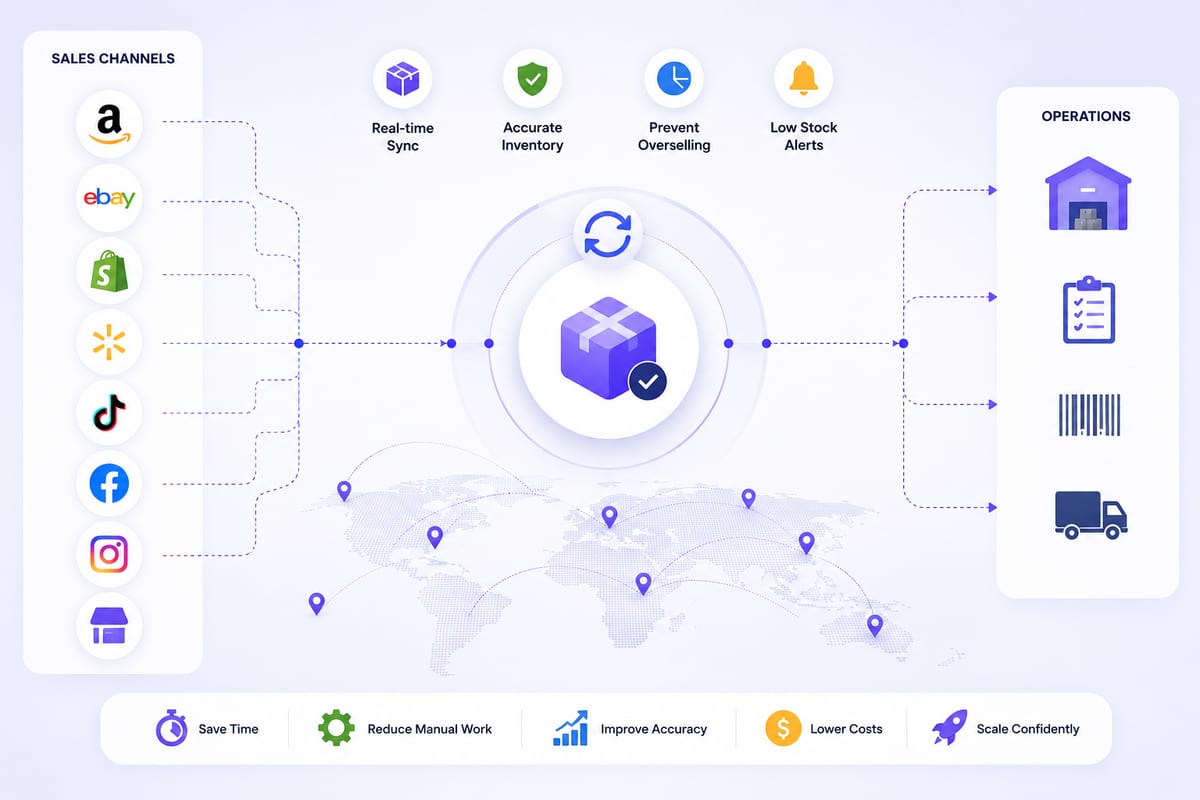
Cross Channel Inventory Management Without the Chaos
Cross channel inventory management for operations running on multiple platforms. The architectural patterns that prevent coordination breakdowns.
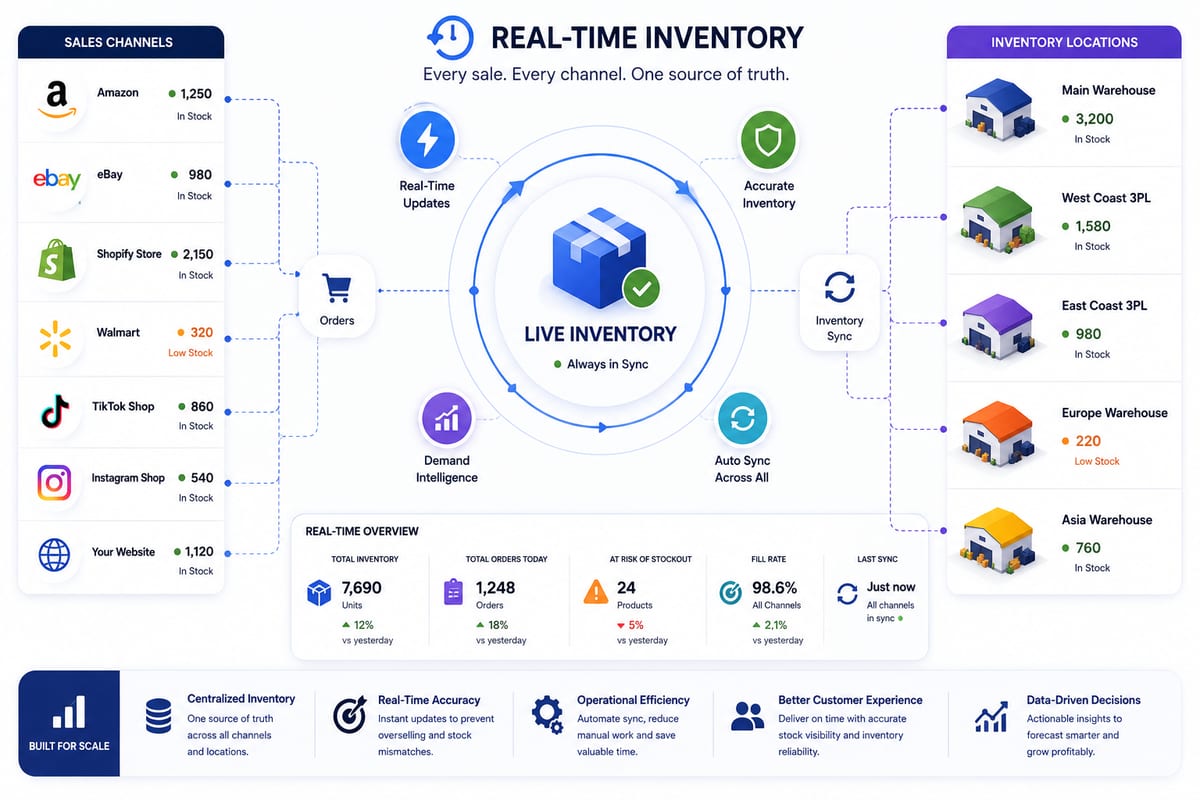
Real Time Inventory Management at Multi-Channel Scale
Real time inventory management requirements for multi-channel ecommerce. The architecture that delivers sub-5-second propagation under load.