Ecommerce Inventory Software That Earns Its Cost

Most ecommerce inventory software is sold on features. Real-time sync, multi-channel support, variation tracking. The features matter, but they are not what determines whether the software is worth the subscription. The actual question, the one founders should ask before any discussion of features, is simpler: does this ecommerce inventory software pay back more than it costs? Most tools do not. The ones that do share a small set of architectural properties that are not visible from feature lists alone.
This article walks through the honest math of ecommerce inventory software ROI, what determines whether a tool earns its subscription, and how to evaluate options based on actual returns rather than feature breadth.
The Real Math of Ecommerce Inventory Software ROI
An ecommerce inventory software subscription costs money. The ROI calculation needs to compare that cost against the savings the software produces. Most founders skip the comparison and end up either paying for tools they do not fully use or staying on cheap tools that cost more in hidden ways.
Three categories of savings determine whether ecommerce inventory software earns its cost.
Labor savings. Time your team currently spends on manual inventory work, reconciliation, count adjustments, order routing, stock auditing, that the software automates. This is usually the largest category and the most underestimated.
Lost sale prevention. Revenue from sales that would have been lost to incorrect stockouts. Sample your last 90 days of products that went falsely out of stock and project the lost revenue.
Cancellation cost reduction. Refunds, customer service hours, marketplace penalties, and review damage from oversold orders. This category is hardest to quantify but often the largest in operations with cross-channel inventory drift.
The math for any ecommerce inventory software is: (labor savings + lost sale prevention + cancellation cost reduction) versus subscription cost. Tools that earn their subscription deliver more than they cost across the three categories combined.
What Determines Whether a Tool Actually Earns Its Cost
Three architectural and operational properties determine whether ecommerce inventory software actually delivers ROI in practice.
1. Labor Compression Coefficient
How much manual work does the software actually eliminate? Tools with weak automation produce small labor savings. Tools with strong automation can eliminate 10+ hours of weekly reconciliation work.
The variable: webhook-driven sync vs polling-based sync. Polling-based tools require constant manual review to catch what they miss. Webhook-driven tools run hands-off. For a deeper look at how real-time event-driven sync architecture works, see our guide on inventory sync. According to Cloudflare's documentation on webhooks, event-driven architectures eliminate the manual review burden that polling architectures create.
2. Oversell Prevention Effectiveness
How reliably does the software prevent overselling? Tools without buffer stock configuration, variation-level tracking, or sub-5-second sync produce regular oversells regardless of marketing claims.
The variable: integrated buffer stock + variation-level tracking + webhook sync. Tools missing any of these produce oversells that destroy the cancellation cost savings the subscription was supposed to deliver. This is especially important for multichannel ecommerce operations where the same SKU lives on multiple channels simultaneously.
3. Migration and Lock-In Cost
What is the long-term cost of staying on the tool? Tools with limited data export options, closed APIs, and proprietary data formats become expensive prisons. The cost shows up at migration time.
The variable: data portability and clean APIs. Tools that lock data are storing future migration costs that are not visible in the monthly subscription.
According to Wikipedia's overview of inventory management, data ownership across distributed systems is foundational to operational independence. Tools that violate this principle have hidden costs that show up later.
What Ecommerce Inventory Software That Does Not Earn Its Cost Looks Like
The patterns are predictable.
Tools with polling-based sync at 5 to 15 minute intervals require manual oversight to catch what the polling misses. The labor savings are small because operators still need to monitor for issues.
Tools that track stock at the parent product level let variation oversells through. The cancellation cost savings are smaller than the subscription cost because oversells continue.
Tools with weak audit trails make problem diagnosis dependent on vendor support. Slow support means slow resolution, which means continuing operational losses.
Tools without buffer stock configuration accept some level of oversell as inevitable. Operators absorbing oversells offset the subscription with cancellation costs.
Tools with closed data architectures lock in operators despite poor performance because migration cost outweighs continuing pain. Subscriptions continue paying for tools that have stopped delivering value.
The pattern: tools that do not earn their subscription tend to have architectural deficiencies that look like minor compromises during evaluation but compound into ROI failure over time.
What Ecommerce Inventory Software That Earns Its Subscription Looks Like
The pattern reverses for tools that deliver real ROI.
Webhook-driven sync with sub-5-second propagation eliminates the labor cost of manual oversight. Operators check the dashboard occasionally rather than reconciling weekly.
Variation-level tracking with buffer stock configuration prevents the cross-channel oversell scenarios that produce most cancellation costs. Oversell rates approach zero rather than 1 to 3%.
Comprehensive audit trails enable operators to diagnose and resolve issues without dependency on vendor support. Resolution times drop from days to minutes.
Native channel integrations with retry logic eliminate the silent failure modes that polling architectures create. The labor savings compound over time as operators stop spot-checking sync accuracy.
Open data architectures preserve future migration options. Operators stay because the tool delivers, not because they are locked in.
Tools with all five properties typically deliver 5 to 10x their subscription cost in combined savings across the three categories. For a deeper look at how these properties apply specifically to inventory management generally, see our inventory management pillar guide.
How Nventory Calculates on the Subscription Math
Nventory.io is built around the architectural properties that make ROI possible. Webhook-driven sync with sub-5-second propagation. Variation-level tracking. Buffer stock configuration. Native integrations to 30+ channels. Comprehensive audit logging. Open data architecture.
For the free tier specifically, the subscription math is simple, there is no subscription. The tool delivers the labor savings, oversell prevention, and lock-in protection without monthly cost. Most stores running the free tier reclaim 4 to 8 hours of weekly reconciliation labor and approach zero overselling rates within a month of full deployment.
For WordPress and WooCommerce stores, download Nventory free from WordPress.org. For Shopify operations, install Nventory from the Shopify App Store. Both versions connect to the same multi-channel platform with the same architectural properties.
Paid tiers add multi-warehouse routing, advanced fulfillment workflows, custom reporting, and priority support. The subscription math at paid tiers depends on whether your operation actually uses those advanced features. Operations that need them get clear ROI; operations that do not should stay on the free tier rather than paying for unused capability.
How to Calculate ROI for Your Operation
Before committing to any ecommerce inventory software, run this calculation for your specific situation.
Step 1: Measure your current labor cost. Track your team's actual inventory work for one week. Hours per week x hourly cost x 52 = annual labor spend on inventory.
Step 2: Calculate your overselling cost. Pull 90 days of cancellations caused by inventory issues. Refunded revenue + 20% soft costs (customer service time, marketplace penalties, review damage) = annualized overselling cost.
Step 3: Estimate your lost sale cost. Sample 10 SKUs that went falsely out of stock in 90 days. Average sales velocity x stockout duration x profit margin = lost revenue. Project across catalog.
Step 4: Add the three categories. Labor + overselling + lost sales = total annual cost of current setup.
Step 5: Compare to subscription cost. If a tool costs $99/month ($1,188/year), it needs to deliver more than $1,188 in savings to earn its subscription.
For most growing ecommerce stores running stacked plugins, the current cost calculation produces numbers in the $5K to $30K annual range. Subscription costs of $50 to $200/month are easily justified by 50%+ compression on those numbers.
Common Mistakes in the ROI Calculation
A few patterns to avoid.
Underestimating labor. Founders consistently underestimate their team's reconciliation hours by 50 to 70%. Track for one full week, no shortcuts.
Ignoring soft costs. Customer service time, marketplace penalty risk, and review damage all count. Hard costs alone undercount the full impact.
Comparing against vendor claims instead of own data. Vendor claims are best-case marketing. Your data is real. Calculate against your actuals.
Not accounting for migration cost. If you are switching tools, the migration cost in time and risk should be included in the comparison.
Assuming all tools deliver equal savings. Tools without webhook-driven sync, variation handling, or buffer stock configuration deliver less than their marketing implies. Calculate based on actual capabilities.
Final Thoughts
Ecommerce inventory software earns its subscription when it delivers more value across labor savings, oversell prevention, and lock-in protection than it costs. Most tools do not, because architectural deficiencies that look like minor compromises during evaluation compound into ROI failure over time. The tools that do earn their subscription share a small set of architectural properties that do not appear in feature comparisons but determine real-world impact.
If you want to test ecommerce inventory software built around the architectural patterns that produce real ROI, install Nventory on your platform of choice. For WordPress and WooCommerce stores, download Nventory free from WordPress.org. For Shopify stores, install Nventory from the Shopify App Store. Visit nventory.io to compare integrations and learn more about the platform.
Frequently Asked Questions
Tools with webhook-driven sync, variation-level tracking, buffer stock configuration, comprehensive audit trails, and open data architecture. Nventory is one example built around these properties, available on WordPress.org and the Shopify App Store.
Measure current labor cost, overselling cost, and lost sale cost separately, then compare the total to subscription pricing. Tools that compress 50%+ of the current cost are usually worth the subscription.
Architectural deficiencies that look like minor compromises during evaluation compound into ROI failure over time. Polling-based sync, parent-level tracking, and closed data architectures all reduce real-world savings.
Yes, when the architecture is right. Real free tiers with proper architectural patterns deliver the labor savings and oversell prevention without the subscription cost.
No. Cheap tools with weak architectures often have higher total cost when migration costs and continuing operational losses are factored in.
For tools with strong architectures, savings typically appear within 30 days. Labor compression shows up first; oversell prevention takes a full peak season cycle to fully demonstrate.
Related Articles
View all
Inventory Automation That Actually Saves Operations Time
Inventory automation for ecommerce operations past manual reconciliation. The categories that produce compounding labor savings at scale.
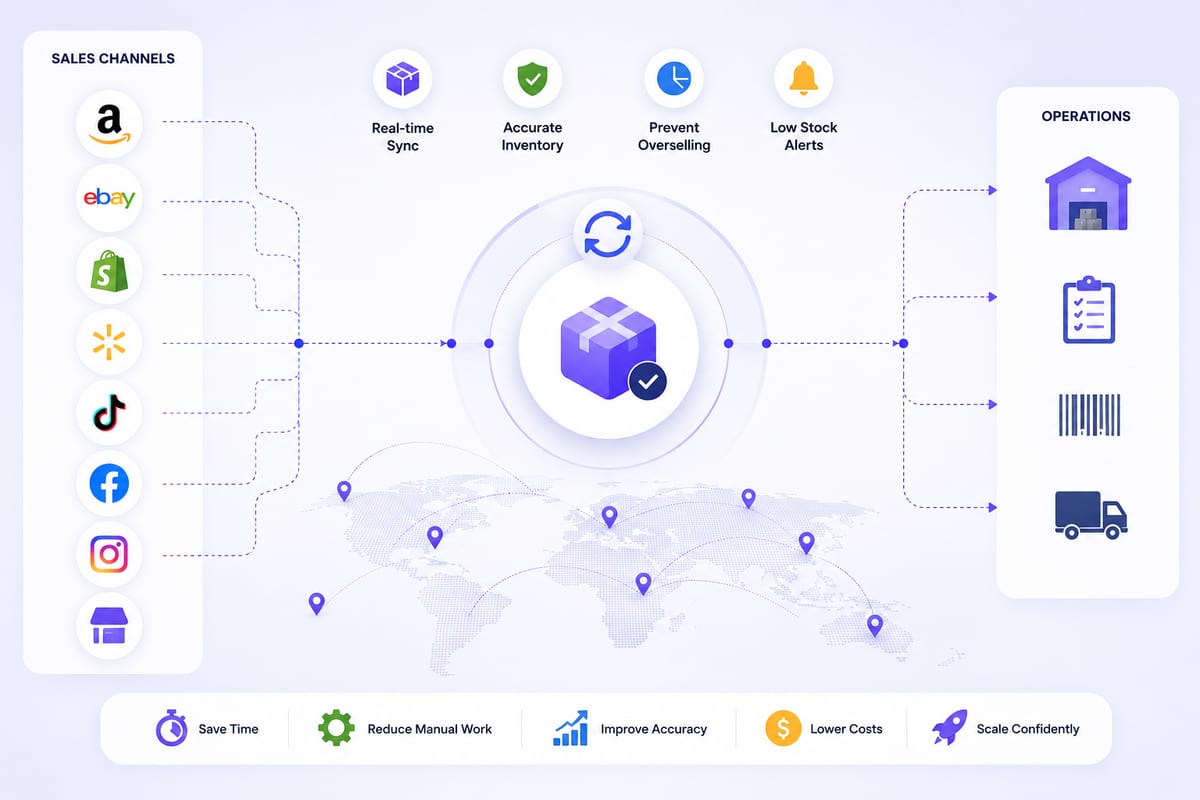
Cross Channel Inventory Management Without the Chaos
Cross channel inventory management for operations running on multiple platforms. The architectural patterns that prevent coordination breakdowns.
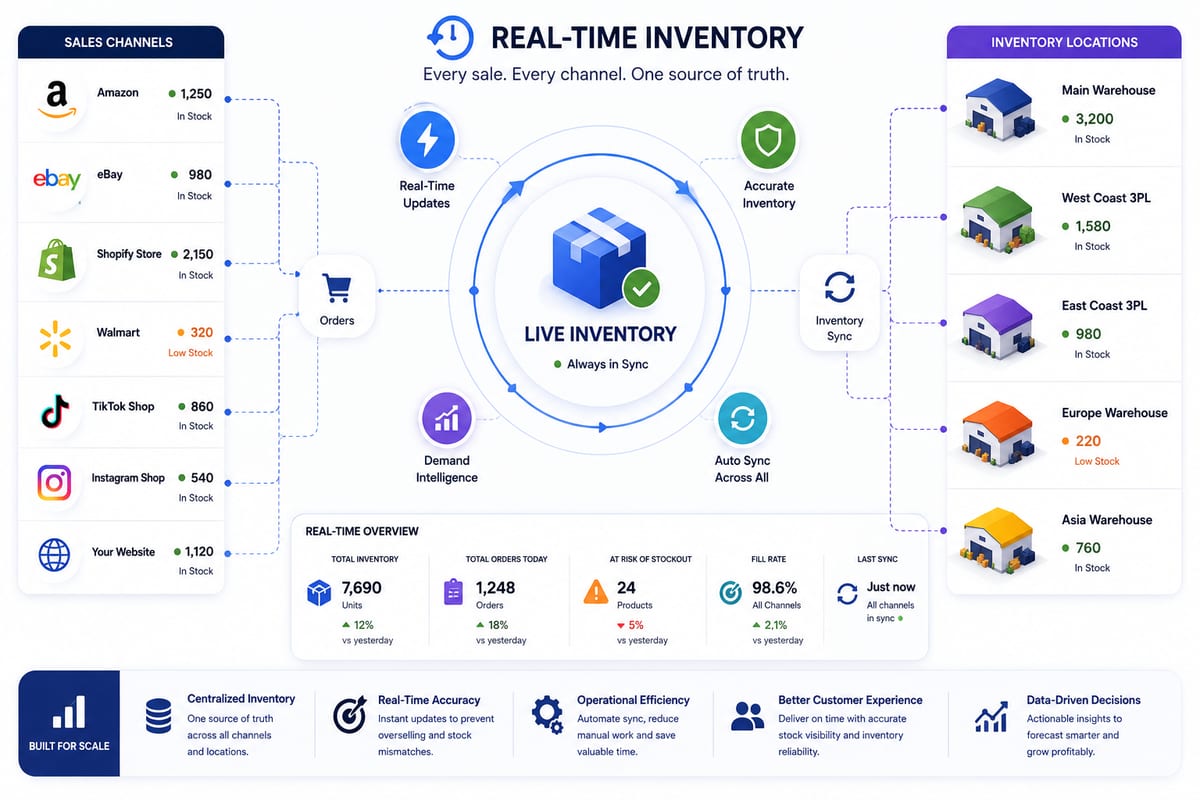
Real Time Inventory Management at Multi-Channel Scale
Real time inventory management requirements for multi-channel ecommerce. The architecture that delivers sub-5-second propagation under load.