Warehouse Management for Multi-Channel Operations
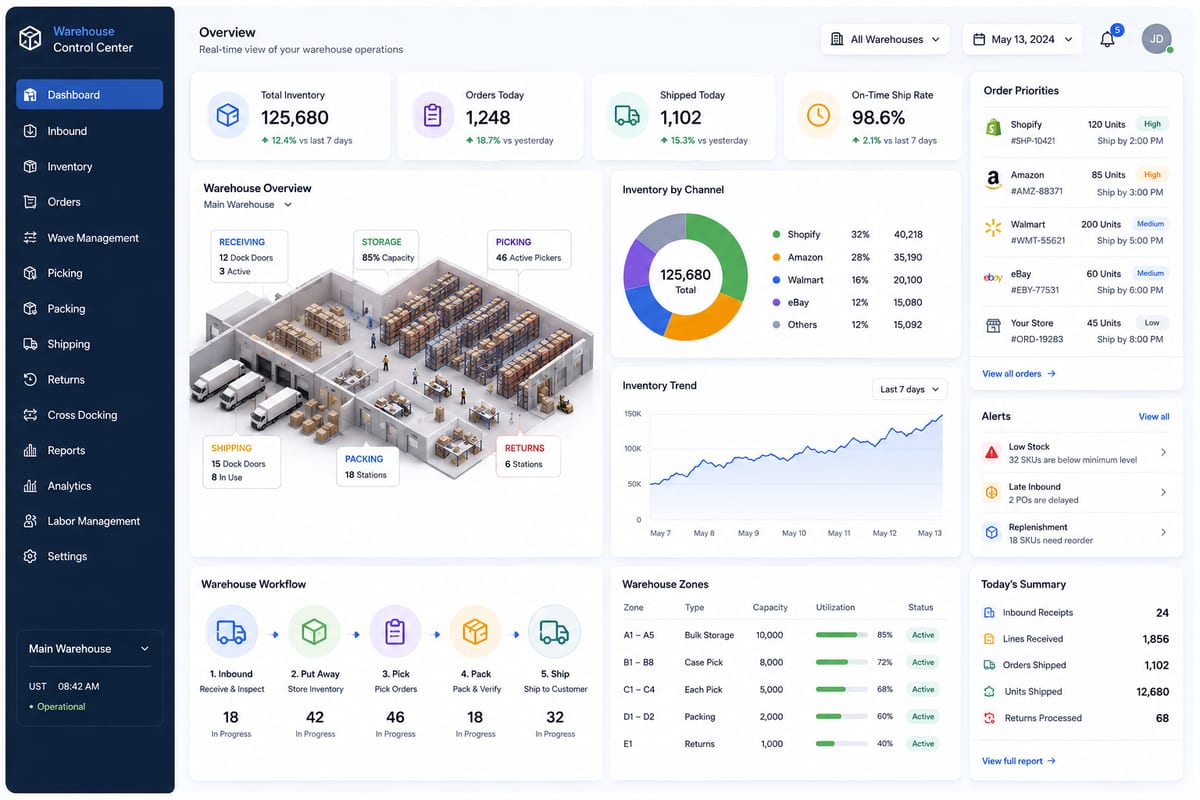
Warehouse management used to be a specialized discipline running on dedicated software, isolated from the rest of operational systems. Stock came in, stock got picked, stock went out. The warehouse worked on its own clock with its own data, and reconciliation happened on whatever cadence the operation could sustain. That model worked when warehouses supplied one or two channels with predictable demand patterns. It breaks down completely in modern multi-channel ecommerce operations where the same warehouse might supply five storefronts and three marketplaces simultaneously, with order volume spiking unpredictably across all of them.
This article walks through what warehouse management actually requires in multi-channel operations, the architectural patterns that connect warehouses to the rest of the operational stack cleanly, and the practical decisions that separate well-run operations from chaotic ones.
What Modern Warehouse Management Has to Do
The core function of warehouse management is physical stock coordination, receiving inventory, organizing it, picking orders, shipping orders, and managing returns. In multi-channel ecommerce operations, this core function gets extended by several connecting requirements.
Channel-aware allocation. Different channels may have different stock pools, fulfillment priorities, or shipping commitments. Warehouse management needs to understand which physical stock supplies which channel.
Real-time availability publishing. Every channel that sells from this warehouse needs to know current availability in seconds, not hours. Warehouse-side counts have to propagate to storefronts and marketplaces immediately. For the architectural depth, see our inventory sync guide.
Order routing intelligence. When an order arrives, warehouse management needs to determine whether this warehouse should fulfill it based on stock availability, customer location, channel-specific rules, and fulfillment economics.
Multi-warehouse coordination. Operations with multiple physical locations need warehouse management that handles transfers, allocation rebalancing, and intelligent order routing across the location network.
Returns processing accuracy. When returns arrive, warehouse management needs to update stock counts correctly, account for damaged goods appropriately, and trigger refund processing in connected systems.
Integration with the broader stack. Warehouse management cannot operate as an isolated system anymore. It needs deep integration with inventory management, channel sync, order management, shipping, and accounting systems.
Tools that handle the physical warehouse function well but treat the connecting requirements as afterthoughts produce operational gaps that consume team attention. Modern warehouse management requires both the physical operations expertise and the integration architecture.
Why Most Warehouse Management Setups Struggle in Multi-Channel Contexts
The reasons warehouse management struggles in multi-channel operations cluster into predictable patterns.
Isolated WMS architecture. Traditional warehouse management systems were designed as standalone applications with their own data models. Modern multi-channel operations need warehouse management deeply connected to inventory, channels, and orders. Tools that operate as isolated systems create reconciliation overhead that scales poorly.
Channel-blind allocation. Warehouse management that does not understand which channels need which stock cannot allocate inventory intelligently. Aggregate availability gets used when channel-specific allocation would be more efficient.
Slow availability propagation. When warehouse-side counts update but storefront-side counts lag, customers buy products that the warehouse already shipped to someone else. Speed of propagation matters as much as accuracy of the count.
Single-warehouse mental models. Tools designed for single-warehouse operations break when operations expand to multi-warehouse, 3PL relationships, or international distribution. The mental models embedded in the software do not generalize.
Returns handling gaps. Many warehouse management tools handle outbound flows well but treat returns as edge cases. In ecommerce operations with 10 to 30% return rates, this is a serious operational gap.
According to Wikipedia's overview of inventory management, centralized data ownership and real-time availability are foundational properties of accurate inventory operations. Warehouse management that violates these properties produces the structural issues that show up as operational pain.
The Architecture That Connects Warehouses to Multi-Channel Operations
Warehouse management that works in multi-channel operations shares specific architectural properties that distinguish it from isolated WMS approaches.
Unified data layer. Warehouse management data lives in the same canonical layer as inventory management and channel sync. According to the broader inventory management framework, centralized ownership across distributed operations is foundational to accuracy.
Event-driven propagation. When stock changes in the warehouse, the change propagates to every connected system within seconds via webhooks. According to Cloudflare's documentation on webhooks, event-driven architectures handle high-velocity changes far more reliably than polling-based alternatives.
Channel-aware routing logic. Warehouse management understands which channels are connected, which stock pools supply which channels, and how to route orders intelligently. Aggregate stock is not the only data model.
Multi-location native handling. Warehouse management designed for multi-warehouse operations from the start handles location coordination cleanly. Single-warehouse tools retrofitted for multi-location work usually break in subtle ways.
Returns as first-class operations. Returns processing follows the same rigor as outbound flows. Damaged goods routing, refund triggering, and stock restoration all work correctly without manual intervention.
Operator-accessible audit trails. Every warehouse event logs with timestamps and replay capability. Operators can diagnose issues without going through warehouse software support.
How Warehouse Management Connects to Multi-Channel Operations
The architectural connection between warehouse operations and the broader multichannel ecommerce stack determines whether the operation runs cleanly or fights coordination fires.
The clean connection pattern: warehouse management publishes inventory state to a centralized inventory layer. The inventory layer propagates state to connected channels via webhooks. Channels read availability from the inventory layer rather than maintaining separate counts. Orders flow from channels back through the inventory layer to warehouse management with appropriate routing logic.
This pattern eliminates the structural coordination problems that plague isolated WMS setups. Stock counts stay consistent because there is only one canonical source. Order routing works correctly because the routing logic has access to current state. Returns process cleanly because all systems participate in the same data layer.
The messy connection pattern: warehouse management maintains its own counts. Each channel maintains its own counts. Periodic reconciliation jobs attempt to keep everything aligned. Reconciliation usually lags reality, drift accumulates, and the operations team spends real hours weekly on coordination work.
The architectural choice determines which pattern an operation runs.
How Nventory Connects to Warehouse Operations
Nventory.io operates as the centralized inventory layer that connects warehouse management to the rest of the multi-channel stack. The platform does not replace warehouse management software, it integrates with it to handle the cross-channel propagation that isolated WMS approaches do not address.
For operations running on WooCommerce, download Nventory free from WordPress.org. For Shopify operations, install Nventory from the Shopify App Store. Both versions connect to the same multi-channel platform that handles the warehouse-to-channel coordination.
Sync is webhook-driven with sub-5-second propagation between warehouse-side updates and channel-side availability. Variations track at the SKU level even with deep variation depth. Native integrations connect to 30+ channels including Amazon, eBay, Walmart, TikTok Shop, Etsy, BigCommerce, and others. Every event logs with operator-accessible replay capability.
For multi-warehouse operations, paid tiers add advanced routing logic that handles channel-to-warehouse allocation, inter-warehouse transfers, and 3PL coordination. The architecture supports operations from single-warehouse setups through enterprise-scale multi-location deployments without forcing a rebuild.
The Multi-Warehouse Inflection Point
Single-warehouse operations have relatively simple warehouse management requirements. The discipline becomes meaningfully more complex when operations add a second physical location or 3PL relationship.
The signals that single-warehouse approaches have reached their limits:
Stock concentration risk. All inventory in one location creates fragility, fires, floods, regional disruptions can wipe out operations.
Shipping cost optimization opportunity. Customers concentrated in regions far from the warehouse pay high shipping costs. Multi-location distribution reduces zone-skipping and lowers shipping costs significantly.
Order volume scaling pressure. Single warehouses have throughput ceilings. Operations approaching ceiling need additional capacity through location expansion.
International expansion considerations. Cross-border shipping costs and customs friction often justify regional warehouses for international markets.
Specialized inventory needs. Hazmat, refrigerated, or specialty product requirements often justify dedicated facilities or 3PL partnerships.
Most operations hit these inflection points around $5M to $10M annual revenue. The warehouse management approach needs to support the transition rather than forcing rebuilds.
How to Audit Warehouse Management for Multi-Channel Fitness
Before evaluating new warehouse management approaches, audit your current setup for multi-channel readiness.
Audit 1: Propagation speed. Measure the time between warehouse-side stock updates and channel-side availability changes. Anything longer than 5 minutes indicates coordination gaps.
Audit 2: Multi-warehouse handling. If operating on multiple locations, test order routing for accuracy. Misrouted orders indicate routing logic gaps.
Audit 3: Returns processing accuracy. Sample returns processed in the last 30 days and verify stock restoration happened correctly. Failures indicate returns-handling gaps.
Audit 4: Cross-system audit trails. Try to trace a specific order from channel through warehouse through fulfillment. If the trace requires multiple systems and manual reconciliation, integration is inadequate.
Audit 5: Channel allocation visibility. Verify that warehouse-side reports show channel-specific allocation data. Aggregate-only reports indicate channel-blind allocation.
The audit usually surfaces 2 to 3 specific operational gaps that warehouse management improvements should address. These gaps are typically what motivates the transition from isolated WMS to integrated multi-channel architectures.
Common Warehouse Management Mistakes
A few patterns to avoid.
Treating WMS as isolated software. Modern multi-channel operations need warehouse management deeply connected to the broader operational stack. Isolated WMS approaches produce coordination overhead.
Picking based on warehouse-side features alone. Warehouse management needs to handle physical operations well AND integrate with channels cleanly. Tools that excel at one but fail at the other create operational gaps.
Underestimating returns processing. Returns handling at scale requires the same rigor as outbound flows. Tools that treat returns as edge cases produce drift.
Ignoring multi-location readiness. Single-warehouse tools that do not generalize to multi-warehouse operations force expensive rebuilds when expansion happens.
Skipping integration testing. Warehouse management integrations to channels and inventory need to be tested on staging with realistic data before production deployment.
Final Thoughts
Warehouse management for multi-channel ecommerce operations requires architectural integration with the broader operational stack, channel sync, inventory management, order routing, returns processing. Isolated WMS approaches that worked in traditional retail operations create coordination overhead that consumes team attention in modern multi-channel contexts. Operations that integrate warehouse management deeply with centralized inventory layers handle multi-channel coordination cleanly; operations that treat warehouse management as isolated software fight reconciliation fires constantly.
If you want to test multi-channel inventory and channel sync that integrates cleanly with warehouse management operations, install Nventory on your platform of choice. For WordPress and WooCommerce stores, download Nventory free from WordPress.org. For Shopify stores, install Nventory from the Shopify App Store. Visit nventory.io to review the platform architecture and integration documentation.
Frequently Asked Questions
Tools designed for integration with broader operational stacks rather than isolated WMS deployments. Combined with platforms like Nventory for cross-channel propagation, modern WMS handles the integration requirements. Nventory is available on WordPress.org and the Shopify App Store.
Through a centralized inventory layer that owns canonical stock data. Warehouse-side updates propagate to channels via webhooks; channel-side orders flow back to warehouse management for fulfillment. The centralized layer eliminates the coordination overhead of distributed data models.
For operations under 1,000 orders per month, basic warehouse processes work with spreadsheets and shipping integrations. Above that volume, dedicated warehouse management becomes operationally necessary.
Warehouse management focuses on physical operations (receiving, picking, shipping). Inventory management focuses on stock data and channel sync. They are complementary disciplines that need to integrate cleanly.
Typical inflection points: $5M to $10M annual revenue, shipping cost optimization opportunities, throughput ceilings, international expansion, or specialty inventory requirements. The warehouse management architecture needs to support the transition without forced rebuilds.
Yes, the right ones can. Modern warehouse management treats 3PL partners as virtual warehouses with appropriate integration and reporting capabilities. Look for tools with strong 3PL connector ecosystems.
Related Articles
View all
Inventory Automation That Actually Saves Operations Time
Inventory automation for ecommerce operations past manual reconciliation. The categories that produce compounding labor savings at scale.
Cross Channel Inventory Management Without the Chaos
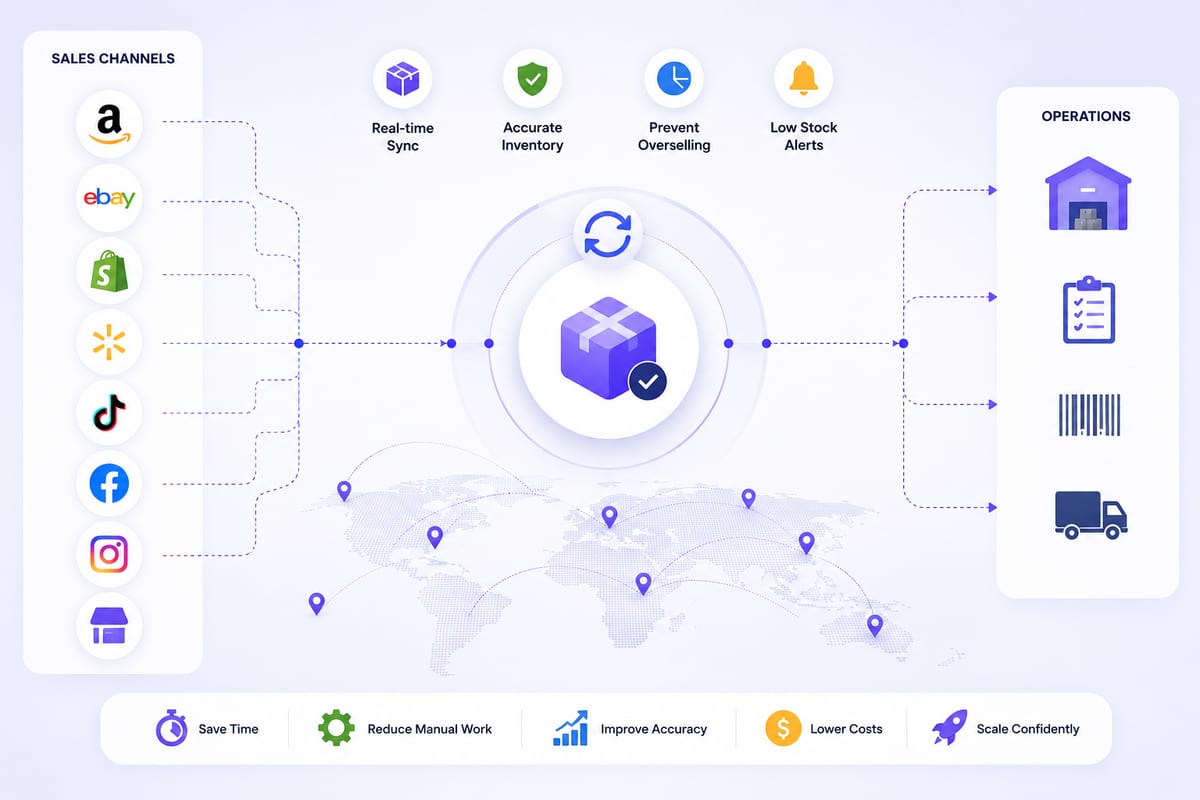
Cross channel inventory management for operations running on multiple platforms. The architectural patterns that prevent coordination breakdowns.
Real Time Inventory Management at Multi-Channel Scale
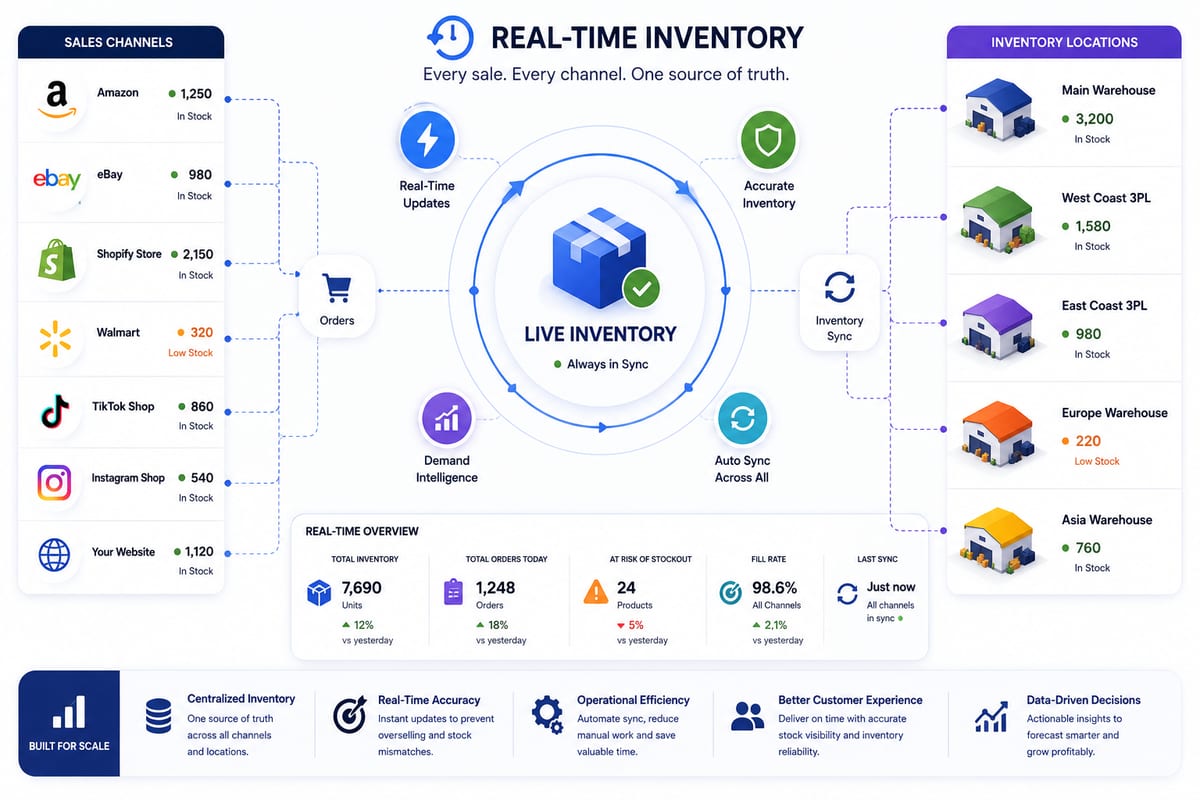
Real time inventory management requirements for multi-channel ecommerce. The architecture that delivers sub-5-second propagation under load.