Real Time Inventory Management at Multi-Channel Scale
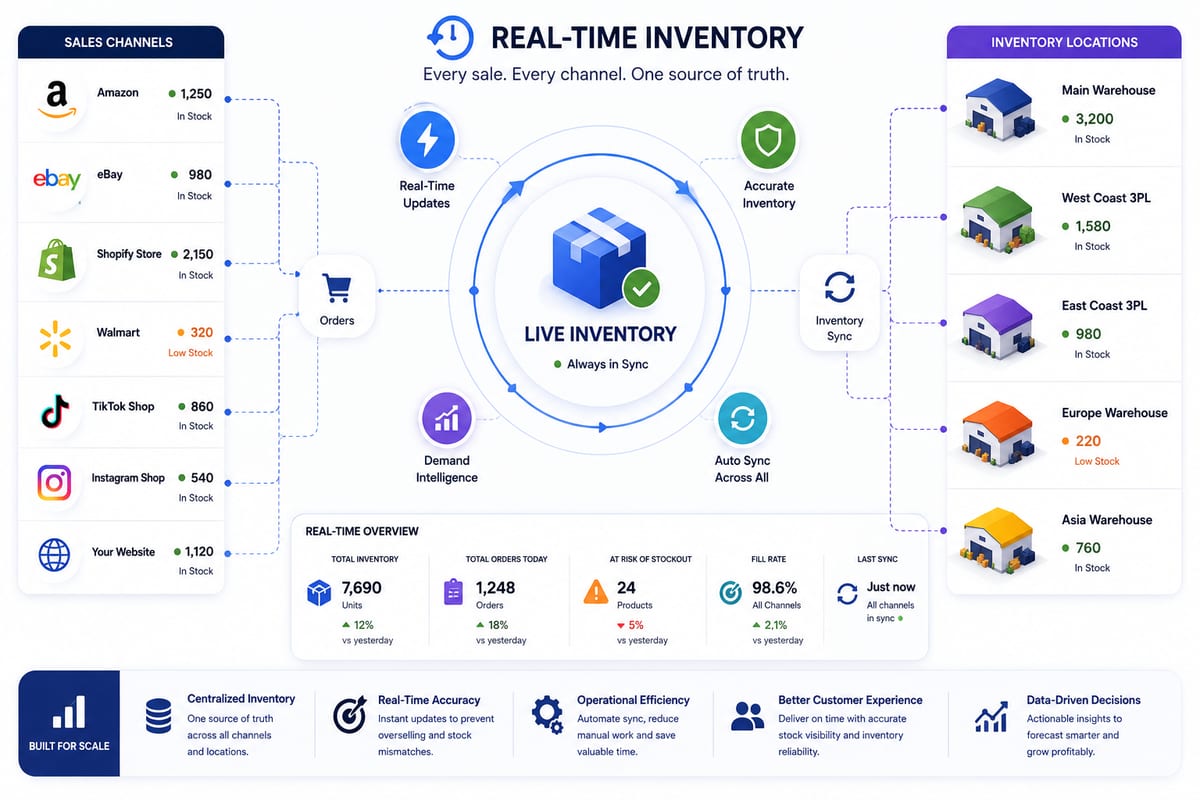
The phrase "real time inventory management" gets used by virtually every inventory tool vendor. The marketing claims look similar across the category, but the operational reality of what each tool actually delivers varies enormously. Operations relying on real time inventory management claims without verifying the underlying architecture end up with tools that produce 5-minute polling marketed as real time, leaving them with the structural overselling and metric damage that real time inventory management is supposed to prevent.
This article walks through what real time inventory management actually requires architecturally, the specific properties that distinguish real real time from marketing real time, and how to verify which tools actually deliver sub-5-second propagation under production load.
What "Real Time" Actually Means for Inventory Management
The conceptual definition is straightforward, inventory updates propagate to all relevant systems immediately when changes happen. The practical definition matters more. Real time inventory management in 2026 ecommerce means specific properties.
Sub-5-second propagation as standard. When stock changes on any channel, every other channel reflects the change within 5 seconds. This is the modern industry standard for serious operations.
Event-driven architecture. Stock changes trigger immediate propagation via webhooks rather than waiting for polling cycles. According to Cloudflare's documentation on webhooks, event-driven architectures deliver real time behavior far more reliably than polling alternatives.
Concurrent update handling. Multiple simultaneous updates to the same SKU serialize correctly. Race conditions do not produce drift even during burst traffic.
Failure recovery within real time windows. When webhook delivery fails, retry logic recovers within seconds. Operations do not fall back to polling-rate recovery.
Audit trail capture in real time. Every event logs with timestamps as it happens. Operators can review activity in real time without waiting for batch processing.
Tools delivering all five properties provide actual real time inventory management. Tools delivering some but not all provide partial real time that fails at predictable scale points. For deeper architectural context, see our inventory sync framework.
Why Polling Architecture Cannot Deliver Real Time
Many tools market real time inventory management while using polling architecture underneath. Understanding why polling fundamentally cannot deliver real time matters because polling-based tools will always disappoint at scale regardless of optimization.
Polling architecture checks each connected channel for changes every N minutes. Even at fast polling intervals like 1 minute, the architecture has built-in limitations.
Interval gap problem. Between polls, channels can disagree. During a 5-minute polling cycle, the worst-case sync gap is 5 minutes. No amount of optimization within polling architecture closes the gap; only architectural change does.
Peak velocity problem. Peak sales periods produce inventory velocity that polling intervals cannot track. A SKU selling 40 units per minute loses sync accuracy completely under 1-minute polling.
API rate limit problem. Polling at fast intervals hits API rate limits that marketplaces impose. Amazon, eBay, and other channels rate-limit polling aggressive enough to approach real time. The architecture conflicts with platform constraints.
Cost scaling problem. Fast polling produces high server costs that scale with channel count. The economic constraint becomes binding before the technical constraint resolves.
Latency lower bound. Even if all other problems were solved, polling has inherent minimum latency equal to the polling interval. Sub-5-second sync requires sub-5-second intervals, which produce other problems.
Polling architecture fundamentally cannot deliver real time inventory management at the standard modern operations require. Faster polling is not real time; it is just shorter intervals between gaps.
The Architectural Properties That Deliver Real Time
Real time inventory management at production scale requires specific architectural properties.
Webhook-driven primary updates. Each connected channel pushes events the moment they happen. The handler propagates updates outward immediately.
Idempotency keys on every event. Each event carries a unique identifier. Retries are safe; duplicate processing is impossible.
Per-SKU locking for concurrent updates. Updates to the same SKU serialize correctly. Updates to different SKUs parallelize. Race conditions during burst traffic become structurally impossible.
Logical ordering with timestamps. Event ordering follows source system timestamps rather than arrival order. Out-of-order events produce correct final state.
Hybrid architecture with reconciliation. Real time primary sync supplemented by periodic reconciliation passes that catch anything real time missed. Pure real time accumulates drift over time.
Comprehensive event logging. Every event logged with timestamps, source attribution, and replay capability accessible to operators. Real time diagnosis depends on accessible logs.
Native channel integrations. Direct API connections to each channel rather than middleware-routed integrations. Native integrations have lower latency and better reliability.
According to Wikipedia's overview of inventory management, centralized data ownership with real time propagation is foundational to operational accuracy in distributed operations. Real time inventory management embodies this principle.
How Real Time Inventory Management Differs Across Scales
Real time inventory management requirements scale with operational complexity in specific ways.
Single-channel operations can run on sync intervals up to 15 minutes without producing significant operational problems. The architectural quality matters less because there is only one channel to coordinate.
2 to 3 channel operations start showing real time advantages with sync under 1 minute. Below that threshold, occasional overselling and customer experience problems emerge.
4 to 8 channel operations require sub-5-second sync. Multiple concurrent channels with high velocity produce constant coordination demands that anything slower cannot handle.
8+ channel operations demand architecturally sophisticated real time sync with all seven properties listed above. Any architectural weakness produces structural problems that compound.
The threshold is not arbitrary. The relationship between channel count, order volume, and sync architecture quality follows predictable patterns. Operations expanding past their current sync architecture's capacity see operational quality degrade in specific ways.
For broader context on operational scaling, see our multichannel ecommerce framework.
How Real Time Inventory Management Affects Marketplace Performance
Real time inventory management directly affects marketplace performance metrics in ways that compound into significant business outcomes.
Amazon Order Defect Rate. Cancellations from cross-channel overselling damage Amazon's ODR metric. Operations with polling-based sync regularly cross ODR warning thresholds. Real time inventory management prevents this category of damage.
eBay defect rate. Similar to Amazon, eBay's defect rate metric punishes overselling. Real time sync protects defect rate by preventing the cross-channel cancellation cascades that produce metric damage.
Walmart seller performance scorecard. Walmart evaluates seller performance on multiple dimensions including order accuracy. Real time inventory management protects scorecard metrics that affect Buy Box eligibility and search ranking.
Shopify reliability indicators. While Shopify does not have marketplace-style performance metrics, customer satisfaction from real time inventory accuracy translates to repeat purchase rates and review scores.
For Amazon-specific implications, see our Amazon inventory management framework. The marketplace performance impact is one of the strongest justifications for investing in real time inventory management architecture.
How Nventory Implements Real Time Inventory Management
Nventory.io is built around the architectural properties that deliver actual real time inventory management. The platform implements all seven properties: webhook-driven primary updates, idempotency keys, per-SKU locking, logical ordering, hybrid reconciliation, comprehensive logging, and native channel integrations.
Sync propagation typically completes in under 5 seconds. Variations track at the SKU level. Every webhook event logs with replay capability. Native API integrations connect WooCommerce, Shopify, BigCommerce, Amazon, eBay, Walmart, TikTok Shop, Etsy, and 30+ other channels without middleware dependencies.
For WordPress and WooCommerce stores, download Nventory free from WordPress.org. For Shopify operations, install Nventory from the Shopify App Store. Both versions connect to the same multi-channel platform with identical architectural properties.
The free tier includes the full real time inventory management functionality without subscription cost. The architectural properties are the same in free and paid tiers, what changes is operational depth rather than core sync capability.
How to Verify Real Time Inventory Management Claims
Before committing to any tool claiming real time inventory management, run these specific verification tests on staging.
Test 1: Measured latency under normal load. Configure the tool with multiple channels. Trigger stock changes and measure propagation time. Sub-5-second results indicate genuine real time architecture.
Test 2: Burst load latency. Generate 50 synthetic orders within 60 seconds. Measure propagation under burst conditions. Architecture that handles burst load gracefully maintains sub-5-second sync; weaker architecture degrades to minutes.
Test 3: Concurrent update handling. Configure synthetic orders to hit the same SKU simultaneously across channels. Verify final counts match reality. Race condition failures appear here.
Test 4: Webhook failure recovery time. Configure deliberate webhook failures. Measure how long recovery takes. Real time architecture recovers within seconds; polling-based architecture falls back to polling intervals.
Test 5: Audit trail latency. Trigger events and check when they appear in operator-accessible logs. Real time logging produces immediate visibility; batch-processed logging has delays.
Test 6: Idempotency under retries. Trigger duplicate webhook deliveries. Verify events process exactly once. Tools without idempotency double-count.
Tools passing all six tests deliver genuine real time inventory management. Tools failing two or more market real time but do not actually deliver it.
Common Real Time Inventory Management Mistakes
A few patterns that produce real time inventory management failures.
Trusting "real time" marketing without verification. Marketing claims about real time often hide polling-based implementations. Always verify with measurements.
Assuming fast polling equals real time. Polling at 1-minute intervals is faster than 15-minute polling but still is not real time. The architecture matters more than the interval.
Ignoring concurrent update handling. Real time sync without proper concurrency control produces race conditions that look random.
Underestimating reconciliation importance. Pure real time without reconciliation accumulates drift. The hybrid combination delivers actual accuracy.
Skipping the verification testing. Vendor demos show real time behavior in controlled conditions. Production conditions reveal architectural weaknesses that demos hide.
Final Thoughts
Real time inventory management at multi-channel scale requires specific architectural properties that distinguish it from marketing claims. Webhook-driven updates, idempotency keys, per-SKU locking, logical ordering, hybrid reconciliation, comprehensive logging, and native integrations together deliver sub-5-second propagation under production load. Operations verifying these properties through staging tests select tools that deliver actual real time inventory management. Operations trusting marketing claims often find the gap between claims and reality during peak season when the cost is highest.
If you want to test real time inventory management built around the architectural properties that actually deliver sub-5-second propagation, install Nventory on your platform of choice. For WordPress and WooCommerce stores, download Nventory free from WordPress.org. For Shopify stores, install Nventory from the Shopify App Store. Visit nventory.io to review platform architecture documentation.
Frequently Asked Questions
Sub-5-second propagation between channels via webhook-driven architecture. Polling-based tools at 5 to 15 minute intervals are obsolete for serious multi-channel operations.
No. Polling has inherent minimum latency equal to the polling interval. Fast polling at 1-minute intervals is faster than slow polling but still is not real time. Architecture matters more than interval optimization.
No. The free Nventory plugin on WordPress.org and Nventory Shopify app deliver real time inventory management without subscription cost. Architecture matters more than pricing tier.
Sub-5-second propagation is the modern standard. Many production systems deliver sub-2-second propagation. Latency above 30 seconds is not real time regardless of vendor claims.
Polling-based architecture marketed as real time. Operations testing latency on staging find the actual behavior differs from marketing claims.
Combined with buffer stock configuration and proper integration setup, overselling rates approach zero. Real time sync alone reduces but does not always eliminate overselling without buffer stock as backup.
Related Articles
View all
Inventory Automation That Actually Saves Operations Time
Inventory automation for ecommerce operations past manual reconciliation. The categories that produce compounding labor savings at scale.
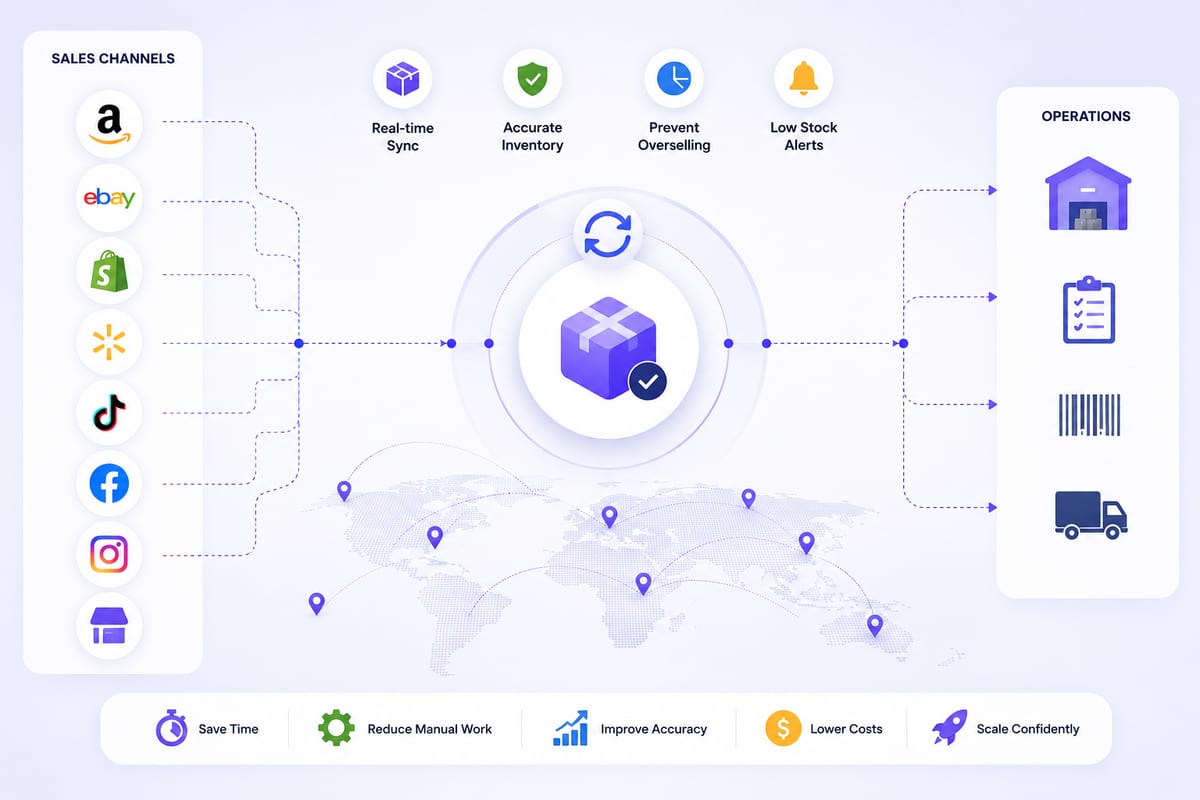
Cross Channel Inventory Management Without the Chaos
Cross channel inventory management for operations running on multiple platforms. The architectural patterns that prevent coordination breakdowns.
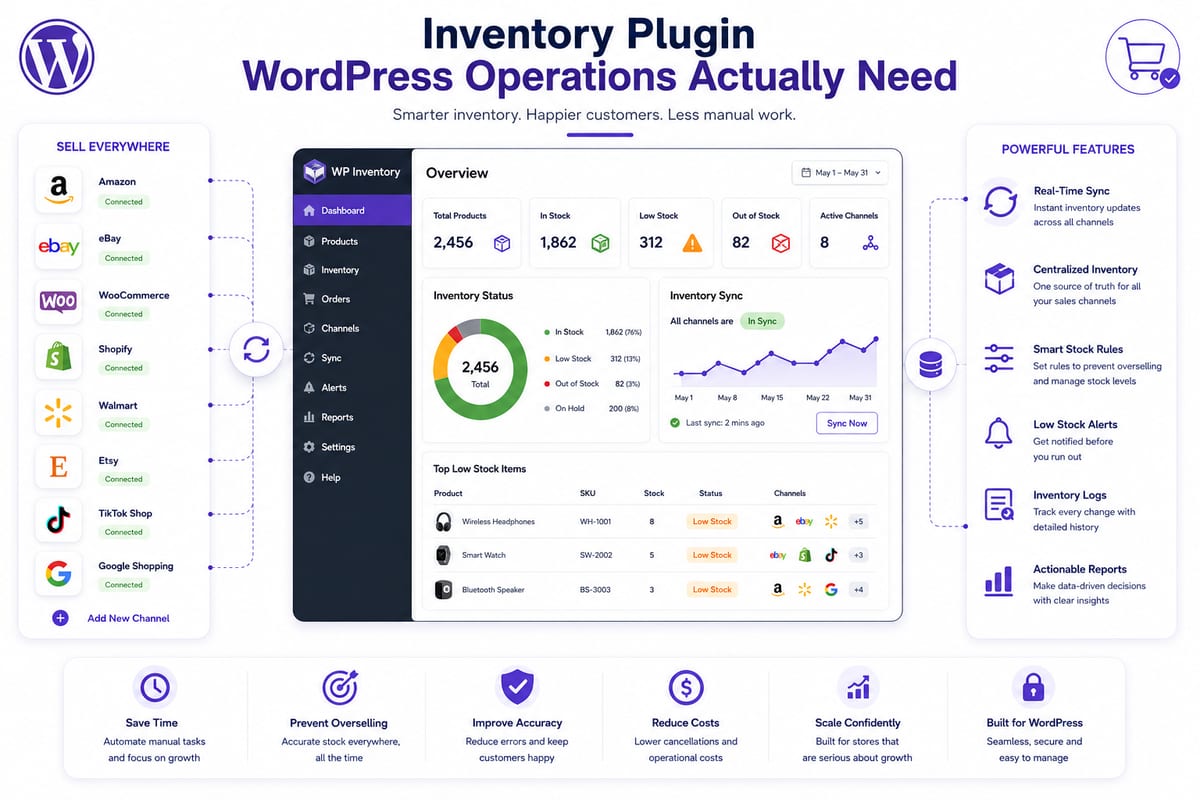
Inventory Plugin WordPress Operations Actually Need
Inventory plugin WordPress comparison for serious WooCommerce stores. The architectural properties that scale past the WordPress plugin stack ceiling.