Cross Channel Inventory Management Without the Chaos
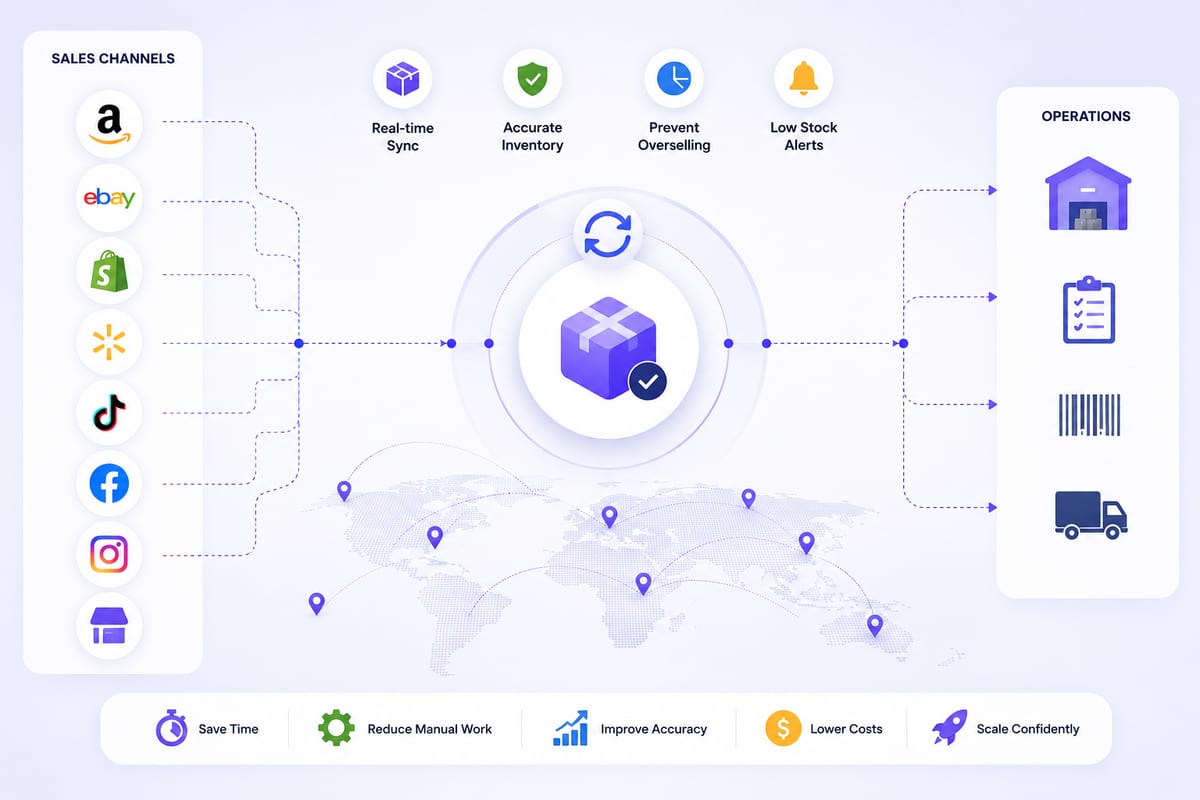
Cross channel inventory is the operational reality of any ecommerce brand selling on more than one platform. The same physical units exist as listings on multiple channels simultaneously. Sales can happen on any channel at any moment. The cross channel inventory layer has to coordinate these realities accurately enough that customers never buy units that already sold elsewhere. Most operations handle this layer poorly, producing the cancellation cascades and metric damage that destroy growing brands.
This article walks through what cross channel inventory management actually requires, the architectural patterns that prevent the coordination chaos that breaks scaling operations, and how to evaluate the infrastructure that handles cross channel coordination cleanly.
What Cross Channel Inventory Actually Means
Cross channel inventory covers the discipline of maintaining accurate stock counts across multiple sales channels for the same physical inventory. Several specific operational requirements define the discipline.
Real-time stock coordination. When a unit sells on any channel, every other channel needs to know in seconds. The threshold gets set by the fastest channel in your stack.
Variation-level granularity. Each variant of variable products tracked as its own SKU across all connected channels. Aggregate tracking breaks for catalogs with meaningful variation depth.
Channel-specific rule respect. Different channels have different cancellation policies, shipping commitments, return windows, and performance metrics. Cross channel inventory respects these without manual intervention per channel.
Reconciliation discipline. Even with excellent real-time sync, periodic reconciliation passes catch drift that real-time misses. The combined approach produces operational accuracy that pure real-time cannot achieve.
Buffer stock management. Reserve units invisible to channels as safety nets against brief sync gaps. Critical for high-velocity products on multiple channels.
Audit trail completeness. Every cross channel inventory event logs with timestamps, source attribution, and replay capability. Diagnosis depends on the audit trail.
For broader context on the operational patterns, see our multichannel ecommerce framework on operations at scale.
Why Cross Channel Inventory Coordination Breaks Down
Operations producing cross channel inventory chaos share predictable failure patterns. Understanding the patterns helps avoid them.
Distributed data ownership. Multiple systems maintaining their own stock counts produce drift. Each system "knows" what the inventory should be; the systems disagree about reality.
Polling-based sync architecture. Tools checking channels every 5 to 15 minutes leave gaps where channels can disagree. During the gaps, overselling happens.
Parent-level inventory tracking. Tools tracking stock at the parent product level cannot surface variation-level drift. Variable products break in ways that are not visible from aggregate counts.
Middleware-routed integrations. Integrations routing through third-party middleware add latency and create failure points. Native channel integrations significantly outperform middleware-routed alternatives.
Inaccessible logging. Tools storing event logs in vendor backends rather than operator-accessible interfaces make diagnosis impossible without support tickets. By the time support responds, problems compound.
Missing reconciliation. Tools without periodic reconciliation never catch drift between real-time updates. Drift accumulates silently until customer complaints surface the patterns.
According to Wikipedia's overview of inventory management, centralized data ownership across distributed channels is foundational to operational accuracy. Cross channel inventory done right embodies this principle.
The Architectural Foundation That Prevents Chaos
Cross channel inventory management that prevents coordination chaos shares specific architectural properties. Operations should evaluate these explicitly.
Centralized canonical inventory. One platform owns the authoritative stock count. Other systems read from it; nothing else writes directly. Race conditions cannot produce drift because there is only one place stock data lives.
Webhook-driven propagation. Changes propagate via webhooks the moment they happen. According to Cloudflare's documentation on webhooks, event-driven architectures handle high-velocity events dramatically more reliably than polling alternatives.
Variation-first data model. Every variant is its own SKU with its own count, sync rules, and buffer stock. Parent products are organizational metadata, not the unit of tracking.
Native channel integrations. Direct API connections to each connected channel rather than middleware. Native integrations have lower latency and better error handling.
Hybrid reconciliation. Real-time sync supplemented by periodic reconciliation. Pure real-time accumulates drift; pure reconciliation lags too much. The hybrid combination produces both speed and accuracy.
Operator-accessible audit trails. Every event logged with timestamps and replay capability accessible to operators directly. Problems get diagnosed in minutes rather than days.
For broader architectural context, see our inventory sync framework on the architecture that scales.
The Channel-Specific Requirements That Shape Cross Channel Strategy
Different channels have different cross channel inventory requirements that shape strategy decisions.
Amazon-specific requirements. Amazon's defect rate sensitivity makes sub-5-second sync critical. Order Defect Rate damage from cross channel overselling compounds into account health problems quickly.
eBay-specific requirements. eBay's defect rate threshold and Multi-Variation Listing complexity create eBay-specific cross channel requirements. For deeper context, see our eBay inventory management framework.
Walmart-specific requirements. Walmart's seller performance scorecard rewards fast sync. Cross channel sync delays produce metric damage.
Shopify-specific requirements. Shopify's webhook patterns, API rate limits, and location model shape cross channel integration architecture.
WooCommerce-specific requirements. WooCommerce's WordPress foundation creates hosting-specific implications for cross channel sync architecture.
Cross channel inventory platforms handling channel-specific requirements correctly produce significantly better outcomes than generic tools applied across channels without channel-specific awareness.
How Cross Channel Inventory Differs from Single-Channel Inventory
The operational discipline differs from single-channel inventory in several specific ways worth understanding.
Coordination overhead scales with channel count. Single-channel inventory has linear complexity. Cross channel inventory has complexity that grows non-linearly with channel count because each channel pair creates coordination requirements.
Failure consequences cascade. Single-channel inventory errors affect one channel. Cross channel inventory errors cascade across channels, producing compounding damage.
Customer experience consistency matters. Single-channel customers see one consistent picture. Cross channel customers expect consistency across channels they visit.
Marketplace performance metrics matter differently. Marketplaces evaluate seller performance separately. Cross channel inventory failures damage performance across multiple marketplaces simultaneously.
Audit trail importance increases. Diagnosis requires reconstructing events across multiple channels. Audit trail completeness matters more than in single-channel operations.
The cross channel discipline is not just more complex single-channel inventory, it is a distinct operational discipline with its own architectural and operational requirements.
How Nventory Handles Cross Channel Inventory
Nventory.io is built around the architectural properties that prevent cross channel inventory chaos. The platform serves as the centralized canonical inventory source for cross channel operations.
Sync is webhook-driven with sub-5-second propagation. Variations track at the SKU level. Native integrations connect to 30+ channels including WooCommerce, Shopify, BigCommerce, Amazon, eBay, Walmart, TikTok Shop, and Etsy. Hybrid reconciliation runs periodically. Every event logs with operator-accessible replay capability.
For WordPress and WooCommerce stores, download Nventory free from WordPress.org. For Shopify operations, install Nventory from the Shopify App Store. Both versions connect to the same multi-channel platform with identical cross channel capabilities.
The free tier includes core cross channel inventory functionality without subscription cost. Buffer stock is configurable per SKU. Multi-warehouse routing is available in paid tiers for operations with location-specific complexity.
How to Audit Cross Channel Inventory Capabilities
Before committing to any cross channel inventory platform, run these specific verification tests.
Test 1: Concurrent channel sales. Configure synthetic orders to hit the same SKU simultaneously across multiple channels. Verify final counts match reality. Race condition failures appear here.
Test 2: Burst load simulation. Generate 50+ synthetic orders within 60 seconds. Watch sync propagation across channels. Queue overflow failures appear here.
Test 3: Variation propagation. Sell out specific variations on staging. Verify every channel reflects changes without affecting siblings.
Test 4: Webhook failure recovery. Configure deliberate webhook delivery failures. Verify retry logic and surface persistent failures to operators.
Test 5: Bulk operation handling. Bulk-update 500+ products across channels. Verify all updates process without dropping events.
Test 6: Audit trail accessibility. Query event logs for specific cross channel transactions. Verify operators can see exactly what happened.
Platforms passing all six tests have sound cross channel architecture. Platforms failing two or more should be eliminated.
Common Cross Channel Inventory Mistakes
A few patterns to avoid.
Treating cross channel as just more channels. Cross channel inventory is a distinct discipline, not single-channel inventory scaled up. The architectural and operational requirements differ.
Trusting "real-time" claims without verification. Many platforms market real-time sync but use polling underneath. Always verify with specific latency measurements.
Stacking channel-specific tools. Multiple tools writing to channel-specific stock data create silent conflicts. Consolidate to unified platforms.
Underestimating peak period stress. Sync that works at 30 orders/day can fail at 30 orders/hour. Test under burst conditions on staging.
Skipping variation testing. Variable products break tools that do not track variations correctly. Test specifically with realistic variation depth.
Final Thoughts
Cross channel inventory management without coordination chaos requires architecture designed for the modern challenge: the same physical inventory existing as listings on multiple channels with sales happening concurrently across all of them. The architectural properties, centralized canonical data, webhook-driven sync, variation-first model, native integrations, hybrid reconciliation, accessible audit trails, eliminate the failure modes that characterize struggling multichannel operations. The properties are knowable and implementable through the right infrastructure.
If you want to test cross channel inventory built around the architectural properties that prevent coordination chaos, install Nventory on your platform of choice. For WordPress and WooCommerce stores, download Nventory free from WordPress.org. For Shopify stores, install Nventory from the Shopify App Store. Visit nventory.io to review the platform documentation.
Frequently Asked Questions
Platforms with centralized canonical inventory, webhook-driven sync, variation-first data models, native integrations, hybrid reconciliation, and operator-accessible audit trails. Nventory implements these, available on WordPress.org and the Shopify App Store.
Sub-5-second propagation is the modern industry standard. Polling-based tools at 5 to 15 minute intervals are obsolete for serious cross channel operations.
For operations under 100 daily orders on 2 channels, basic manual coordination works. Above that scale, dedicated platforms become necessary.
Combined with buffer stock and proper integration setup, overselling rates approach zero. Tools alone without operational discipline still produce occasional issues.
Standardize SKUs first. Set up the new platform on staging. Migrate one channel at a time. Validate each channel for 7 to 14 days before adding the next. Plan 2 to 4 weeks total for clean migration.
Distributed data ownership across multiple tools each writing to channel-specific stock data. Centralizing on one canonical source eliminates the structural cause of cross channel drift.
Related Articles
View all
Inventory Automation That Actually Saves Operations Time
Inventory automation for ecommerce operations past manual reconciliation. The categories that produce compounding labor savings at scale.
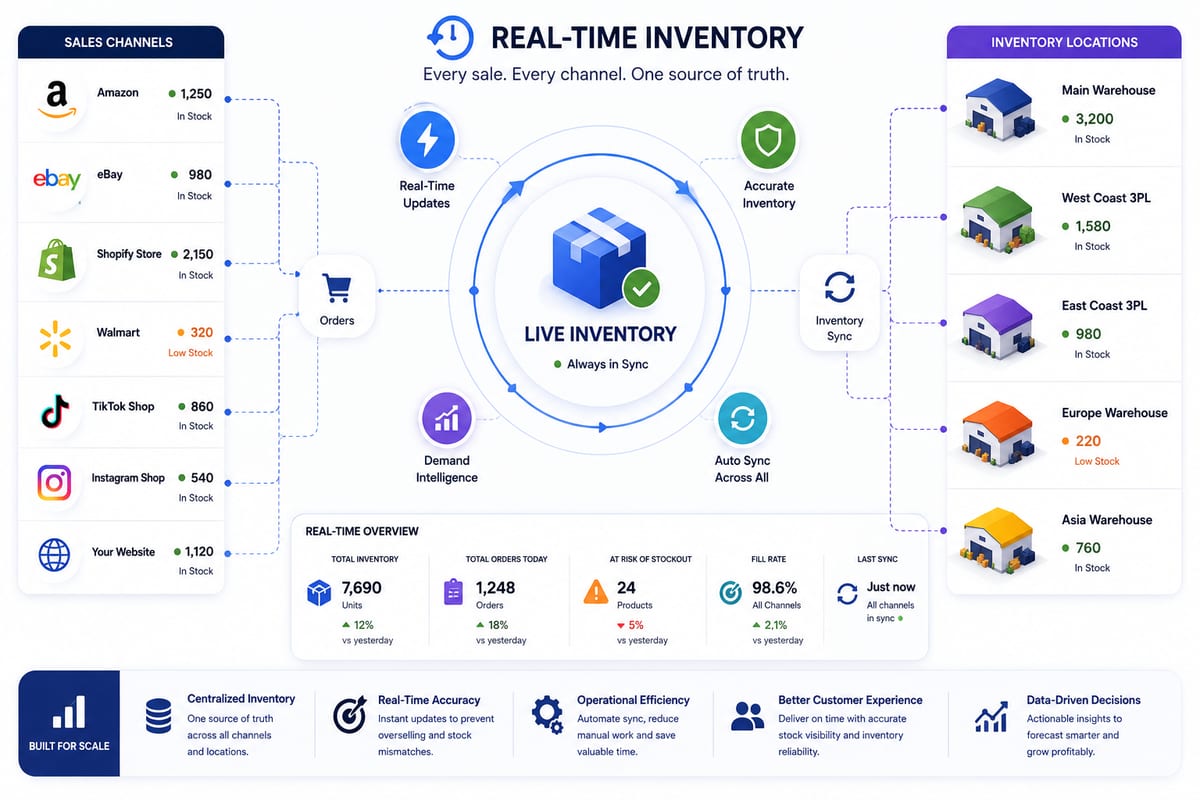
Real Time Inventory Management at Multi-Channel Scale
Real time inventory management requirements for multi-channel ecommerce. The architecture that delivers sub-5-second propagation under load.
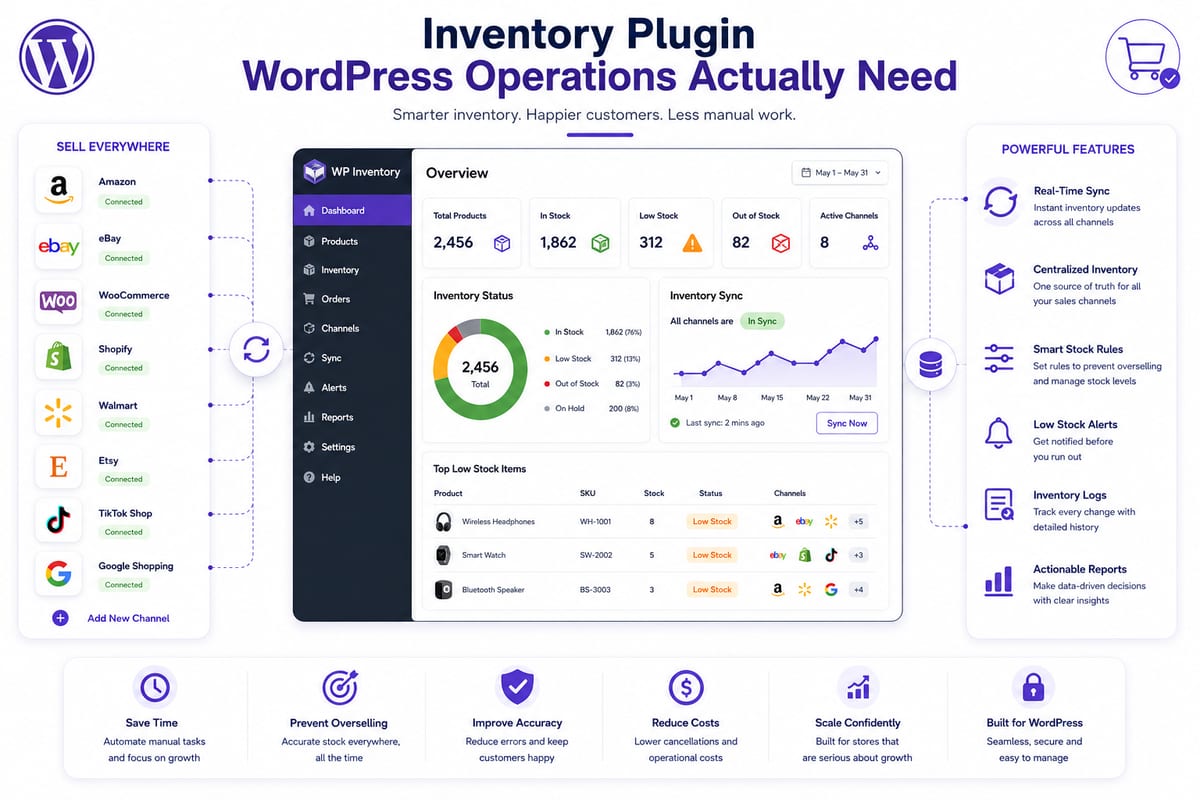
Inventory Plugin WordPress Operations Actually Need
Inventory plugin WordPress comparison for serious WooCommerce stores. The architectural properties that scale past the WordPress plugin stack ceiling.