Multichannel Order Manager: What Real Operations Need
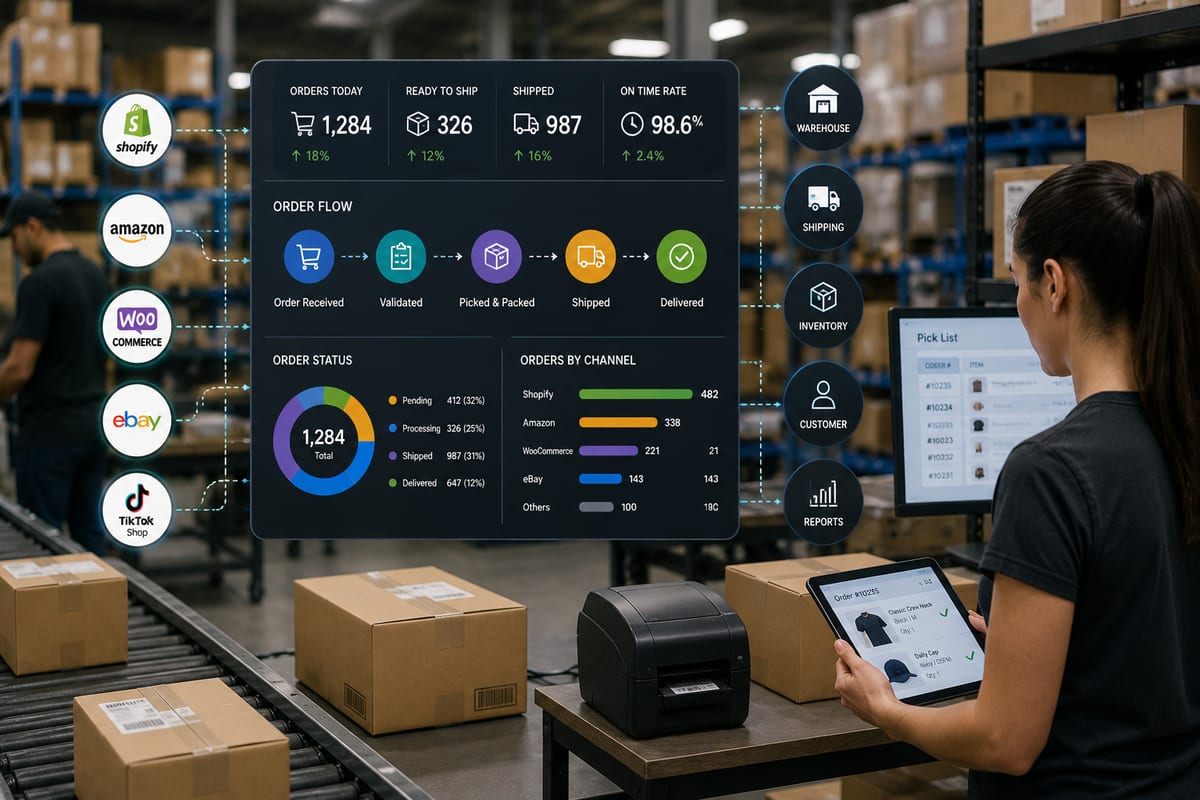
The multichannel order manager category covers a wide range of tools, from basic order aggregators to full operational platforms. The differences matter enormously for whether the tool actually fits your operation. Buyers comparing multichannel order manager options based on feature lists often end up with software that looks comprehensive in demos but fails at the specific operational coordination that scaling brands actually need.
This article walks through what a multichannel order manager has to do for real-world ecommerce operations, the capabilities that separate purposeful tools from feature pile-ups, and how to evaluate options based on operational fit rather than marketing.
What a Multichannel Order Manager Actually Does
The core function is unifying order operations across multiple sales channels into one operational system. Orders flow in from Amazon, eBay, Walmart, Shopify, WooCommerce, TikTok Shop, and other channels with different formats and different timing. The multichannel order manager normalizes these into unified workflows.
Order ingestion from multiple sources. Each channel sends orders with its own data structure, metadata, and timing patterns. The order manager converts these into a unified data model that downstream systems can consume.
Inventory validation in real time. Before accepting an order for fulfillment, the system verifies that inventory actually exists. This requires real-time connection to current stock data, not snapshot data from yesterday.
Routing logic across warehouses or 3PLs. Orders need to route to specific fulfillment locations based on stock availability, customer location, and channel-specific rules. Generic routing produces wrong decisions when location-specific factors matter.
Status propagation back to channels. Tracking numbers, shipping confirmations, and delivery updates need to flow back to originating channels in the formats each channel expects. Channel-specific status formatting matters because marketplaces evaluate seller performance based on it.
Exception handling workflows. Orders that cannot process cleanly need human attention. The multichannel order manager surfaces these exceptions through workflows operators can manage at scale.
Cross-system event triggers. Order events trigger actions across inventory, fulfillment, customer service, accounting, and analytics systems. The order manager coordinates these triggers consistently. For broader context on this layer, see order management system.
Why Multichannel Orders Are Operationally Different
Single-channel orders have relatively contained complexity. The same channel sends orders consistently; the same warehouse fulfills them; the same customer expectations apply.
Multichannel orders introduce complexity that compounds with channel count.
Format diversity across channels. Amazon orders include FBA designation, prime eligibility, and Amazon-specific metadata. eBay orders include item specifics, auction vs Buy It Now distinction, and seller performance data. Each channel adds its own requirements that the order manager has to handle.
Channel-specific rules. Different channels have different cancellation policies, shipping deadlines, communication standards, and return windows. The order manager needs to respect channel-specific rules during processing.
Channel-specific fulfillment patterns. Amazon orders may go through FBA. eBay orders may need specific shipping carriers for top-rated seller status. Walmart orders may require specific service levels. Generic fulfillment logic produces compliance violations on specific channels.
Channel-specific status formats. Marketplaces require status updates in specific formats on specific timing. Generic status updates produce account health degradation on demanding channels.
Cross-channel customer recognition. Customers purchasing across multiple channels create complexity around order coordination, marketing, and service. The order manager needs cross-channel customer awareness.
According to Wikipedia's overview of inventory management, centralized data ownership across distributed channels is foundational to operational accuracy, and for multichannel order management specifically, this principle becomes the difference between operations that scale cleanly and operations that accumulate coordination chaos.
The Architectural Properties That Matter
Multichannel order managers need specific architectural properties to handle real-world complexity.
Event-driven order intake. Orders enter the system the moment they happen on channels, via webhooks. According to Cloudflare's documentation on webhooks, event-driven architectures handle high-velocity orders far more reliably than polling-based alternatives.
Real-time inventory integration. Order validation against inventory requires current state. Snapshot-based validation produces overselling. Integration with multichannel ecommerce inventory infrastructure matters as much as order management capabilities themselves.
Native channel integrations. Direct API connections to each channel produce better reliability than middleware-routed connections. Channel-specific quirks are easier to handle with deep native integration.
Configurable routing rules. Rules engines that handle multi-warehouse, multi-channel, and exception scenarios. Hardcoded routing breaks when business rules change.
Comprehensive audit trails. Every order action logs with timestamps and replay capability. When exceptions occur (and at scale, they always do), the audit trail enables fast resolution.
Open APIs for downstream integration. Order data needs to flow into accounting, customer service, analytics, and other systems. Closed architectures create integration chaos that consumes team time.
How Multichannel Order Managers Differ From Storefront Order Tools
Many operations try to use storefront-native order management (Shopify orders, WooCommerce orders) as their multichannel order manager. This pattern works at low scale but breaks at predictable inflection points.
Storefront order management handles orders from that storefront. Multichannel order management coordinates orders from all channels including marketplace channels the storefront cannot directly access.
The functional differences:
Storefront tools see orders from one channel; multichannel tools see orders from all channels.
Storefront tools handle one channel's specific rules; multichannel tools handle channel-specific variations across multiple channels.
Storefront tools route through that storefront's fulfillment systems; multichannel tools route across warehouses, 3PLs, and channel-specific fulfillment paths.
Storefront tools provide reporting on that storefront's orders; multichannel tools provide consolidated reporting across all channels with channel attribution.
For operations selling on 2+ channels, the difference between using storefront tools and dedicated multichannel order managers shows up as compounding operational friction. The storefront tools were not designed for the multichannel coordination problem and trying to force them produces predictable failures.
How Nventory Implements Multichannel Order Management
Nventory.io implements multichannel order management as part of its unified inventory and operational platform. Orders flow in from connected channels via webhooks, get validated against real-time inventory, route through configurable rule engines, and propagate status back to originating channels in seconds.
The platform connects to Amazon, eBay, Walmart, TikTok Shop, Etsy, Shopify, WooCommerce, BigCommerce, and 20+ other channels through native API integrations. Routing logic supports multi-warehouse, 3PL, and channel-specific rules. Status propagation respects each channel's specific format and timing requirements. Audit trails are operator-accessible for diagnostic work.
For WordPress and WooCommerce stores, download Nventory free from WordPress.org. For Shopify operations, install Nventory from the Shopify App Store. Both versions provide the same multichannel order management capabilities.
The free tier includes core multichannel order management functionality without subscription cost. Paid tiers add advanced routing rules, custom workflow automation, and priority support for operations with specific complexity beyond standard configurations.
The architectural value is unification, instead of managing orders separately in each channel's interface, operators work in one system with consolidated visibility. Team time scales with order volume more slowly than channel count, which is exactly what scaling operations need.
For the broader operational framework, see how this connects to inventory management practices.
How to Evaluate Multichannel Order Manager Options
Before committing to any multichannel order manager, verify these specific properties on staging.
Verification 1: Channel coverage and integration depth. Does the system natively support your specific channels? Native integration outperforms middleware for reliability and feature depth.
Verification 2: Order intake speed under load. Generate 50 synthetic orders within 60 seconds across multiple channels. Measure ingestion latency. Sub-30-second processing is the modern standard for serious operations.
Verification 3: Routing rule flexibility. Can the routing engine accommodate your specific business requirements? Test with realistic scenarios including multi-warehouse, channel-specific, and exception cases.
Verification 4: Status propagation accuracy. Verify that tracking numbers and order status flow back to originating channels in the correct formats. Channel-specific marketplace performance depends on this.
Verification 5: Exception workflow quality. How does the system surface orders requiring human attention? Strong exception workflows reduce operational chaos at scale.
Verification 6: Audit trail accessibility. Can operators trace any specific order through its complete history without going through support? Self-service audit access matters significantly at scale.
Tools that pass all six verifications have sound architecture. Tools that fail two or more should be eliminated from consideration regardless of marketing claims.
Common Multichannel Order Manager Mistakes
A few patterns to avoid.
Treating storefront order management as sufficient. Storefront-native order tools work for single-channel operations. Multi-channel operations need dedicated coordination.
Picking based on feature breadth. All vendors check most feature boxes. Architecture and operational fit matter more than feature lists.
Ignoring marketplace performance implications. Multichannel order management directly affects marketplace performance metrics. Tools that handle status propagation poorly produce account health damage on demanding channels.
Underestimating exception handling complexity. Most orders process cleanly; the operational pain lives in the exception 5 to 10%. Tools with weak exception workflows make scaling painful.
Skipping the integration verification. Closed order management systems create downstream integration chaos. Verify API depth and data export options before committing.
Final Thoughts
Multichannel order management for ecommerce operations selling across multiple channels requires capabilities beyond what storefront-native order management provides. Event-driven order intake, real-time inventory integration, native channel connections, configurable routing rules, comprehensive audit trails, and open APIs separate purposeful multichannel order managers from feature pile-ups. Operations that evaluate options through these architectural properties select tools that scale with growth.
If you want to test a multichannel order manager unified with inventory and built around the architectural properties that actually matter, install Nventory on your platform of choice. For WordPress and WooCommerce stores, download Nventory free from WordPress.org. For Shopify stores, install Nventory from the Shopify App Store. Visit nventory.io to review platform capabilities for multichannel order operations.
Frequently Asked Questions
Dedicated multichannel platforms with webhook-driven architecture, native channel integrations, and operator-accessible audit trails. Nventory implements these, available on WordPress.org and the Shopify App Store.
For single-channel operations, yes. For multichannel selling, storefront-native tools hit ceilings at predictable inflection points. Dedicated multichannel platforms produce better outcomes for serious multi-channel operations.
Order intake and inventory verification should complete in seconds. Status propagation back to channels should happen within minutes. Polling-based tools at 5 to 15 minute intervals are obsolete for serious multichannel use.
Yes, the right ones do. Integration depth varies. Native carrier integrations outperform middleware for reliability. Look for tools supporting your specific carrier mix natively.
Status propagation gaps that produce marketplace performance damage. When tracking numbers and order status do not flow back to channels correctly, marketplace metrics degrade and seller standing suffers.
For unified platforms like Nventory: 2 to 4 weeks of staging work plus a low-traffic cutover weekend. Channel-by-channel migration is the recommended approach to validate each integration before adding the next.
Related Articles
View all
Best Inventory Management System in 2026: What Top Operators Actually Use
The best inventory management system in 2026 matched by business type. Real capabilities, honest limitations, and what top ecommerce operators actually use.
The Order Management Software Top Sellers Use in 2026
Top ecommerce sellers don't guess on order management software. See the OMS features, architecture, and criteria that separate scaling brands from stalling ones.

Free Inventory Management Software in 2026: Honest Guide (And When to Upgrade)
Free inventory management software honestly compared, real reviews, hidden limits, and when free actually works vs. when paid pays back within 60 days.