Inventory Optimization Past the Spreadsheet Stage
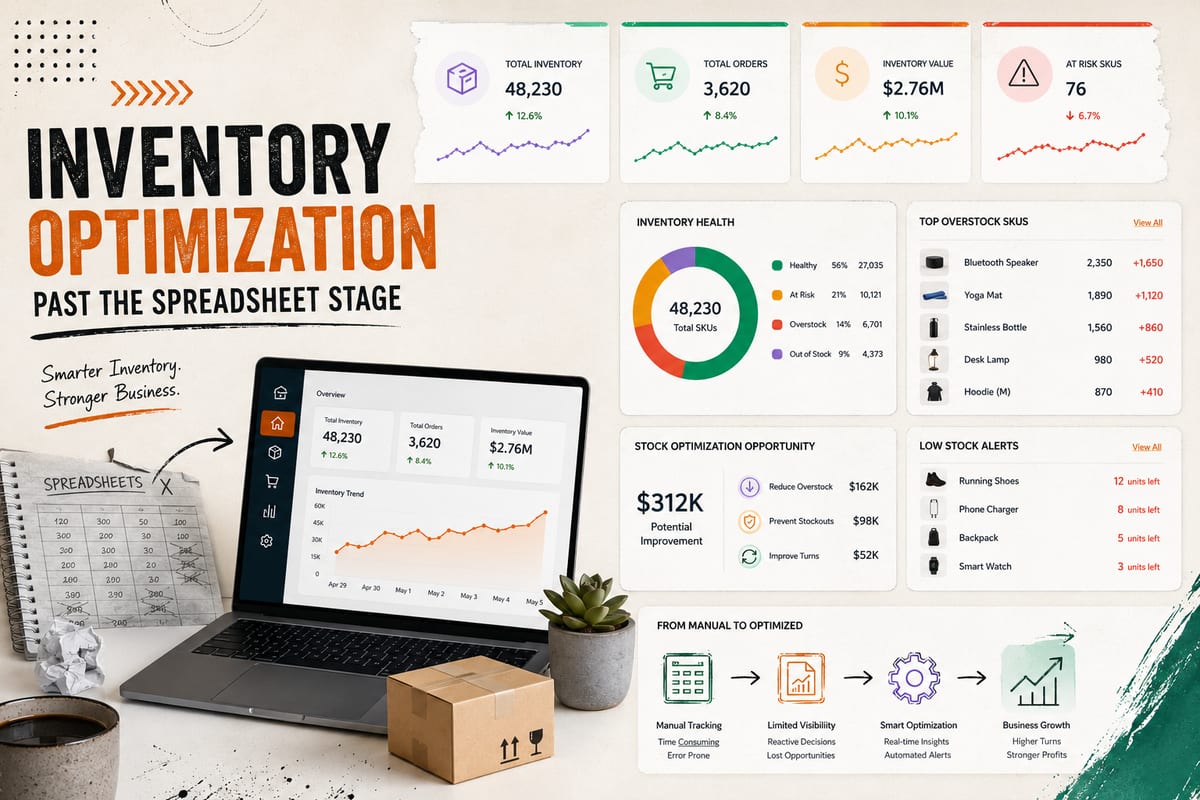
Most ecommerce operations approach inventory optimization the same way. Pull sales data into a spreadsheet, do some math, decide how much to reorder, repeat monthly. The approach works at small scale but breaks down predictably as operations grow. Spreadsheet-based optimization cannot keep up with multi-channel velocity, does not surface dead stock fast enough, and cannot model variation-level demand. The result is operations that look like they are optimizing inventory while actually just maintaining the same problems on a faster cycle.
This article walks through what inventory optimization actually means past the spreadsheet stage, the practices that produce compounding margin improvements, and the operational decisions that separate optimization from busy work.
What Inventory Optimization Actually Means
The phrase gets used loosely. Practically, inventory optimization covers several specific operational disciplines.
Demand forecasting accuracy. Predicting how much you will sell of each SKU over future periods. The foundation everything else builds on.
Reorder point calculation. Determining when to reorder each SKU based on demand velocity, lead time, and target service level. Too early ties up capital; too late produces stockouts.
Optimal order quantity. How much to reorder each time. Larger orders reduce per-unit costs but increase carrying costs. Smaller orders reduce carrying costs but increase ordering overhead.
Dead stock identification. Surfacing inventory that is not moving fast enough to justify continued carrying. Dead stock represents capital tied up in non-productive assets.
Channel-specific allocation. Distributing stock across channels based on each channel's actual demand patterns rather than blanket allocation rules.
Pricing-driven optimization. Adjusting pricing to manage demand and inventory levels. Slow-moving SKUs get discounted to clear; high-demand SKUs hold premium pricing.
Real inventory optimization addresses all six disciplines simultaneously. Operations that focus on only one or two produce marginal improvements that do not compound into significant margin gains.
Why Spreadsheet Optimization Hits a Ceiling
Spreadsheets work for inventory optimization at small scale because the complexity stays manageable. Each SKU has known sales history. Forecasting can happen by inspection. Reorder decisions are obvious from the data.
The model breaks at predictable inflection points.
Catalog size complexity. Spreadsheets handle a few hundred SKUs comfortably. They become unwieldy past 1,000 SKUs and unusable past 5,000.
Channel velocity variation. When the same SKU sells at different velocities on different channels, spreadsheet models cannot capture the patterns without becoming unmaintainable.
Variation complexity. Variable products with 4+ variations per parent multiply effective catalog complexity. Spreadsheet models that work for 1,000 simple SKUs become impossible at 1,000 variable products.
Demand volatility. Viral products, seasonality, and supply disruptions break linear forecasting models. Operations need probabilistic approaches that spreadsheets cannot easily implement.
Update frequency. Modern ecommerce changes daily. Weekly spreadsheet review cannot keep up with multi-channel velocity at scale.
Operations stuck on spreadsheet optimization past these inflection points typically are not optimizing, they are just maintaining inventory chaos faster. For broader operational patterns, see inventory management.
The Architectural Foundation Optimization Requires
Inventory optimization at scale requires architectural foundations that spreadsheets cannot provide.
Real-time data foundation. Optimization decisions need current inventory and sales data, not data from yesterday's export. Operations running optimization on stale data make decisions on patterns that no longer exist.
Variation-level granularity. Forecasting and reorder calculations need to happen at the variation level for variable products. Aggregate data hides variation-specific patterns.
Multi-channel awareness. Demand patterns differ by channel. Optimization needs to model channel-specific velocity rather than treating channels as interchangeable.
Comprehensive audit trails. Optimization improvement depends on understanding why past decisions worked or did not. Without historical data accessible to operators, learning compounds slowly. For the importance of audit trails generally, see inventory tracking.
Automation hooks. Optimization insights need to drive automated actions, reorder triggers, pricing adjustments, allocation changes. Manual implementation of optimization decisions slows compounding.
According to Wikipedia's overview of inventory management, accurate operational data across distributed channels is foundational to optimization at any scale. Operations missing the architectural foundation cannot optimize effectively regardless of analytical sophistication.
The Five Inventory Optimization Practices That Compound
Across scaling ecommerce operations, five optimization practices consistently produce compounding margin improvements.
Practice 1: Demand Forecasting by Variation
Forecast demand at the variation level rather than the parent product level. A blue medium t-shirt has different demand patterns than a black large t-shirt. Aggregate forecasting masks the patterns that matter.
Compounding effect: variation-level forecasting reduces both stockouts (under-ordered variations) and dead stock (over-ordered variations) simultaneously. The margin improvement comes from both directions.
Practice 2: Channel-Specific Allocation
Allocate stock across channels based on each channel's actual demand velocity rather than treating channels as equivalent. Channels with higher velocity get more stock; lower-velocity channels get smaller allocations.
Compounding effect: better channel-specific allocation increases sell-through on high-velocity channels and prevents dead stock accumulation on low-velocity channels. Both effects compound over inventory turn cycles.
Practice 3: Dynamic Reorder Points
Adjust reorder points based on current demand patterns rather than static thresholds. SKUs experiencing demand spikes need higher reorder points; SKUs slowing down need lower ones.
Compounding effect: dynamic reorder points prevent stockouts during demand spikes and prevent overstocking during demand decay. The capital efficiency improvement compounds.
Practice 4: Slow-Mover Identification
Surface SKUs that are not moving fast enough to justify continued carrying. The threshold depends on category, but typically 90+ days of zero movement warrants attention.
Compounding effect: identifying slow movers early enables clearance actions (discounting, bundling, channel reallocation) before they become deeply dead stock requiring write-downs.
Practice 5: Pricing-Inventory Coordination
Coordinate pricing decisions with inventory levels. Slow-moving SKUs get tactical discounts to clear; fast-moving SKUs hold premium pricing.
Compounding effect: pricing-inventory coordination improves both margin (on fast movers) and inventory turn (on slow movers). The dual effect compounds over time.
How Multi-Channel Operations Optimize Differently
Multichannel ecommerce operations have specific optimization requirements that single-channel operations do not share.
Channel-specific demand modeling. Each channel has its own demand patterns, seasonality, and competitive dynamics. Optimization at the multi-channel layer needs channel-specific modeling.
Cross-channel cannibalization analysis. Sales on one channel often cannibalize sales on another. Optimization needs to account for the net effect of multi-channel selling rather than treating channels independently.
Channel-specific pricing optimization. Different channels have different fee structures, competitive dynamics, and customer price sensitivity. Optimal pricing varies by channel.
Inventory pool decisions. Whether to maintain channel-specific inventory pools or one shared pool. Each approach has different optimization characteristics.
Channel-aware reorder logic. Reorder decisions need to incorporate channel-specific demand patterns. Generic reorder logic can produce wrong decisions when channel patterns diverge.
How Nventory Supports Inventory Optimization
Nventory.io provides the architectural foundation that inventory optimization requires. The platform delivers real-time data, variation-level granularity, multi-channel awareness, comprehensive audit trails, and automation hooks that optimization practices build on.
According to Cloudflare's documentation on webhooks, event-driven architectures provide the real-time data foundation that optimization decisions depend on. Polling-based architectures with multi-hour lag fundamentally cannot support optimization at modern ecommerce velocity.
For WordPress and WooCommerce stores, download Nventory free from WordPress.org. For Shopify operations, install Nventory from the Shopify App Store. Both versions provide the same data foundation for optimization work.
The free tier includes the core operational foundation. Paid tiers add advanced reporting and forecasting capabilities that support sophisticated optimization workflows. Operations using Nventory as the data foundation typically run their optimization analysis through standard BI tools (Looker, Tableau, Metabase) consuming Nventory's API.
Common Inventory Optimization Mistakes
A few patterns that produce optimization activity without compounding improvement.
Optimizing without good data. Optimization decisions based on stale, incomplete, or inaccurate data produce wrong conclusions. Fix the data foundation first.
Forecasting at the wrong granularity. Parent-level forecasting on variable products masks variation-specific patterns. Forecast at the variation level.
Ignoring channel-specific patterns. Treating channels as equivalent produces wrong allocation decisions. Model channels specifically.
Manual implementation of optimization insights. Insights that require manual action get implemented slowly and inconsistently. Connect optimization to automated triggers where possible.
Focusing only on one discipline. Optimization compounds when multiple practices reinforce each other. Operations focusing only on forecasting (and ignoring allocation, pricing, dead stock) get smaller returns than operations addressing all five disciplines.
Final Thoughts
Inventory optimization past the spreadsheet stage requires architectural foundations and operational practices that compound over time. Demand forecasting by variation, channel-specific allocation, dynamic reorder points, slow-mover identification, and pricing-inventory coordination produce margin improvements that build on each other. Operations stuck on spreadsheet-based optimization eventually hit ceilings; operations that build proper foundations see compounding returns over multi-year horizons.
If you want to test the data foundation that inventory optimization builds on, install Nventory on your platform of choice. For WordPress and WooCommerce stores, download Nventory free from WordPress.org. For Shopify stores, install Nventory from the Shopify App Store. Visit nventory.io to review the data architecture that supports modern inventory optimization workflows.
Frequently Asked Questions
For most operations, dead stock identification and clearance. Most stores have 10 to 20% of inventory tied up in slow movers that are not generating return. Surfacing and clearing this capital often produces the biggest immediate margin improvement.
Specialized forecasting and optimization tools help, but the foundation matters more. Without real-time data, variation-level granularity, and multi-channel awareness, specialized tools produce limited value. Nventory provides this foundation, available on WordPress.org and the Shopify App Store.
Yes, but with simpler practices. Single-channel operations under 500 SKUs can run effective optimization on spreadsheets. Multi-channel or larger operations need architectural foundations spreadsheets cannot provide.
Weekly review for fast-moving categories. Monthly for stable categories. Quarterly for slow-moving or seasonal categories. Cadence should match the velocity of decisions the analysis informs.
Optimizing without good data. Operations that try to optimize on stale or inaccurate data produce wrong conclusions and lose faith in optimization practices. Fix the data first.
Yes. Dead stock represents capital tied up in non-productive assets. Identifying and clearing it earlier produces capital that can be redeployed into productive inventory. The compounding effect is significant over multi-year horizons.
Related Articles
View all
Tips on How to Sell on eBay: Operational Practices at Scale
Tips on how to sell on eBay alongside multiple channels. The operational practices that protect seller standing and produce sustainable margin.
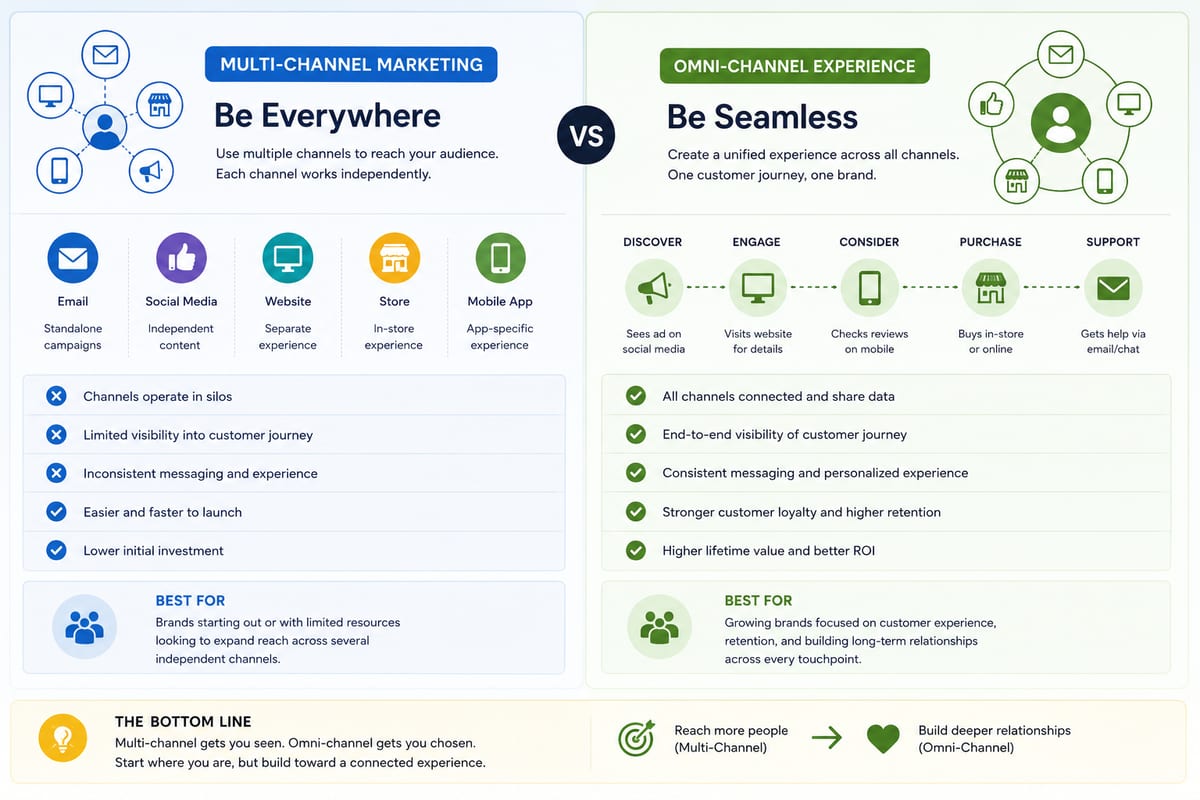
Multi Channel Marketing vs Omni Channel: Honest Comparison
Multi channel marketing vs omni channel breakdown for ecommerce operations. The operational differences that determine which approach fits your business.

ERP Software vs Multi-Channel Platforms: Honest Choice
ERP software comparison for growing ecommerce brands. When ERP fits and when multi-channel platforms produce better outcomes at lower cost.