Marketplace Inventory Management Across Amazon, eBay, Walmart
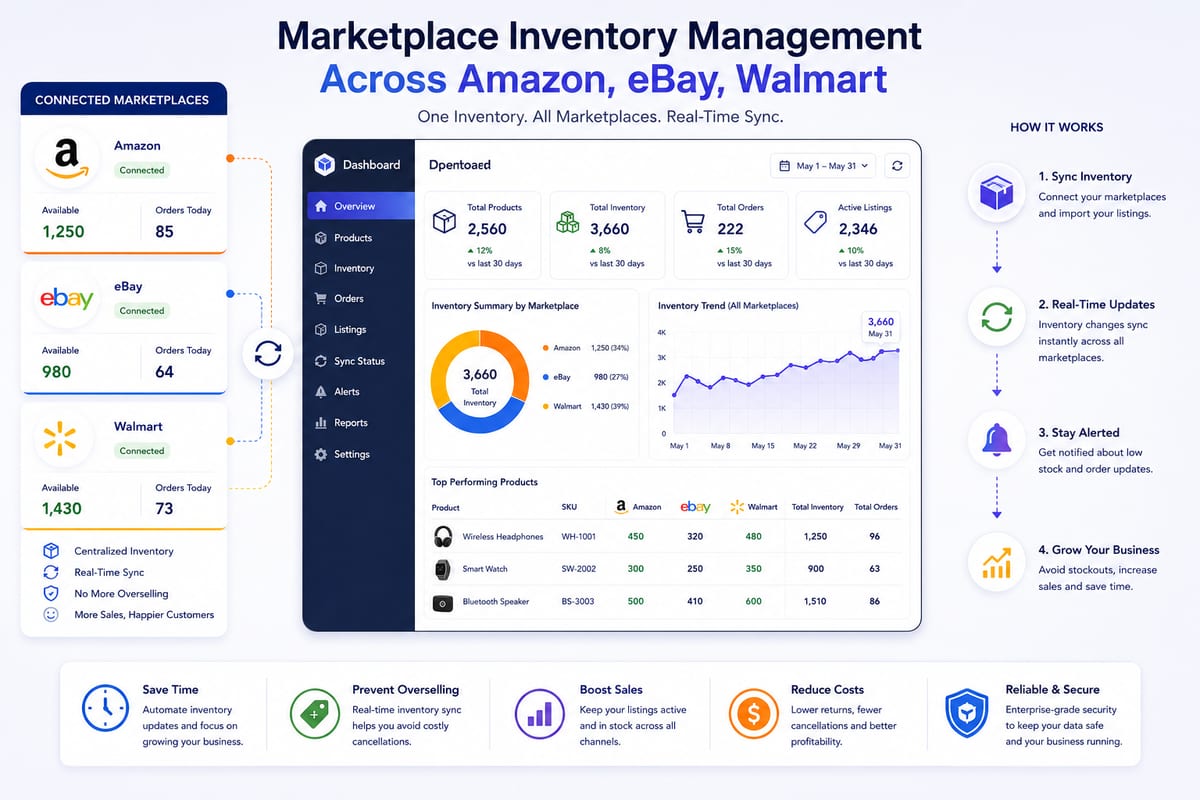
Marketplace inventory management has different stakes than storefront inventory management. Marketplaces evaluate seller performance through specific metrics, Amazon Order Defect Rate, eBay defect rate, Walmart seller scorecard, TikTok Shop performance ratings. Inventory drift between marketplaces and storefronts produces overselling that damages these metrics, which compounds into search ranking decay, Buy Box loss, fee penalties, and eventually account suspension. The marketplace inventory management discipline is essentially survival economics for serious multi-marketplace sellers.
This article walks through what marketplace inventory management actually requires across multiple channels, the marketplace-specific consequences of inventory drift, and the architectural patterns that protect seller metrics across all connected marketplaces.
What Multi-Marketplace Inventory Actually Requires
Selling on multiple marketplaces simultaneously requires inventory management that goes beyond basic stock tracking. Specific operational requirements emerge from marketplace-specific characteristics.
Real-time cross-marketplace sync. When stock changes anywhere, every marketplace needs to know in seconds. Polling-based sync at 5 to 15 minute intervals leaves overselling windows wide open during peak periods.
Marketplace-specific seller metric protection. Each marketplace evaluates seller performance through its own metrics. Inventory management needs to protect all of them simultaneously.
Multi-marketplace variation handling. Variable products listed across marketplaces need variation-level tracking that respects each marketplace's variation model (Amazon parent-child, eBay Multi-Variation Listings, etc.).
Marketplace-specific SKU mapping. Different marketplaces use different SKU conventions. Inventory management needs to maintain mapping accuracy across the marketplace mix.
Returns and refund workflow per marketplace. Each marketplace has different return policies and refund flows. Inventory management coordinates restoration across the variation.
Buffer stock per marketplace. Different marketplaces may warrant different buffer stock levels based on their specific metric sensitivity.
For broader operational context, see our multichannel ecommerce framework on operational patterns at scale.
The Marketplace-Specific Consequences of Inventory Drift
Each major marketplace produces specific consequences when inventory drift causes overselling. Understanding the consequences explains why marketplace inventory management matters more than storefront-only inventory management.
Amazon Consequences
Amazon's Order Defect Rate metric tracks cancellations as a percentage of orders. The threshold for warnings is 1%; suspension risk emerges around 2%. Multi-channel inventory drift is the most common cause of ODR crossings.
Additional consequences include Late Shipment Rate damage (when sync delays force manual order processing), Buy Box eligibility loss (compounding into 70%+ revenue drops), and selling limit restrictions that constrain growth.
For deeper context, see our Amazon inventory management framework on Amazon-specific implications.
eBay Consequences
eBay's defect rate metric threshold is 2%. Crossing it triggers warnings, then restrictions, then suspension. Cross-channel inventory drift produces defect rate damage that compounds quickly.
Additional consequences include Top Rated Seller status loss (search ranking lift loss, fee discount loss), selling limit restrictions, and Multi-Variation Listing accuracy problems.
For deeper context, see our eBay inventory management framework on eBay-specific implications.
Walmart Consequences
Walmart's seller performance scorecard evaluates multiple dimensions including order accuracy. Scorecard damage from cross-channel overselling produces Buy Box eligibility issues, search ranking decay, and eventual seller standing restrictions.
TikTok Shop Consequences
TikTok Shop's emerging marketplace produces specific performance metrics tied to listing accuracy and order fulfillment. Inventory drift damages these metrics with consequences for product visibility in TikTok's algorithm.
Etsy Consequences
Etsy's seller performance evaluation produces standing implications when overselling happens. While Etsy is often less strict than Amazon or eBay, repeated overselling damages reviews and Etsy-specific rankings.
The combined consequences mean marketplace inventory management protects multiple revenue streams simultaneously. The same inventory drift can damage Amazon ODR, eBay defect rate, Walmart scorecard, and TikTok Shop metrics within a single peak sales day.
The Architectural Foundation Multi-Marketplace Inventory Requires
Marketplace inventory management at production scale requires specific architectural properties.
Webhook-driven sub-5-second sync. Each marketplace needs immediate notification of stock changes from other channels. According to Cloudflare's documentation on webhooks, event-driven architectures deliver this far more reliably than polling alternatives.
Native marketplace integrations. Direct API connections to Amazon SP-API, eBay Trading API, Walmart Marketplace API, TikTok Shop API, and other marketplace APIs rather than middleware. Native integrations have lower latency and better error handling.
Marketplace-specific event handling. Each marketplace has different webhook semantics, rate limits, and ordering guarantees. Tools handling marketplace-specific patterns correctly produce significantly better outcomes than generic tools.
Per-marketplace metric monitoring. Each marketplace's specific metrics need monitoring and alerting. Generic operational monitoring misses marketplace-specific signals.
Marketplace-aware order routing. Orders from different marketplaces may need different fulfillment paths. Amazon FBA orders route differently than eBay Top Rated Seller orders.
Comprehensive audit trails. Marketplace inventory diagnosis often requires reconstructing events across multiple marketplaces. Audit trail completeness matters significantly.
According to Wikipedia's overview of inventory management, centralized data ownership across distributed channels is foundational to operational accuracy. For marketplace inventory management specifically, this principle becomes seller survival economics.
How to Sequence Multi-Marketplace Inventory Setup
Operations adding marketplaces to their channel mix should sequence the addition carefully to avoid operational disruption.
Step 1: Standardize SKUs across storefront and existing channels. Before adding any marketplace, ensure SKU naming is consistent. Inconsistent SKU naming is the #1 cause of multi-marketplace sync failures.
Step 2: Set up the centralized inventory layer. Install and configure the multi-channel inventory platform before connecting marketplaces. Test on staging with realistic data.
Step 3: Connect first marketplace and validate. Add one marketplace to the platform. Run for 14+ days monitoring for sync accuracy and marketplace-specific metrics.
Step 4: Add second marketplace after validation. Connect the second marketplace only after the first is validated. Each marketplace addition should follow the same pattern.
Step 5: Configure marketplace-specific monitoring. Each marketplace's metrics need monitoring with appropriate alerting thresholds.
Step 6: Set up buffer stock and reconciliation. Configure buffer stock on high-velocity SKUs across all marketplaces. Schedule periodic reconciliation passes.
Operations following this sequence produce significantly better outcomes than operations adding multiple marketplaces simultaneously. The validation period after each addition catches problems while they are still small.
How Nventory Implements Marketplace Inventory Management
Nventory.io is built specifically for multi-marketplace inventory management. The platform handles Amazon SP-API, eBay Trading API, Walmart Marketplace API, TikTok Shop API, Etsy API, and 30+ other marketplace integrations through native connections.
Sync is webhook-driven with sub-5-second propagation. Each marketplace's specific event semantics, rate limits, and ordering guarantees are handled correctly. Marketplace-specific metric monitoring surfaces seller standing risks early. Buffer stock is configurable per marketplace. Comprehensive audit trails are accessible to operators.
For WordPress and WooCommerce stores, download Nventory free from WordPress.org. For Shopify operations, install Nventory from the Shopify App Store. Both versions connect to the same multi-marketplace platform.
The free tier includes core multi-marketplace functionality without subscription cost. Paid tiers add advanced workflows for operations with multi-warehouse complexity or specialized fulfillment requirements. The architectural foundation that protects seller metrics across marketplaces is consistent across tiers.
Common Marketplace Inventory Management Mistakes
A few patterns that produce seller standing damage across marketplaces.
Treating marketplaces like storefronts. Marketplaces evaluate seller performance through specific metrics. Inventory management approaches designed for storefront operations do not protect marketplace metrics.
Running polling-based sync. Polling intervals leave gaps where marketplaces can disagree. The defect rate damage from gap-window overselling compounds quickly.
Skipping marketplace-specific metric monitoring. Generic operational monitoring misses marketplace-specific signals. Each marketplace's metrics need dedicated monitoring.
Adding marketplaces too quickly. Operations adding multiple marketplaces simultaneously cannot validate each addition before the next. Sequential addition with validation periods produces better outcomes.
Ignoring marketplace-specific variation models. Amazon, eBay, Walmart, and TikTok Shop all handle variations differently. Generic variation handling produces marketplace-specific failures.
Final Thoughts
Marketplace inventory management across Amazon, eBay, Walmart, TikTok Shop, and other channels has different stakes than storefront-only inventory. Marketplace-specific seller metrics, ODR, defect rate, scorecards, performance ratings, directly reflect inventory management quality and compound into search ranking, Buy Box eligibility, fee penalties, and account standing consequences. The architectural foundation that protects seller metrics across marketplaces, webhook-driven sub-5-second sync, native marketplace integrations, marketplace-specific event handling, per-marketplace monitoring, separates operations that scale across marketplaces from operations that get restricted.
If you want to test marketplace inventory management built around the architectural properties that protect seller metrics across channels, install Nventory on your platform of choice. For WordPress and WooCommerce stores, download Nventory free from WordPress.org. For Shopify stores, install Nventory from the Shopify App Store. Visit nventory.io to review marketplace-specific capabilities.
Frequently Asked Questions
Platforms with webhook-driven sync, native marketplace integrations, marketplace-specific event handling, per-marketplace metric monitoring, marketplace-aware order routing, and comprehensive audit trails. Nventory implements these, available on WordPress.org and the Shopify App Store.
Sub-5-second propagation is the standard. Polling-based sync at 5 to 15 minute intervals damages seller metrics on Amazon, eBay, Walmart, and other demanding marketplaces.
Amazon ODR, eBay defect rate, Walmart seller scorecard, and TikTok Shop performance ratings all directly reflect inventory management quality. All need protection through proper sync architecture.
Yes, with the right platform. Nventory handles all four through native integrations with sub-5-second sync. The platform also supports Etsy, BigCommerce, and 25+ other channels.
Combined with buffer stock and proper operational discipline, overselling rates approach zero. Sync alone reduces but does not always eliminate overselling without buffer stock as backup.
For each marketplace: 1 to 2 weeks of staging setup plus 14 days of validation. Adding 5 marketplaces typically takes 2 to 3 months when done with proper validation between additions.
Related Articles
View all
Inventory Automation That Actually Saves Operations Time
Inventory automation for ecommerce operations past manual reconciliation. The categories that produce compounding labor savings at scale.
Cross Channel Inventory Management Without the Chaos
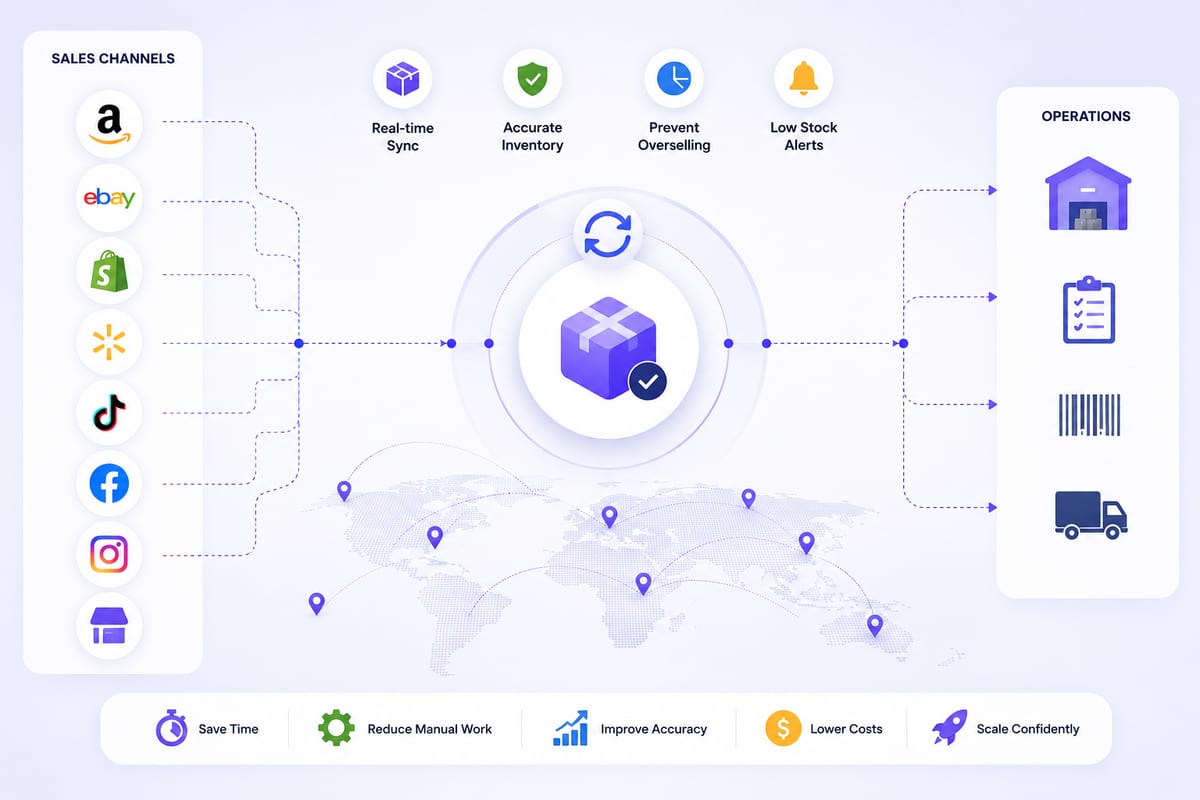
Cross channel inventory management for operations running on multiple platforms. The architectural patterns that prevent coordination breakdowns.
Real Time Inventory Management at Multi-Channel Scale
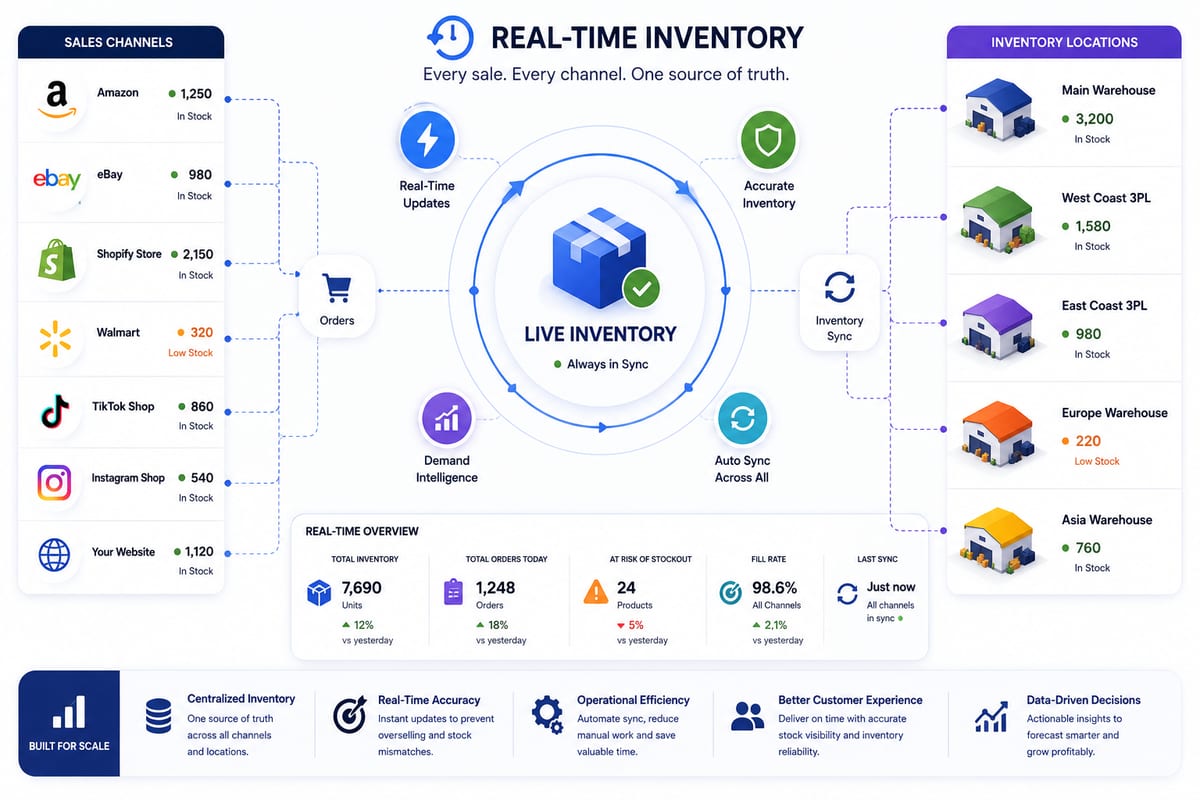
Real time inventory management requirements for multi-channel ecommerce. The architecture that delivers sub-5-second propagation under load.